

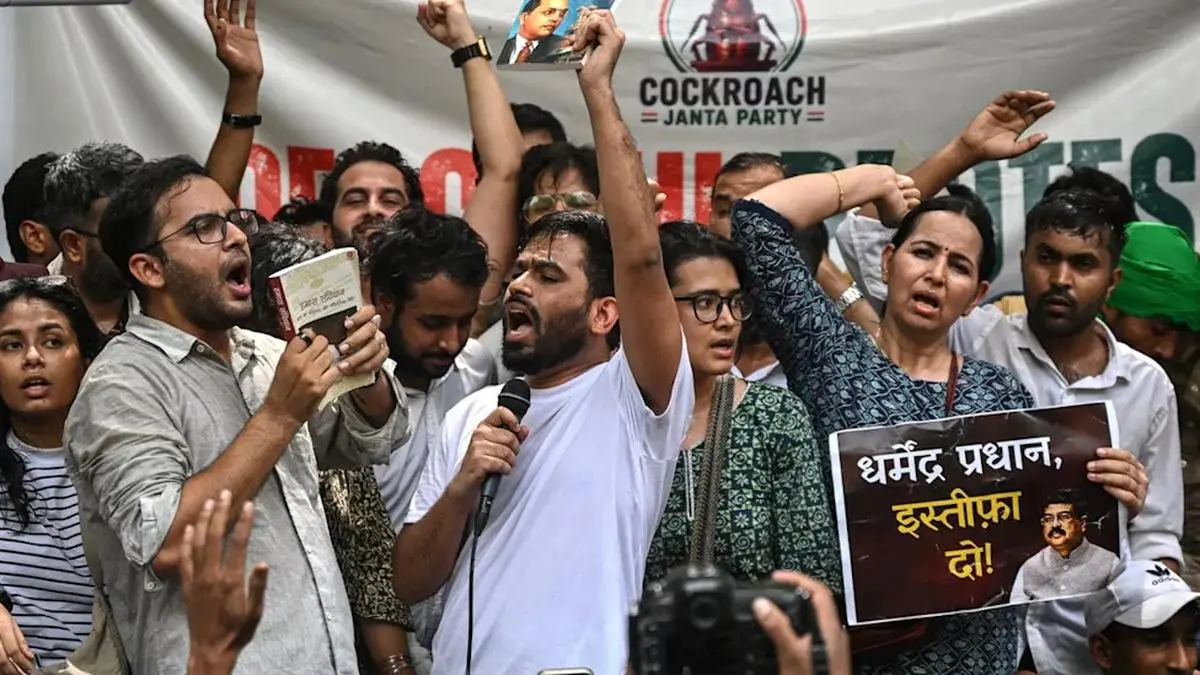
The Cockroach Janta Party (CJP) was an accident born of a response to a statement by the Chief Justice of India that equated the jobless with roaches. The CJP is now seeking a life beyond cyberspace. Its founder, Abhijeet Dipke, who returned to India on June 6, led hundreds of students, young professionals and supporters at a protest in Delhi’s Jantar Mantar the same day, demanding the resignation of the Union Education Minister Dharmendra Pradhan over alleged irregularities in examinations, including NEET, CUET, and CBSE.
As the CJP, which has given the government a week to meet its demands, gears up for more action, it is worth looking at its origins and trajectory so far. The CJP’s rise has been nothing short of remarkable. What began as a meme on May 16 rapidly evolved into an online movement that adopted the cockroach as its political symbol. Within a week, the CJP’s Instagram following crossed 22 million, surpassing that of the BJP, which is in power at the Centre and in 21 States.
But Instagram is always in search of the next big trend. So, the young people believe the initial online momentum must be met with real world activity. Dipke seems not just irreverent but also fearless. The Intelligence Bureau is reported to have flagged the CJP as a national security threat, and the CJP’s X handle was blocked, a move he has challenged in court. Aged 30, Dipke is fully Gen Z and clearly understands political communication.
Having spent three years in the AAP’s communication wing (until 2023), Dipke decided to pursue a master’s degree in the US. He is categorical that the CJP was not designed as a political party. In its short existence, the cockroach symbol has indeed been able to connect with the angst of the young in a country where they face a jobless future and a corrupt education system. On Instagram, one sees responses from both urban and rural people. But can the CJP go beyond?
The Anna Hazare movement of 2011 that led to the creation of the AAP in 2012 took place when the Manmohan Singh government allowed protests and engaged with protesters. Now, protest is described as a subversive activity. The CJI’s remark about cockroaches, in fact, reflects this attitude. Permissions for protests are difficult to get, and even the designated spaces have shrunk.
Unlike the media in the Manmohan Singh era, which gave non-stop coverage to anti-government protests, the present media has instructions to ridicule, attack, or ignore the CJP, and stick to themes showing the Narendra Modi regime in a good light or as attempting to fix problems. Yet, the CJP’s sudden traction will worry New Delhi, which governs through big proclamations and narratives propagated by a pliant media. The cockroaches also emerge at a time when the electoral process is seen as compromised and institutional independence as seriously eroded.
A larger rot
A perfect economic storm is brewing as well, with escalating oil prices causing all around inflation; investments not coming into a country that until recently claimed Vishwaguru, or world leader, status; the flight of capital; and the fact that India has also missed the AI bus. The government pretended for many months that there was no oil crisis, but once the Assembly elections were done, the Prime Minister suddenly announced grave economic trouble and asked Indians to tighten their belts.
Into this chaos came the shocking revelations around the leakage of question papers in competitive examinations, and the flawed evaluation of the school-leaving examination. In the minds of the young, their future has been jeopardised by institutional incompetence and corruption.
Even the crisis response appears clueless and incompetent. It has been declared that the Indian Air Force will transport question papers for the rescheduled National Eligibility cum Entrance Test (undergraduate). It is also said that the Prime Minister will monitor admissions to medical colleges!
India has a large youth demographic (65 per cent of its population is below 35 years). Beyond trying to shut down social media accounts, New Delhi should ideally sack Dharmendra Pradhan, who has held the education portfolio since 2021. But should that happen, the cockroaches would undoubtedly claim credit, and the government will not want that. At the time of writing, the Chairperson of the Central Board of Secondary Education has been transferred to the Department of Agriculture. (It is somewhat baffling. Are incompetent officers preferred in Agriculture?)
The unfolding problems are symptomatic of a larger rot in the system, and the dominoes are suddenly falling. The business community is finally saying, albeit in hushed tones, that India’s present rulers may not know how to manage the economy as well as they manage electoral conquest and subsequent extraction, which has ensured the BJP’s record as the richest party in India’s history. One must remember that funding parties other than the BJP is an invitation to enforcement and tax agencies.
Cheeky takes
Cronyism, therefore, spreads unchecked. In case you missed the news, the 229 billionaires of India named in the Forbes list have quickly recovered to a combined net worth of over $1 trillion. And, amidst a sudden trend of the American government announcing Indian developments, the US has also dropped its case against the Adani Group. So, we are presumably back to the extraordinary allocations for/purchases of “everything, everywhere, all the time” by one business house owned by one of India’s richest men.
When nation-building is conflated with asset grabbing (often with severe environmental damage), it is small wonder that the system leaks all the way down to the smallest middleman, as has apparently happened on the examination front. However, the informal job generation scheme, of becoming a foot soldier in the extended Sangh Parivar, is in expansion mode all the time. Presumably, this, in lieu of real jobs, makes unemployed youth feel part of the community.
Cockroach Janta Party spokespersons, Saurav Das (R) and Ashutosh Ranka address a news conference in New Delhi on June 4.
| Photo Credit:
SHIV KUMAR PUSHPAKAR
The Left and the Congress have been a bit wary of the CJP, but admit its traction is also because of the vacuum in the Gen Z opposition space. Some pro-Congress commentators do, however, describe the CJP as just another ventilation platform like the AAP, designed to let malcontents blow off steam and slow down the traditional opposition. But if we see the glass as being half full, Dipke’s AAP experience can be seen merely as good training ground for a political debut. The party that once stormed New Delhi is still in power in Punjab, where it has just put up a good show in the corporation election. But that is also why some pro-Congress commentators insist that the CJP was created to weaken the traditional opposition.
Incidentally, the CJP manifesto has cheekily taken on big capital as well, along with the institutions meant to uphold democracy. So, apart from declaring that “[a] Chief Justice or judge is strictly barred from receiving political rewards—such as a Rajya Sabha seat—from the government immediately following their retirement”; “[i]f legitimate votes are deleted in any state, the Chief Election Commissioner shall be arrested under the UAPA (Unlawful Activities Prevention Act)”; and defectors from political parties “shall be heavily penalized and barred from holding public office or contesting elections for 20 years”, it has also announced that the licences of media houses owned by Adani and Ambani will be cancelled and the bank accounts of their media anchors investigated.
It is hard to predict the future of the CJP and Dipke. Can he and his roach party carve out a political profile? Can this fledgling movement crack through the armour of an increasingly authoritarian system? One waits to see how the meme lands on the ground.
Saba Naqvi is a Delhi based journalist and author of four books who writes on politics and identity issues.
Also Read | SIR and the slow unmaking of universal adult franchise
Also Read | Photo-ops in a banana republic
