

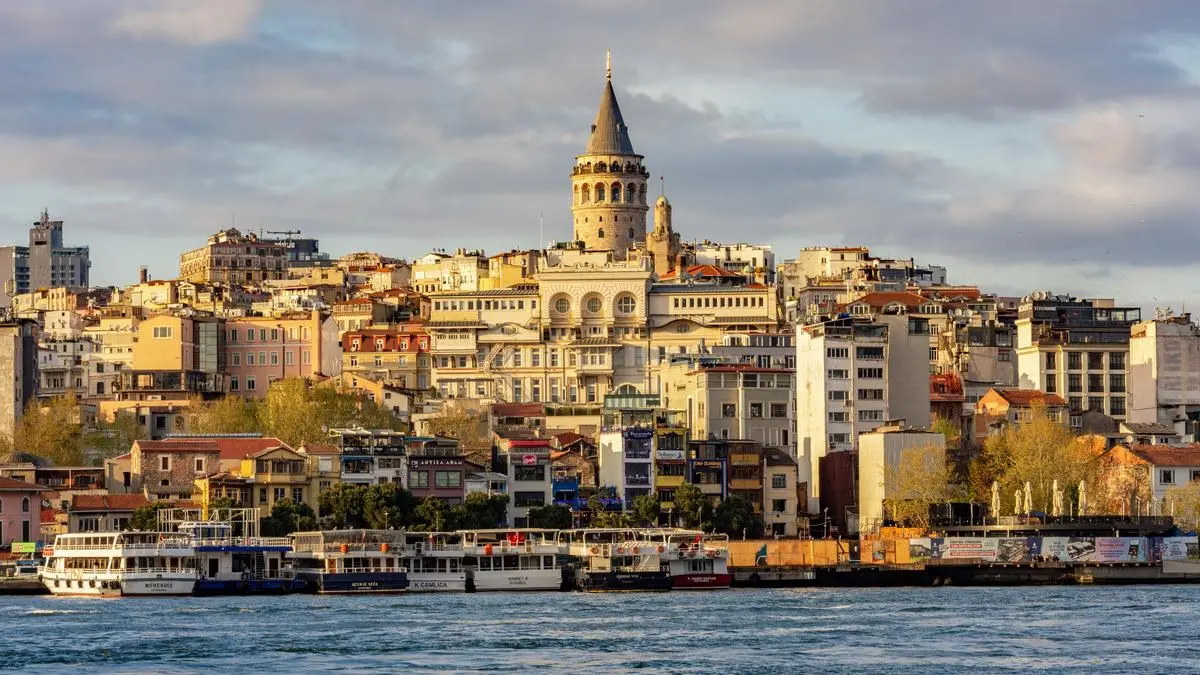
We are often told that the journey is what matters. It may have been the case when travel meant sailing ships, camels, horses, and elephants, but in the age of buses, planes, and baggage checks, what matters are the destinations. The travelogue is an anachronism. Nobody remembers, or wants to remember, the actual travel to any place. Who wants to remember being queued and X-rayed, de-shoed and unbuckled, being overcharged and bloated, sleep-deprived and flight-cancelled? We remember what matters. We remember the destinations.
Or more accurately, we remember the stories—the annotations—we have attached to a nebulous collage of sensory impressions of places and people. My visit to Istanbul at the end of April 2016 also had to do with enabling annotations. Not in the brain but on the web. Suzan Üsküdarlı, a professor at Boğaziçi University in Bebek, had invited a mutual friend, Kavita Philip, then a professor of history at UC Irvine, to participate in a workshop on the development of annotation tools for the web. The meetup had come up with a clever name, “AnnotateIST” (Annotate Istanbul) and, for an academic conference, an unusually clear mission:
“The intention of this gathering is to bring together people who have been working on annotation frameworks and those who see the potential in annotating web documents. We aim to model a space and a form of technological practice, in an experimental collaborative workshop.”
In other words, Istanbul has the best kababs in the world! I had no expertise on either web tech or annotation theory (yes, there is a theory), but they did not know that. And Kavita vouched for me, so I received an invite as well. When I reached Istanbul—I have no memories of the actual trip—I was roomed, for a day, at one of the university’s guest houses, which was located along the Bosphorus. It had been one of the Greek Orthodox Church’s old properties, appropriated and refurbished. The bathroom had been unexpectedly magnificent, with a great blue sweeping, panoramic view of the Black Sea on one side and the Sea of Marmara on the other. And there I was, seated on the ceramic throne, my posterior thoroughly intimidated by the panoply of history and civilisational variety surrounding me. It felt irresponsible, uncouth even, to have travelled so long a way, be granted so grand a setting, and then commit so furtive an act. Orhan Pamuk, in contrast, used these settings to write great novels.
I felt at home in other ways. The crowds, the chaos, the variety of foods, the dilapidated buildings: I had left home to come home. Türkiye also seemed to be undergoing a makeover. Or at least Istanbul was. Any self-respecting makeover starts with renaming things; I could tell when this had happened because the roads would look unmaintained, but the street signs would be new. Things considered “good” become things once considered good, and then they become bad altogether. Türkiye was now an Islamic Republic, not the cosmopolitan gateway to Europe or other such liberal nonsense. Posters with Mustafa Kemal Atatürk (“atatürk” means “father of Turks”) had been replaced with those of President Recep Tayyip Erdogan.
Istanbul has the best kebabs in the world.
| Photo Credit:
Getty Images/iStock
On one of the twisting, uphill streets in the district of Fatih, I had stopped at a shop to ask for directions to Kasip Osman, a restaurant famed for its “Iskander kabap”. An important pillar of my foreign policy is to favour restaurants with names I can pronounce. The shopkeeper examined me. I stood there panting, like a fat Labrador that had exceeded its quota of exercise. “Indian?” he asked, half-smiling. I nodded. I looked “Indian”; he looked “Turkish”. It is impolitic to say people of a given region have a characteristic look, but reality often is impolitic. Either our ancestors did not date widely or each region in the world has been populated by one designated Adam and one designated Eve.
“Raj Kapoor,” he said, the half-smile now a full smile. Perhaps he proceeded to hum a few lines from “Mein Awara Hoon”. I knew about the soft power of Hindi films and that of Raj Kapoor in particular, but it brought home how stories are the world’s real travellers.
Also Read | A tale of two Indias
The workshop was held at one of the university’s Kandilli Campus buildings in Bebek. This turned out to be, no surprise, the kind of posh locality where the Khan Market types of every nation like to shop, mate, and browse. Like Kavita and Suzan, and unlike myself, the other participants were all researchers or industry experts. This included Benjamin Young, Simon Worthington, Fulya Sari, Asli Telli, and the Dutch computer scientist Lambert Guillaume Louis Théodore Meertens.
Not many people have mathematical properties named in their honour, but he is one of them. Meertens, who had settled in Istanbul, had written a book in his 20s about appropriating computer science as a branch of mathematics. His only mistake had been to overestimate the capabilities of computer scientists. When I made this joke, Meertens thought for a bit and nodded sombrely. He did not get most jokes, and he gazed at you with full attention which is unnerving when you are telling a joke.
Feeling at home in Istanbul because of the chaos, the variety of foods, the dilapidated buildings.
| Photo Credit:
Getty Images/iStock
Meertens had taught and mentored some of the best talent working in programming language design, including Anders Hejlsberg and Mads Torgersen, the creators of C#, and Guido van Rossum, the creator of Python, quite possibly the most popular programming language in the world today. He couldn’t speak Turkish (Türkçe), but all the Turks in the room agreed that if anyone had doubts about its grammar, Meertens was the man to ask.
Interviewing Meertens
Kavita had the bright idea of recording an interview with Meertens about his role in the early years of the software industry. She had been building a database of such interviews. He pretended not to be flattered. They settled for doing the video interview at the waterfront, near a restaurant within walking distance from Taksim Square, sort of Istanbul’s Connaught Place. The plan was to do the interview and then meet Meertens’ significant other—let us call her X—at the restaurant.
When we reached the location, we noticed the area was unusually devoid of women. There were women, but some men can seem to occupy twice as much space as a woman. The area seemed heavy with such men.
We found a spot, Kavita set up her camera. The men watched. There was a chill wind gusting around us like an overeager pet. Meertens did not bother to run his hands through his hair. It was clear he was going for the genius look. Kavita led Meertens through his career, taking her time, asking the kind of questions scientists almost never get asked by the regular media. I listened from the sidelines. I noticed more men wandering around our little cluster, clearly curious about what we were up to.
I also noticed Meertens’ significant other approaching. X was doing more than approaching. She was walking faster and faster, gesturing at us, and practically breaking into a run towards the end. When she reached, X caught Meertens by the arm and brusquely ordered us to follow her. We did. We reached the restaurant, sat down, quite winded. X waited, glowering, until we had placed the orders. Then she lit into Meertens. The gist of it was: okay, Kavita and I were foreigners, ergo, stupid, but for heaven’s sake, he lived here, didn’t he know what day it was? Then she continued, as the Yanks are rumoured to say over beef and beer, “tearing him a new one”. He listened like a little child, not at all repentant and smiling at us sheepishly. He was probably thinking about quadratic equations and solving for x.
X calmed down. She explained it was the anniversary of the 2015 May Day protests. Last year, the leftists had faced off with the state. Some 20,000 security personnel had been sent to clear the area. Water cannons. Tear gas. This year, the state was taking no chances. Hence the men with extra volume. Hence their interest in two coloured, but obviously foreign, reporters talking with a white guy, suspiciously disguised as a mad scientist. We simply had not seen the signs. Or we had seen them but not understood what they meant. Or understood what it all mean, but did not want it getting in the way of our conception of the city as a cosmopolitan and liberal place. X had calmed down, even begun to smile and joke a little. The pizza was delicious.
Meertens fascinated me. What was he doing in Türkiye? He seemed to feel totally at home and, in equal measure, looked totally out of place. I asked him the question, when I felt I knew him well enough to presume and when we were at a party. The answer to my question was a remarkable story, and those of his friends who knew the story smiled and relaxed the way people do when they know a retelling is on its way.
Finding X
In the early 1980s, Meertens had been based in Amsterdam. In those heady days, he had been with the Centrum Wiskunde & Informatica (earlier, the Mathematical Centre in Amsterdam). One day, someone new from the janitorial department came to clean his university quarters (or perhaps it was his office). X was from Türkiye and serious about her art; she had come to Europe to make a little money, travel, explore. Meertens chatted her up—her Dutch was sketchy, his Turkish was non-existent, their English was unsatisfactory—and after X had left, he crossed the street and went over to Suzan Üsküdarlı’s office. She was a graduate student at the time and must have been bemused by the respected professor’s request. He wanted to learn Türkçe, and Meertens being Meertens had a plan: would Suzan kindly offer the necessary tutorial classes?
A seller of grains for birds sits in this cabin by the New Mosque and Egyptian Bazaar at Fatih square in Istanbul.
| Photo Credit:
Getty Images/iStock
Meertens had fallen in love. Plummeted, plunged, drowned. He had found the One. The eigenvalues of his heart aligned to one truth: surrender. When he laughed, poems burst out of him. Great beams of sunlight speared the streets. Nightingales tendered their resignation; it was not possible to compete. X was taken aback, to say the least. The unconditional sincerity of his declarations. He had no expectation of reciprocity. All he wanted was to be around her, love her, take care of her. He had no expectations of quid pro quo. But still. He was not threatening in the least. But still. She liked Europe in the manner of people who do not necessarily want to live there. She liked the gentle, eccentric professor. But still.
Also Read | Is Europe’s ‘legally complex’ excuse its foreign policy future?
Meertens had moved to Istanbul, bought a house, begun learning the language. His career had to be dependent on frequent conferences, extended stays at universities more at the centre of things. Unlike India, Türkiye was not a key player in the software revolutions of the 1980s and 1990s. It did not matter. X took care of Meertens. Meertens took care of X.
I got the sense his love, unchanged after three decades, was at times wearisome for X. Perhaps he was weary of it too; who would want the gods to seize them by the hair and whisper in their ear? But still.
It seemed to me then (but less so now) that their asymmetrical relationship resembled the story of Türkiye and Europe. About a decade has passed since my Istanbul trip. In my memory, which is very inclined towards melodrama and confabulation, Istanbul is preserved as how funny-sad clowns are supposed to be: lots of fun and olives under the sun but also a sense of things unravelling underneath it all. Perhaps this is true of all places now.
The anxiety is understandable. Edmond Jabès defined a foreigner as “a man who makes you think you are at home”. That used to be true. These days, a foreigner is increasingly someone who wants to take your home. It is in the act of taking, imagined or otherwise, that many people seem to remember what it is they want to keep. If we did not have foreigners, we would have to invent them.
When I recall my travels, which are actually quite a few in number, what comes to mind are the encounters with people, with their stories. I did not go to Istanbul to attend a semi-academic workshop. I think it was clear to me, even then, that I was going to add some stories to my life. These encounters are more than annotations of a destination; they are the destination itself.
Anil Menon is a novelist, whose most recent work is The Coincidence Plot.
