

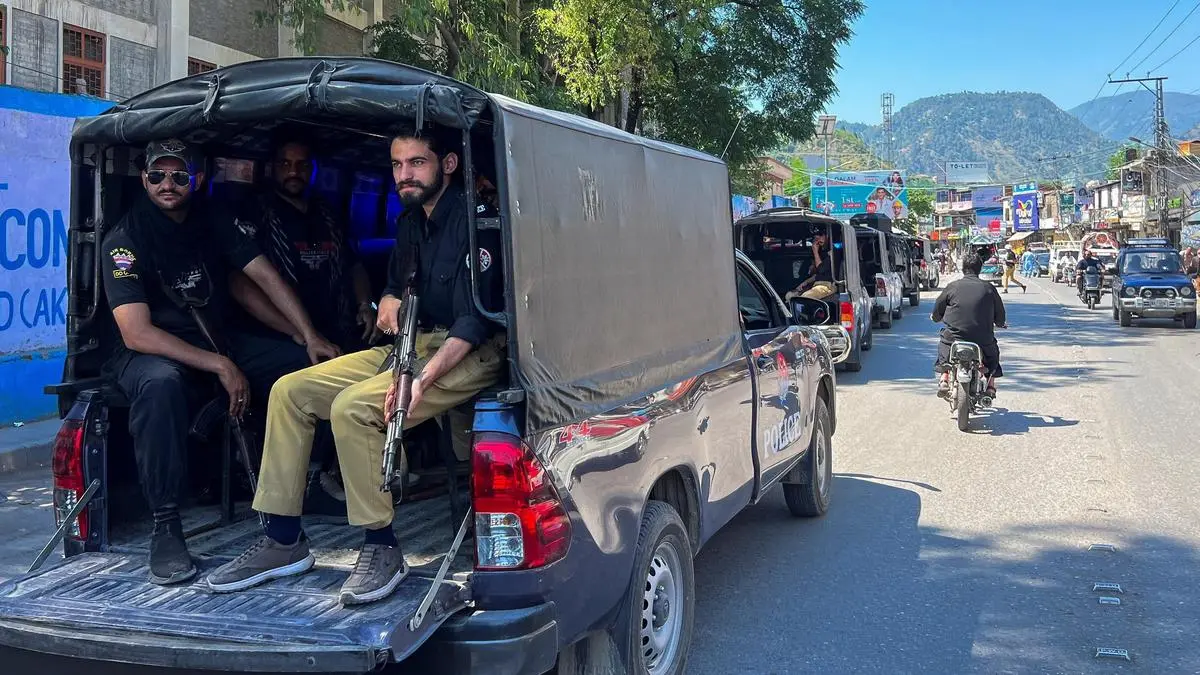
Pakistan-occupied Kashmir (PoK) is in a state of severe unrest after regional authorities in Rawalakot opened fire on protesters and activists gathered at a funeral of a rights activist, killing at least 11 people and leaving dozens injured.
A popular civil society initiative in the region has been protesting against inflation, especially rising flour and electricity prices, and demanding the restoration of political, economic, and human rights. Additionally, the protesters had urged the authorities to abolish the reservation of 12 seats for refugees in the forthcoming July 27 election to the restive region’s legislative body.
Media reports from the strife-torn region said that the latest round of violent clashes erupted on June 5.
However, this is not the first time that the other part of Kashmir, divided by the Line of Control (LoC) for the last seven decades, has witnessed violence on the streets.
In September last year, nine people, including three police officers, were killed in the region as a result of violent clashes between civilian protesters and security forces. At the time, the federal government in Islamabad had sent a negotiating committee to Muzaffarabad, the capital city of PoK, to cool down tempers and hold peace talks with the Jammu Kashmir Joint Awami Action Committee (JAAC). There was no breakthrough, though.
Why are the residents in Rawalakot hitting the streets? What are their key demands? And why has the government banned the JAAC, a popular umbrella organisation?
The JAAC is a conglomerate representing civil society coalitions, trade bodies, and various socio-religious groups based in PoK. It has has been spearheading the protest movement, demanding subsidised electricity and flour as well as the restoration of political and economic rights of the people of three key areas, namely Muzaffarabad, Rawalakot, and Mirpur.
Only four days ahead of the protest march scheduled for June 9, the authorities banned the JAAC under an anti-terror law.
Authorities in Rawalakot accused the JAAC of “misleading the masses” and provoking them to indulge in violence against the state. They alleged that some protesters were carrying automatic weapons with them, while others threw petrol bombs and other material at security forces.
Local reports said that the protests turned violent on the day government forces reportedly opened fire on mourners gathered at a funeral in PoK in the aftermath of the killing of a human rights defender, also a JAAC leader, in Rawalakot.
Expert opinion
Regional political analysts, commentators, and activists described the police action and the banning of the JAAC as disproportionate and repressive.
Ershad Mahmud, a well-known journalist-author born in Rawalakot and currently based in Calgary, Canada, said that the action taken by security forces and authorities had “bruised the hearts” of everyone living in PoK.
Describing the government action against the protesters as “disproportionate”, Mahmud said that the demands raised by the JAAC were “overwhelmingly” in the larger public interest.
Speaking to Frontline from Calgary, he said: “The JAAC has given lockdown calls in the past too. Nothing adverse would have happened if the protesters had been allowed to march to Muzaffarabad, as they are peaceful and their demands enjoy popular support. The use of force to suppress the non-violent movement for political demands is uncalled for.”
According to him, the JAAC leadership had been peacefully mobilising public opinion and wanted to lead a protest march to Muzaffarabad on June 9.
On the hotly contested issue of 12 reserved seats for refugees in the Assembly, Mahmud said that it has stirred a political hornet’s nest.
“Of these 12 seats, eight generally go to the kitty of whichever is the ruling party in Punjab province, two are forcibly taken by the Pakistan Peoples Party (PPP) in Sindh province, while in some cases, the seats have also been captured by those who have absolutely nothing to do with Kashmir. In some cases, the courts in the past have described them as ineligible.”
Mahmud also said that Umar Nazir, a key JAAC leader, was shot at, which resulted in escalation on multiple fronts.
Analysis of issues
Another analyst, who wished to remain anonymous, told Frontline that there have been discrepancies in the voters’ list too. “In essence, the issues are related to governance, administration, and political and economic rights. The JAAC has taken a maximalist position, but meaningful talks would have resolved everything on the table. The reforms are much needed, but I do not think the Pakistani establishment is in favour of anyone setting a new precedent of granting concessions to those who hit the streets in protest.”
In a video analysis, Moeed Pirzada, a renowned British-Pakistani geostrategic analyst and former television anchor, said: “In reality, the governments in [Pakistan-occupied] Kashmir have never been free. More often, these have been puppet regimes or rubber stamps, duly approved by the governments in power in Islamabad. In recent times, the region has witnessed public gatherings and rallies with massive turnout under the banner of the JAAC, demanding political and economic rights.”
He added: “The decision to impose a ban on the JAAC under an anti-terror law is a recipe for disaster. It is an unwise decision demonstrating stupidity. How can you ban such a popular organisation?”
In London, the influential British Kashmiri diaspora organised a coordinated lobbying campaign in Westminster, sending letters to the country’s parliament members. Additionally, the chair of the All-Party Parliamentary Group on Kashmir wrote to the foreign secretary, and a formal briefing paper was handed over to MPs and Lords.
Families of Kashmiri descent living across the UK could not contact their relatives in PoK, as mobile phone lines and Internet services there have been cut. The situation in the region seems to have escalated further, especially after the authorities banned the JAAC.
In a video analysis, Mansoor Ali Khan, a journalist and television host on Hum News, said: “Internet, mobile phone, and cellular data services have been stopped in the region. But protests have continued in various parts. The situation has become serious after four security forces personnel were killed, allegedly by the protesters. Authorities have accused activists of the JAAC of possessing modern ammunition.”
In PoK, the Prime Minister is the executive head while the President remains the constitutional head of the state. Raja Faisal Mumtaz Rathore of the PPP is the current PoK Prime Minister. The region’s Legislative Assembly consists of 45 seats, of which 12 are reserved for refugees who settled in PoK and Pakistan. The region has a population of about 50 lakh with about 34 lakh registered voters.
“The state has begun a massacre of our people in Rawalakot,” Shaukat Nawaz Mir, a JAAC leader, claimed in a video message on X.
A prominent political scientist from Srinagar said that it looked like the civilian protesters want to undermine the overwhelming authority of the Pakistani establishment in the region.
Inshah Malik, an academic of Kashmiri origin currently based in Iran, took to social media to register her angst, stating: “This terrible policy towards Kashmiris has to end. This is terrifying!”
Gowhar Geelani is a senior journalist and author of Kashmir: Rage and Reason.
Also Read | Pakistan: Chaos and the way out
Also Read | Is Pakistan undergoing a reset in army-civilian ties?
