

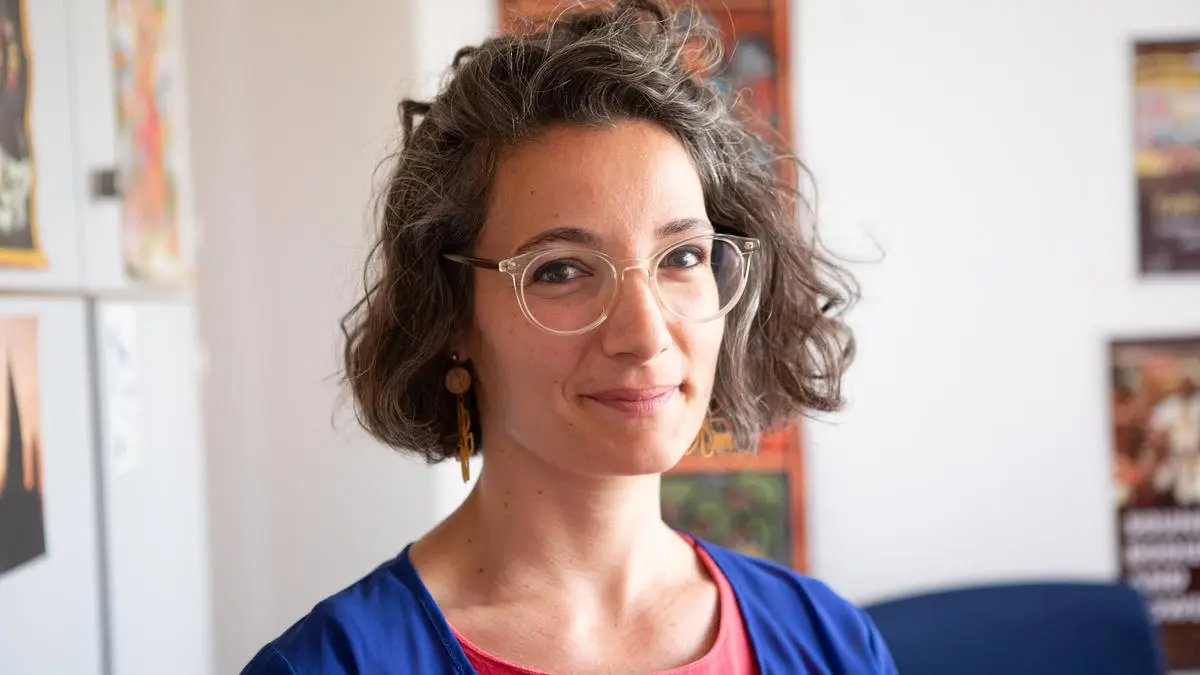
Over the past decades, different political parties in West Bengal have sought the allegiance of the Matua community. In recent times, the Matuas—who originally came from Bangladesh—are most prominently discussed in the context of vote-bank politics that influence election outcomes in India’s eastern State of West Bengal. As the BJP won a landslide victory in West Bengal after a controversial Special Intensive Revision (SIR) that left millions disenfranchised, including Matuas, anthropologist Carola E. Lorea, professor of social and cultural anthropology at the University of Tübingen, Germany, speaks to Frontline about the historical displacement of the Matua community, their resilience, and their multiple identities.
Lorea recently published her book, Communities of Sound: Religion, Displacement, and Caste in the Bay of Bengal, which captures the community’s long struggle and resilience. Lorea’s academic expertise includes popular religious movements, the religious history of Bengal, and sonic practices in South Asia. Excerpts:
Can you talk about the historical displacement of Matuas and how Partition shaped their social identity?
The displacement of Matuas goes back a long way. When Brahmanical Hinduism arrived in Bengal during the Sena dynasty, under Ballal Sen, they were pushed to the peripheries—they started inhabiting marshes, swamps, and the riverine delta. In the Sri Sri Harililamrita, a hagiography of the extraordinary life of Harichand Thakur, we are told that Harichand’s family gave money to the local zamindar. They had borrowed this money because they needed to pay tribute to the Nawabs, and instead of allowing them to repay the debt, the zamindar forcefully evicted Harichand’s family from their land. That’s how Harichand’s family arrived and settled in Orakandi, in present-day Bangladesh.
Partition triggered one of the most dramatic mass migrations in history. Namashudra families—mostly landless farmers, fishermen, and boatmen—were compelled to leave their homeland. They left with very little security, employment, and patronage. This exacerbated inter-religious tensions with Bengali Muslims who shared the same socio-economic background. And that’s how we have riot refugees.
The Liberation War of Bangladesh in 1971 produced another massive wave of displacement. After the proclamation of the independence of Bangladesh and its new constitution declaring it a secular country, many Matua families tried to return only to find that their homes and villages had been destroyed, or had been confiscated and redistributed under the Enemy Property Act (later renamed the Vested Property Act).
We must be careful to remember that 1947 and 1971 are not once-and-for-all historical events. They have a longue durée. They persist like an open wound and have an aftermath that continues to affect people’s lives. This is quite obvious if we look at the contemporary political situation in Bangladesh, where a Bangladeshi national identity is under reconstruction. Every Matua family, in one way or another, experienced multiple and prolonged displacements. Some relatives might be in Bangladesh, some in Odisha, Uttarakhand, or the Andaman Islands, depending on the refugee rehabilitation policies and their histories of forced migration.
Even for those still living in Bangladesh—where an estimated 9 to 10 million Matua followers live today—there is also displacement. This is a displacement in the sense of estrangement, stemming from being constantly accused of non-belonging and of not being genuinely Bangladeshi citizens.
Compared with States like Odisha and Uttarakhand, how culturally distinct are the Matuas of West Bengal?
The important factors behind Namashudras establishing themselves in West Bengal rather than elsewhere are geographical and geopolitical—obviously, it’s right on the other side of the border. There are also socio-cultural factors: West Bengal and Bangladesh share language, culture, and centuries of history—both pre-Islamic and pre-Hindu, if we think of the flourishing arts and culture during the Pala dynasty.
What else contributed to the establishment of a strong Matua community in West Bengal was simply the resilience of these people. This happened despite the government’s attempts to disperse oppressed-caste refugee families as far as possible from Kolkata.
We need to keep in mind that in the 1940s, before Partition, when Matua leaders were actually supporting Partition, they were told that their households would become part of India and fall under the Indian side of the border. This did not happen. But they ended up on the wrong side of the border because of a random lottery game—namely, the Radcliffe Line, which was drawn in five weeks by a British lawyer (Cyril Radcliffe).
Could you talk us through the transition of the Matua community’s social identity from being minorities in Bangladesh to establishing themselves in West Bengal, and how Thakurbari came to represent the community?
The Matua community is spread across 35 countries through global migration. I would say that they have multiple identities rather than a “transition of identity”. West Bengal is one of the few States where Namashudras are a Scheduled Caste (SC). This is not something to be taken for granted. In Bangladesh, there are no specific reservation quotas for Dalits, and in other parts of India where there are large numbers of Matua devotees, they might be categorised under other administrative labels—OBC in the Andaman and Nicobar Islands, for example.
What made some Matuas consolidate under the power of Thakurbari is a perception built up through the history of the community. Back in the late 19th century and early 1900s, the Thakurbari in Orakandi became the gathering place for the struggle against untouchability. (The Thakurbari in West Bengal today is a replica of the original Thakurbari in Orakandi.) Guruchand Thakur was a very clever and charismatic figure, and thanks to his social and political activism and spiritual leadership, the oppressed castes won some significant battles. The name Chandal—which was derogatorily imposed by outsiders—was removed from the census. So, starting from 1911, we have the more respectable name Namashudra, which was chosen by the community.
Guruchand forged alliances with Baptist missionaries and British governors to secure the very first government jobs for the ex-Chandal community members. He opened several schools for Namashudra boys and girls and led a massive awareness campaign to push for literacy and higher education. Because of the achievements of Guruchand Thakur, his bloodline descendants and family members are still perceived as being impregnated with that same power. Thakurbari, the residence of the bloodline descendants of Harichand and Guruchand, is seen the same way. Many Matua people entrust Thakurbari with their devotion and their hope for just social, political, and spiritual leadership for the benefit of the community.

A rally of Matuas in Bongaon, North 24 Parganas district, in March 2024.
| Photo Credit:
DEBASISH BHADURI
Is the Matuas’ lack of a homeland driving them towards an alliance with the BJP, even though the Hindutva narrative runs counter to the egalitarian society they have espoused? Is this a severe blow to the movement?
About the blow to the movement, I would say it is quite the opposite. The mainstream media and academics in India and Bangladesh have happily forgotten about the Matuas—about this gigantic Dalit religious and social movement—until the Matua vote bank made a difference in party politics and State elections a few years ago. In a way, it’s only because of these shifting strategic alliances that you find the word “Matua” in some headlines today. The fact that millions of displaced people are easy victims of eviction and are struggling with citizenship and statelessness did not make headlines.
From its emergence until today, Matua leaders have been very dynamic in their alliances. Whether the cost of these new alliances will be higher than that of previous ones remains to be seen.
First, they allied with Australian Baptist missionaries and the British colonial government. Then, they supported the Scheduled Castes Federation through the candidature of Jogendranath Mandal. Later, Pramatha Ranjan Thakur (the grandson of Guruchand Thakur), who was with the Indian National Congress, started the very first autonomous Dalit refugee colony in Thakurnagar.
When the Communist Party presented itself as an advocate for refugees in West Bengal, insisting that camp dwellers should be rehabilitated within Bengal, many Matua families embraced that position. In places like the Andaman Islands, Matua families have remained faithful to the Congress—they saw it as the political framework that provided them with a new home, a plot of land, and a new opportunity after Partition. In West Bengal, the Matua elite in Thakurnagar drew patronage from their relationship with Mamata Banerjee and the TMC.
Right now, I see the BJP as only the most recent one in a series of strategic alliances spanning two centuries of Matua history. Is this alliance happening because the Matuas feel genuinely drawn to the Hindutva narrative? I don’t think so, but it is very hard to give a black-and-white answer.
While working with the community over the past 10 years, my fieldwork notes have tracked increasing Islamophobia stemming from a top-down ideological encroachment on Matua spaces by Sangh volunteers, whose agenda was to recast the Matua experience purely as that of a persecuted religious minority, with Bangladeshi Muslims as the perpetrators of historical violence.
But at the same time, none of the Matua devotees whom I have interviewed in West Bengal have ever said they support the BJP because they embrace the Hindutva narrative. What matters is that at least one or two Matua spokespersons will sit in Parliament or in the Legislative Assembly, and that their colour aligns with the ruling party in Delhi. As one popular Matua Mahasangha leader told me: “This synergy with the BJP is going to last as long as it’s good for my people.”
In other words, if the post-colonial state had been able to provide Namashudra migrants with refugee rights—India is not a signatory to the Geneva Convention, so there is no standard protocol for protecting refugees—we wouldn’t be here talking about the BJP’s seduction of Matuas in West Bengal and promises of citizenship today.
A large number of Matuas have been struck off the electoral rolls in the controversial SIR that concluded before the elections. Given that the BJP does not inherently oppose caste hierarchies, are the Matuas, by aligning with it, moving away from their foundational opposition to caste? How do you view this contradiction?
Let’s start with the election context. There is evidence to suggest that the Matua vote remains almost evenly split between the BJP and the TMC.
There is nothing unique about the BJP bringing Dalit communities into a Hindu fold defined by privileged-caste politicians. The idea is to reform and include Dalits within a version of Hindu India, effectively erasing specific Dalit religious traditions and identities.
My ethnographic fieldwork ended in 2023, but I know it has left a significant percentage of Matua voters “unmapped”, generating tremendous panic and anxiety. They are left asking: Are we residents? Are we voters? Are we citizens?
This game of emotional terror is a recurrent pattern, not so different from the National Register of Citizens (NRC) in Assam. The government in power first creates the arson and then presents itself as the firefighter. It reminds the displaced residents that their citizenship is always incomplete and pending, and then offers reassurance by promising them citizenship.
As for the transformation of Thakurnagar into an office issuing Matua cards, it represents a bureaucratisation of religiosity for Dalit migrants motivated by despair.
In your book, you draw a contrast between the Matua approach to caste and the Ambedkarite method—the Matua approach has historically focused on solidarity, love, and a distinct devotional (bhakti) practice. Could you elaborate?
The Matua community is vast, so there isn’t just one trend. Many of my interlocutors, those who live far from Kolkata, keep Buddha on their altars right next to Harichand and Guruchand. In the Sri Sri Harililamrita, Buddha is even presented as a previous incarnation of Harichand Thakur, because both were social reformers who fought for the abolition of caste. So it’s incorrect to say the community has an inherent aversion to Ambedkar.
However, it is true that Ambedkar had an aversion to bhakti saints. He was very vocal about how the spiritual equality promoted by some of these figures was not going to translate into social and political equality.
There are precise historical reasons for the Matuas’ bitterness towards Ambedkar. He won a seat in the Constituent Assembly through the Namashudra vote in East Bengal in 1946, with the political backing of Jogendranath Mandal. According to the Matua narrative, after achieving this victory, Ambedkar failed to show gratitude to the region. Instead of embracing Matua dharma as the universal religion of the oppressed castes, he converted to Buddhism and returned to his home region, Maharashtra, which was unaffected by the Partition—where he could forget about the plight of a partitioned Bengal. I do not think there is any real antagonism towards Ambedkar’s philosophy today. In fact, on many Matua posters, Ambedkar appears side by side with Buddha and Harichand.

Devotees take part in the annual Matua Mela at Thakurnagar in West Bengal on March 27, 2025.
| Photo Credit:
DEBASISH BHADURI
It seems the Matuas have not necessarily sought to completely destroy the concept of caste, but rather to eliminate caste oppression and uplift their social status within the existing framework, whereas Ambedkar sought the total annihilation of caste. Has the Matua movement stayed true to its core philosophy, and has it successfully created an egalitarian space?
You can say that the Matua movement is an anti-caste struggle. My assessment is that the Matua movement has primarily enabled the Namashudra people to achieve social mobility and upliftment as a caste. In other words, if you are fighting for social justice in a caste society, the best you can hope for is the status of your community being enhanced. There are Matua Members of Parliament and Legislative Assemblies, PhD scholars, and celebrated writers. But despite the radical, egalitarian message found in the songs of the founding gurus, a completely casteless utopia did not manifest. It takes a lot more than a single religious community over a few generations to turn a country into a casteless society. There is a lot of self-criticism regarding this within the community.
Given the current political climate and the polarisation against Muslims, has the historical relationship between the Namashudras/Matuas and Muslims reached its lowest point?
The relationship between Namashudras and Muslims of the same socio-economic class is strained. In colonial East Bengal, there used to be a powerful peasant alliance where Muslim and Namashudra farmers fought side by side against landlords, regardless of whether the zamindar was Hindu or Muslim. This kind of inter-religious class alliance is very hard for me to imagine today.
However, I also met many Matua preachers, healers, and singers—especially on the Andaman Islands—who are very vocal against communal divisions. They explicitly state that communal hatred is completely contrary to the teachings of Harichand and Guruchand, and they are openly supportive of inter-religious marriages for their daughters.
In Bangladesh, whenever I bring up communalism, I am reminded of two stories. First, they speak of how Guruchand Thakur himself officiated the inter-religious marriage between a Muslim man, Tinkori Mia, and a Namashudra woman, Malancha. They bring this up to show how progressive their gurus were, often lamenting that present-day Matuas are too trapped in small-minded communalism to live up to those ancestral standards.
The other episode I am reminded of is that, until today, at the Baruni Mela—the most important annual transnational pilgrimage festival for Matua devotees at Orakandi—troops of devotees arrive in groups, each led by a leader (dalapati). By long-standing tradition, the very first group is a Muslim group. Local Muslim women also visit the Orakandi Thakurbari regularly to seek blessings for health or fertility. Of course, this is never the other way around—these gestures are largely unilateral.
Mainstream media often portray the Matuas either as passive victims of history or as political puppets easily manipulated by the rhetoric of Hindutva. Your work challenges this. How do the Matua intellectuals and ordinary followers assert their agency against these homogenising tendencies?
In the overwhelmingly Savarna (privileged-caste), middle-class perspective that dominates mainstream media, Matuas are portrayed either as victims of Partition, casteism, or refugee politics. On the ground, I found a proactive community that is willing to move past painful memories of displacement to articulate resistance and envision a better future.
There is immense diversity within the community, depending on regional geography, migration history, and administrative status. Matua intellectuals have sophisticated, witty ways of criticising Brahmanical Hinduism.
For example if we are talking about BJP’s homogenising tendencies, a well-known Matua writer, Jiban Kumar Sarkar, who wrote a piece where he says Matua dharma and Hindu dharma are like mango and jackfruit—they are two different things. It would be like cooking payesh with onion (if one is trying to blend the two).
How do the different institutional factions within the Matua community—such as the competing leaderships at Thakurbari (Thakurnagar), Orakandi, and Nadia—differ from each other?
There is naturally a plethora of organisations and lineages. The most prominent factions are those whose male leaders are bloodline descendants of Harichand and Guruchand Thakur.
But there are hundreds of informal, less prominent, loosely institutionalised lineages. They are based on spiritual parampara (lineages) and oral transmission—passed down from a guru to their disciples.
It is a constellation of spiritual and social power—more like an archipelago than a nation state. This makes it more challenging to unify and mobilise as a whole, but there is, of course, the keeps or the followers who keep them unified through the continuous circulation of traditional songs, musical instruments, itinerant storytellers, and preachers who empower an otherwise displaced and vulnerable population.
This interview has been edited for length and clarity.
Ritwika Mitra and Abhishek Mukherjee are independent journalists based in Kolkata.
Also Read | West Bengal’s new Left is politically, actually Trinamool: Maidul Islam
Also Read | This Bengal election sees weaponisation of ethnicities: Surajit Mukhopadhyay
