





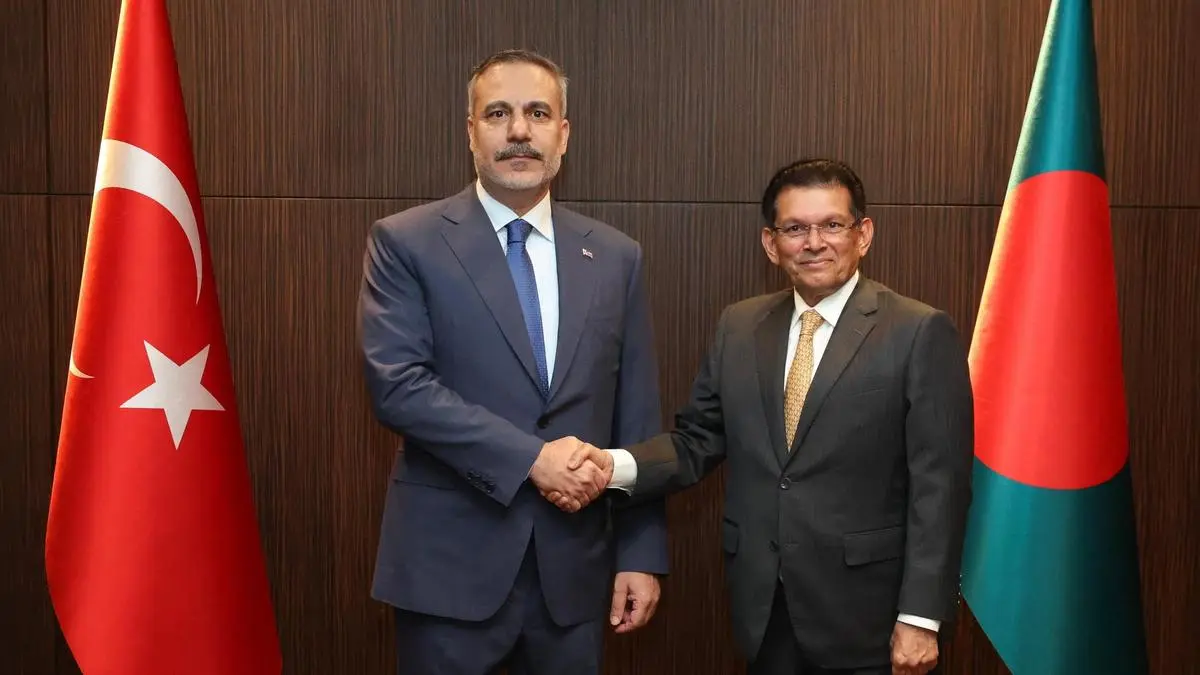
The deepening defence pact between Bangladesh and Türkiye is emerging as the clearest indicator of Bangladesh’s recalibrated foreign policy in the post-Sheikh Hasina era. A high-profile visit to Dhaka by Turkish Foreign Minister Hakan Fidan this weekend culminated in an agreement to establish joint committees on defence and foreign affairs, alongside institutionalising regular “two-plus-two” consultations.
The agenda skipped past routine hardware procurement to focus on drone technology, tank development, electronic warfare systems, and defence industrial cooperation. For the Bangladesh Nationalist Party (BNP)-led government, which assumed elected office after 17 months of interim administration, this is not merely a shopping spree. It is a calculated effort to diversify strategic partnerships and assert autonomy after 15 years of regional diplomacy being heavily anchored to New Delhi.
The development has likely rattled nerves across South Asia, most acutely in India. Policymakers in New Delhi are closely tracking Bangladesh’s expanding footprint with both Türkiye and Pakistan at a time of heightened regional sensitivity. Türkiye’s transformation from an arms-importing middle power to an aggressive defence exporter—anchored by the combat-proven success of its Bayraktar drones from Ukraine to the Caucasus—makes it an attractive partner.
For Bangladesh, which has traditionally relied on a narrow pool of military suppliers, Türkiye offers a twin advantage: cheaper access to advanced technology relative to Western platforms, and a distinct willingness to engage in technology transfer and joint domestic manufacturing.
The timing of this embrace injects a sharp geopolitical edge into what Dhaka frames as routine military modernisation. Türkiye’s relations with India have cooled significantly following Operation Sindoor and Türkiye’s repeated diplomatic backing of Pakistan’s position on Kashmir. That Bangladesh chose this specific moment to institutionalise a strategic dialogue with Ankara suggests a fundamental shift in how the country views its neighborhood.
Alongside the Turkish opening, Dhaka has systematically unfrozen its long-chilled relations with Islamabad. Diplomatic exchanges with Pakistan have spiked, trade talks have resumed, and political channels are louder than they have been in decades.
The shifting security landscape
Inevitably, Indian commentators have interpreted these moves through an anxious zero-sum lens, warning of an emerging Türkiye-Pakistan-Bangladesh axis designed to pull Bangladesh out of India’s strategic orbit. Relations between New Delhi and Dhaka have remained brittle since the 2024 political transition, aggravated by border skirmishes, disputes over undocumented migrants, and a wave of populist anti-India sentiment within Bangladesh.
Yet Dhaka insists that viewing this diversification as a hostile realignment misreads Bangladeshi intent. The reality is pragmatic rather than ideological. Bangladesh’s security landscape is shifting towards asymmetric threats—cyber warfare, unmanned aerial systems, and electronic combat. Türkiye happens to possess mature capabilities in these specific sectors and, crucially, faces fewer political constraints in sharing its industrial blueprints than Western capitals do.
Expanding ties with Ankara is driven by a desire for strategic flexibility and technological capacity, not a desire to join an adversarial bloc.
Dhaka’s diplomatic establishment remains wedded to the country’s foundational maxim of “friendship towards all, malice towards none”. Navigating relationships simultaneously with India, China, the US, and the EU has always been the standard play. The BNP administration is not trying to subvert this tradition; it is trying to restore it after a period of perceived over-dependence on India.
Confrontation with New Delhi remains an economic and geographic impossibility. The two nations share a porous 4,100-km border, deeply integrated river systems, and vital security protocols. India remains one of Bangladesh’s largest trading partners, a primary exporter of electricity, and a critical transit route for regional commerce.
Stability with New Delhi is a structural necessity for Dhaka. But the new government is keen to demonstrate that accommodating Indian interests does not grant India a veto over Bangladesh’s broader sovereign choices.
The ultimate test for this burgeoning partnership with Türkiye will be economic and operational, rather than purely political. Procuring advanced military hardware is straightforward; sustaining it over decades requires sophisticated maintenance pipelines, software updates, and reliable spare-part guarantees.


Foreign Minister S. Jaishankar with the then acting chairman of the Bangladesh Nationalist Party and current Prime Minister Tarique Rahman condoling the death of Rahman’s mother and former Prime Minister Khaleda Zia, in Dhaka, Bangladesh, on December 31, 2025.
| Photo Credit:
Bangladesh Chief Adviser’s Press Wing/Handout via Reuters
If Bangladesh merely buys finished Turkish products without securing genuine technology transfers or local industrial capabilities, it will have traded one form of external dependency for another.
Furthermore, fiscal reality will dictate the pace of any grand defence ambitions. Bangladesh is currently managing strained foreign currency reserves, high inflation, and escalating debt-servicing costs. Any massive capital expenditure on military modernisation will inevitably face intense domestic scrutiny from critics who argue that scarce reserves should be channelled into infrastructure and human development.
For the moment, however, the symbolic and political utility of the Turkish alliance outweighs its immediate battlefield impact. By upgrading its relationship with Türkiye, Bangladesh has signalled that it is comfortable executing a highly independent, multi-directional foreign policy. It is moving away from exclusive or restrictive partnerships in favour of maximising its options on the global stage.
The message directed at India is unambiguous: Dhaka will no longer view its external relationships through the prism of New Delhi’s anxieties. Instead, it will pursue partnerships wherever it identifies a clear economic, technological, or strategic advantage.
For Bangladesh, the calculation is pretty straightforward. Closer ties with Türkiye are not an anti-India provocation, but a vote of confidence in its own sovereignty. Whether Dhaka can successfully pull off this delicate balancing act remains to be seen, but the era of passive compliance is surely over.
Faisal Mahmud is a Dhaka-based journalist.
Also Read | Bangladesh: A nation in turmoil and transformation
Also Read | Tarique Rahman steps into South Asia’s hardest balancing act


