





“Give all power to the many, they will oppress the few. Give all power to the few, they will oppress the many. Both, therefore, ought to have the power, that each may defend itself against the other.”
— Alexander Hamilton(From Speeches in The Federal Convention, June 18, 1787).
In Hamiltonian thought, delimitation is a balancing act in federalism through a specific calculus of representation and parliamentary (procedural) rigidities. We define “delimitation” as the political making and unmaking of a nation by resizing electoral districts from time to time. One-size-fits-all may end up in the “national signification” of the select regions/States and de-signification or marginalisation of others, with considerable bearings on the constitutional-political capacity of a State.
The representation scale determines the legislative and political bargaining capacity of a State. From a federal perspective, delimitation is a two-stage process: (i) federal reorganisation of the people, polities, and regions in a manner that ensures each unit is autonomous and yet integrated to a national core; and (ii) redistricting from time to time, securing equality of votes and representation. Demonopolisation is at the core of a federal delimitation. Unfortunately, India has viewed the two as distinct and separate processes, which has resulted in power asymmetries. The failed delimitation Bill of 2026 viewed delimitation mechanically as a number count in proportion to the population of a State as per Census 2011.
We work out here the possible consequences of the delimitation Bill of 2026. In our exercise, we have taken the opportunity to coin, validated through data, the concept of the “concentric nation” and the “first nation”. The concept of concentric nation follows a distinct spatial pattern with a high political capacity to influence national outcome. The “concentric nation” also has a nested space for reinventing Indian identity, with Uttar Pradesh as a standard reference centre for the making and remaking of India; hence we labelled Uttar Pradesh as “first nation”.
Spatial club method
For ease of understanding, we have followed “spatial club” methods to underline the broad zonal changes. The first circle of States, described as the concentric circle, serves as the central core and also qualifies as a standard national reference centre for the development of a “national State”.
The first circle comprises the erstwhile western provinces, central provinces, united provinces, and “ en route regions/States” of the present northern States. States adjacent to this circle serve as the elongated circle, sharing some common cultural affinity and common socio-economic and political interests with the concentric circle. This includes States like Bihar, Assam, and Odisha.
The third circle, referred to as southern circle, comprises the southern States, and the fourth circle, known as peripheral circle, comprises the smaller States with Lok Sabha seats fewer than two. It is not a coincidence that each circle has distinct historical characteristics of specific ideology, idioms, and identity, and distinctive political construction. The more we move away from the concentric circle, we find identity ruptures and the digression of interests.

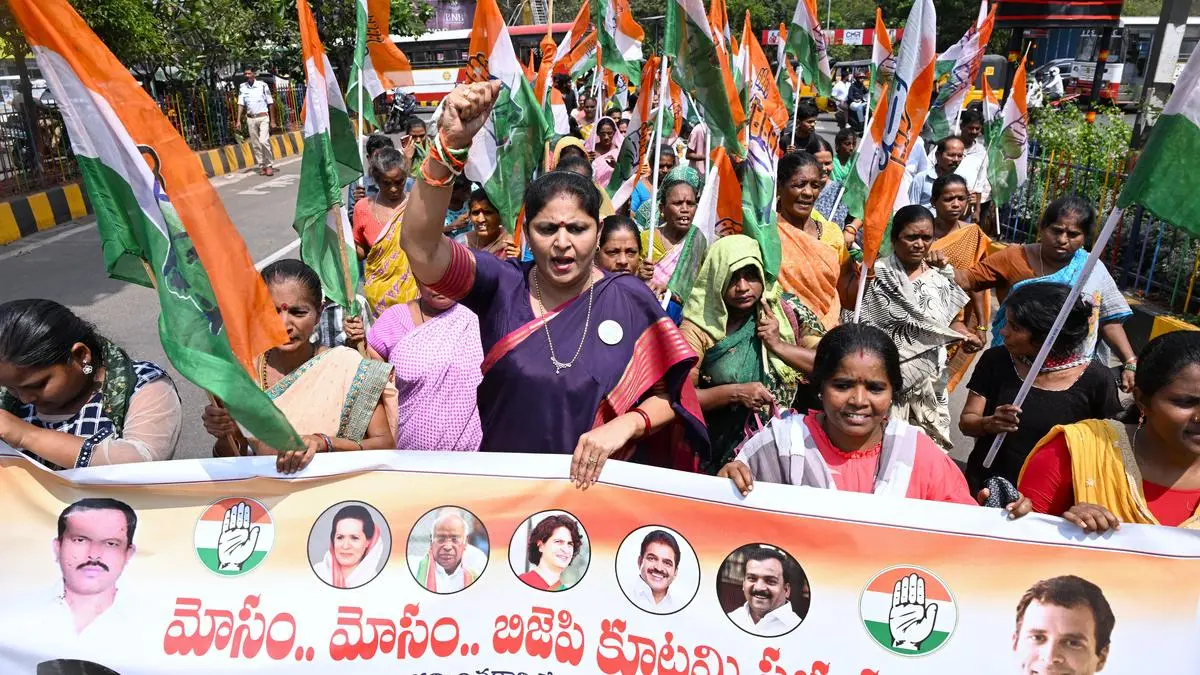
Sowmya Reddy, general secretary of the All India Mahila Congress, with party colleagues at a protest against the delimitation Bill in Bengaluru on April 17.
| Photo Credit:
J. ALLEN EGENUSE
Two primary metrics are employed through the exercise. First, absolute seat gain (projected minus existing), which captures raw increases in constituency count. Second, seat share change (percentage point delta), which captures proportional shifts independent of the overall expansion. To understand the ramifications, States are aggregated into four analytical concentric geographic tiers. For our analysis, the implicit total existing seat count is taken as 550 (maximum sanctioned strength of Lok Sabha), and the projected total as 830, yielding a net addition of 280 seats. With the absolute census count of the country’s population, the projected seats of the Lok Sabha would increase from the constitutional limit of 550 to 825, with the population of each parliamentary constituency totalling approximately 14 to 15 lakh. The projected total differs slightly due to rounding off for each State as Table 1, which gives the State-wise projection of seats, shows.
The column “Projected seats after rounding off” in Table 1 gives the total as 830 instead of 825. This is because 830 is the total that is brought up after rounding off the numbers for each State, which requires a number in the column “Projected seats” to be rounded off to 1 if it is between 0 and 1; numbers greater than 1 are rounded off to the next number if the decimal is 0.5 or higher.


As is evident from Table 1, the seat share of Uttar Pradesh would rise from 80 to 136 (an increase of 56 seats), raising its percentage share from 14.55 per cent to 16.39 per cent; Bihar from 40 to 71 seats (7.27 per cent to 8.55 per cent); Maharashtra from 48 to 77 seats (8.73 per cent to 9.28 per cent); and West Bengal from 42 to 62 seats (7.64 per cent to 7.47 per cent). On the contrary, Tamil Nadu would experience a decline in relative share. Although its seats would increase from 39 to 49, its seat share percentage would decline from 7.09 per cent to 5.9 per cent. Similarly, Kerala would see an increase from 20 to 23 seats, but its percentage share would drop from 3.64 per cent to 2.77 per cent. In brief, these four States may see an increase in absolute seat numbers, but their political weight would decline by approximately 2 to 3 percentage points.


The eight States in the concentric circle (Table 2) account for 42.56 per cent of the existing House and are projected to capture 47.11 per cent of the expanded House, a gain of 4.55 percentage points. These core States in the concentric circle absorb 157 of the ~280 new seats, that is, 56 per cent of all new seats, and when we add the elongated circle (Bihar, Jharkhand, Odisha, Assam, and Delhi) to the core, the aggregate share rises from 60.02 per cent to 65.66 per cent. In other words, 13 States would collectively hold approximately two-thirds of the expanded Lok Sabha. This represents a material shift in the structural weight of Parliament towards these 13 States.
This means that in effect the concentric-elongated circle would critically dominate any moves effecting constitutional changes and parliamentary outcomes. In contrast, the southern States may witness diminished constitutional capacity to effect changes and influence parliamentary outcome. We describe this as constitutional oversizing of select States and undersizing of a few (mainly southern) States, with an adverse impact on parliamentary and federal balance.


A critical pattern is observable across all four southern States and Puducherry (Table 3): each records an increase in absolute seat count but a decline in proportional share. Tamil Nadu’s seat share would decline by 1.19 percentage points, the sharpest absolute share loss among southern States, while Kerala loses 0.87 percentage points. Andhra Pradesh, despite gaining a relatively high number of seats (16), sees a 0.65 per cent contraction in seat share. Karnataka is the least affected, losing only 0.03 percentage points. Peripheral States are likely to move further towards parliamentary insignificance, as seen in Table 4.


What is evident from Table 4 is that this is the only grouping in which the total projected seat count (18) is lower than the existing count (19), a net loss of 1 seat in absolute terms, with Arunachal Pradesh and Goa losing 1 seat each. (However, it is assumed that the number of seats for Arunachal Pradesh and Goa will not be reduced as there is an exception for States with a population strength below 60 lakh.) Second, the collective share of the peripheral States contracts from 3.42 per cent to 2.16 per cent, a decline of 1.26 percentage points, which is proportionally among the steepest contractions in the dataset. Although 11 of the 14 States/Union Territories (UTs) in this grouping maintain their seat count unchanged, all experience proportional dilution in seat share percentage. Of the remaining States/UTs, Jammu and Kashmir, Punjab, and Himachal Pradesh may have occasional significance, especially when major constitutional changes requiring federal consent from the States and special majority are required.
West Bengal, a unique case
As the projected seat share of West Bengal is expected to rise from 42 to 62 in absolute terms, it may at times determine the national outcome, especially in a scenario of floor polarisation or fragmentation. We deliberately did not club West Bengal with the above stated spatial clubs despite its having some affinity with the eastern States (elongated circle) because of its distinguishing features and stand-alone identity, culturally and otherwise. In Table 5, we encapsulate the primary quantitative inferences from the analysis.


This analysis demonstrates that a delimitation exercise calibrated to inter-censal population growth would produce a materially asymmetric redistribution of parliamentary representation. The expansion of the Lok Sabha by approximately 280 seats does not constitute a proportionally neutral scaling of the existing distribution. Rather, it systematically amplifies the representational weight of already dominant geographic clusters while compressing the share of the other regions.
On the basis of the above findings, we conclude that what India needs for equitable representation and constitutional capacity balancing is an independent commission to look into the questions of federal asymmetries after reorganisation of boundaries before any delimitation exercise is undertaken. It is unfortunate that no major reorganisation effected since 1956 attempted to federalise society and pluralise the polity. This is probably why the delimitation exercise has always been at conflict with the core logic of federalism. Any federal delimitation is constitutionally bound to address the question of high asymmetries and ensure they are neutralised.
Ajay K. Singh, Amisha Thakur, Khalid Ansari, and Nalin Verma are faculty members, Centre for Federal Studies, Public Policies and Governance, Jamia Hamdard, New Delhi. The views expressed are personal and do not represent in any way the views of the institution.


