





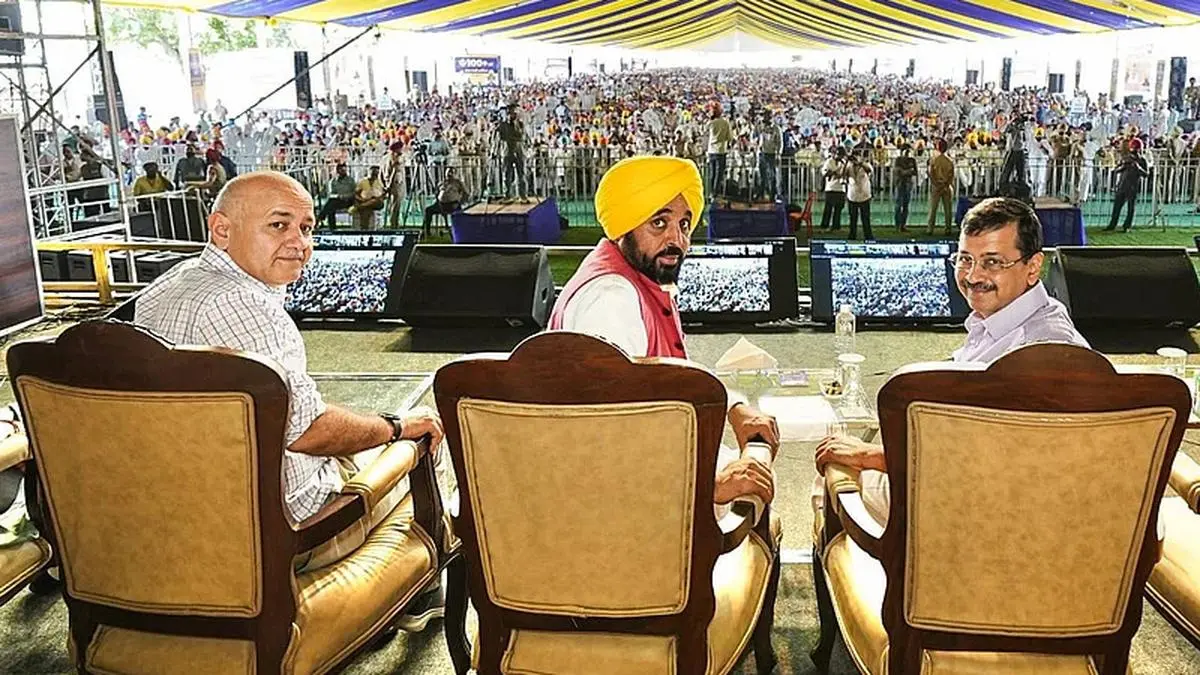
Are the recent urban civic body election outcomes in Punjab a “semi-final” to the next State Assembly election due in February next year? The results were declared on May 29. Talking to reporters, Chief Minister Bhagwant Mann described the outcome as a mandate against “hate and sectarianism” and an endorsement of his AAP’s politics of “development and secularism”.
The AAP bagged 958 of the total 1,977 wards, whereas the Congress secured 397. Independent candidates won 251 wards, the Shiromani Akali Dal (SAD) 192, the BJP 172, and the BSP seven. While the AAP won 48 per cent of the total wards, the Congress finished a distant second with around 20 per cent, followed by Independents at 13 per cent, the SAD at 10 per cent, and the BJP at 9 per cent.
Since losing Delhi, the AAP’s national leaders have stumbled from one crisis to another, battling corruption charges. In Punjab, the party has been finding itself under the lens of Central agencies.
Not long ago, seven of the AAP’s Rajya Sabha members—including five associated with Punjab—joined the BJP, along with several other local party leaders. Chief Minister Mann himself has been under fire over allegations concerning personal conduct. Observers see the AAP’s civic body election sweep in this context as a boost for the embattled party before the final contest, and a warning for the opposition.
Political commentator Harjeshwar Pal Singh says the outcome was a continuation of a long-standing Punjab tradition in which civic elections have invariably favoured the ruling party. “A combination of administrative muscle, opposition disinterest, fragmented local contests and the deeply ingrained belief among voters that ‘kamm karwaune honde han’ (one needs access to those in power) tilted municipal elections towards the government of the day,” Pal Singh says, citing the historical trend that such results rarely had a direct bearing on forthcoming State Assembly election.
In the 2021 municipal elections, the Congress won seven of eight municipal corporations, securing victories across 271 of 351 wards in those seven corporations, and 1,078 wards across 109 municipal councils and nagar panchayats. Similarly, the SAD and the BJP won a majority in four municipal corporations in the 2015 urban civic body elections. The AAP came to power in Punjab in March 2022, ending the Congress’s rule of the State, which had begun on March 16, 2017.
“The opposition can draw some comfort from history,” says Pal Singh. In both the 2015 and 2021 urban local body elections, he notes, the ruling parties—the SAD-BJP alliance and then the Congress—registered impressive victories only to be decisively defeated in the subsequent State Assembly election. Punjab’s electorate, he argues, has historically approached municipal elections differently from State Assembly contests.
But can the civic election results be dismissed as inconsequential? “It would be a mistake,” he says. “It is a significant psychological and organisational victory for the AAP, months before the ‘final’—the 2027 Assembly elections.”
More important than the numbers is what lies beneath them. The AAP is steadily expanding its grassroots footprint through sarpanches, councillors, block samiti members, and local influencers—an organisational layer it largely lacked when it first came to power in 2022. “This network, rooted in locality, patronage, and self-interest, is likely to prove more durable than the enthusiastic but often unreliable volunteer-driven structure that powered the party’s initial rise,” Pal Singh adds.
BJP’s cautious ascent
According to observers, the results confirm that the SAD remains essentially a rural party while the BJP has gained further ground in urban areas—though this is a limited advance, given that the party had already secured majorities to elect its mayors in Amritsar and Jalandhar municipal corporations before the elections.
On the BJP’s performance, Ashutosh Kumar, who heads the Political Science department at Panjab University, says the results have strongly indicated that the party is in ascendance. “It has shed its tag of a ‘second-grade party’ in Punjab—the image of a lackey that had remained under the SAD’s shadow for long.”
The BJP did not win as many seats as it had hoped, but described May 30 as a “historic day” for Punjab and for itself. “This mandate is a testament to the people’s trust in development, accountability, and the BJP’s vision for a stronger Punjab,” the party stated. Soon after, it announced Kewal Singh Dhillon as its new State president. “As it happened in Bengal, Punjabis now want the BJP. In 2027, the BJP will form the government, and Punjab will see massive economic development,” Dhillon said.
Like his predecessor Sunil Jakhar, Dhillon too is a former Congress leader. A former MLA from Barnala (2007–17), the industrialist-politician comes from the Malwa region, which accounts for 69 of the 117 seats in the Punjab Legislative Assembly. He is a Jat Sikh and is widely regarded as an organisationally capable figure, though not a mass leader.
Congress in familiar trouble
For the Congress, the results are another sobering reminder that the party remains in decline, according to Pal Singh. Its performance in the 2024 general election, he says, increasingly looks like a one-off rather than the beginning of a sustained revival.
The Congress has suffered a run of defeats in byelections and local body elections in the State. The latest results also reflect the party’s persistent troubles: factional feuds, demoralised cadres, uninspiring leadership, and an absence of political momentum. On the electoral defeat of Congress State president Amrinder Singh Raja Warring in his home turf of Gidderbaha, Pal Singh says: “It underlined a harsh reality. If Congress leaders struggle to hold ground in their own bastions, the road to power becomes exponentially harder.” Many believe the party needs new State leadership.
But party general secretary in charge of Punjab Bhupesh Baghel has dismissed talk of imminent organisational changes, saying next year’s Assembly election would be contested collectively.
The results offer some consolation to the SAD. “Finishing ahead of the BJP and performing respectably in several small towns, particularly in Malwa, suggests that the party retains pockets of relevance despite years of decline,” Pal Singh says. The SAD has been losing elections since 2017. Its organisational decay, credibility deficit, and leadership challenges remain unresolved. “The ‘dinosaur’ may still be alive,” he concludes. “But it is nowhere near reclaiming its old dominance in State politics.”
Ashutosh Kumar, meanwhile, stopped short of calling the civic election results a semi-final. “The AAP remains an effective party. It would have been in serious trouble had it lost these elections, as the ruling CPM-led Left Democratic Front did in Kerala last year,” he says. The AAP, he adds, remains particularly vulnerable in the face of sustained pressure from Central investigative agencies and the BJP’s aggressive recruitment of leaders from rival parties following its recent West Bengal victory.
Also Read | Punjab: AAP’s last stronghold and its political lifeline
Also Read | AAP after the exodus


