

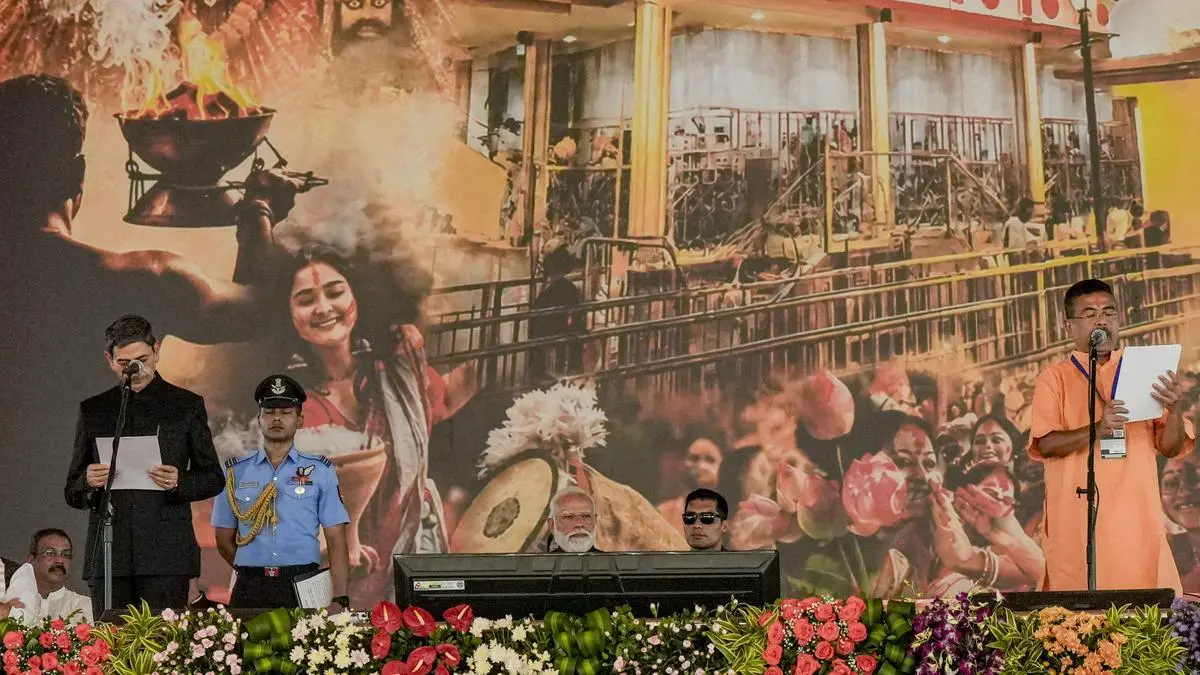
The West Bengal election result stunned everybody. Even the BJP did not expect to secure the two-thirds majority that it did. In many ways the 2026 Bengal Assembly election was one of the strangest elections to report on. Not only was it one of the most silent elections, with voters resolutely keeping their own counsel, it was also an election whose final outcome was almost impossible to gauge, particularly after the deletions following the Special Intensive Revision (SIR) of the electoral rolls just ahead of the election. In short, anything could be expected.
So, when the BJP scored a historic win, toppling the 15-year-old Trinamool Congress government, and Chief Minister Mamata Banerjee herself lost her Bhabanipur seat, it came as a “shock” that did not really surprise most people. What initially appeared to be a quiet undercurrent against Mamata’s rule ended up as a silent tsunami as the BJP mopped up 207 of 293 seats (repolling in the Falta constituency will take place on May 21). It was a massive mandate for change. The BJP’s vote share went up from 38.15 per cent (in the 2021 Assembly elections) to 45.8 per cent; its seat tally increased by 130.
The Congress reopened its account in the State with two seats, as did the CPI(M) with one seat. The All India Secular Front got one seat, as it did in 2021, while Humayun Kabir’s Aam Janata Unnayan Party (AJUP) won two seats.
After nearly 50 years, West Bengal will have a government that is run by a party that also holds power at the Centre. “This development will have national repercussions; with the fall of the Trinamool Congress, regional resistance to the Centre is now mainly confined to the south. The question is, how healthy is this for a vibrant democracy?” said the veteran political analyst Biswajit Bhattacharya.
Fall of a giant
The mighty Trinamool, with its mercurial chief Mamata Banerjee—one of the tallest mass leaders of modern politics—and its immense organisational network across the State, was reduced to 80 seats in the face of an unprecedented anti-incumbency wave. Its vote percentage fell from 48.2 in 2021 to 40.8, with Mamata herself convincingly beaten in her own seat by 15,105 votes by the Leader of the Opposition in the Assembly, Suvendu Adhikari. Adhikari, who had left the Trinamool for the BJP in December 2020, also won in Nandigram, his old stronghold. In the last election, too, he had defeated Mamata when she decided to contest from Nandigram.
In the run-up to the election, Mamata proclaimed that it was she who was contesting from all 294 seats. That makes her defeat especially significant. The Trinamool’s humiliating defeat is being seen as a rejection of Mamata herself by the people of West Bengal.

What were until recently seen as her party’s impregnable bastions in south Bengal were breached. Out of 161 seats in the seven southern districts, the BJP won only 21 in 2021. This time, it won 104: 22 out of 33 in North 24 Parganas; 10 out of 30 in South 24 Parganas; 6 out of 11 in Kolkata; 7 out of 16 in Howrah; 6 out of 11 in Birbhum; all 9 seats in Paschim Bardhaman; 14 out of 16 in Purba Bardhaman; 16 out of 18 in Hooghly; and 14 out of 17 in Nadia.
The Trinamool drew a blank in nine districts: Bankura, Purulia, Jhargram, Paschim Bardhaman, Purbo Medinipur, Alipurduar, Jalpaiguri, Darjeeling, and Kalimpong. It won only 2 of 40 seats in the Jangalmahal area (spanning the forested districts of Bankura, Paschim Medinipur, Jhargram, and Purulia), getting roundly defeated in the reserved SC/ST seats.
A visibly upset Mamata Banerjee speaking to the media on the evening of May 4 in Kolkata. She alleged malpractices in the counting centre and said she had been manhandled.
| Photo Credit:
ANI
The Trinamool also lost heavily in the Rajbongshi belt in north Bengal, winning only 1 out of the 30 seats there.
“The BJP won all the seats reserved for the STs, and 51 of the 68 seats reserved for the SCs, including 18 of the 21 Matua-dominated seats,” said the psephologist Biswanath Chakraborty. He pointed out that while the Trinamool lost heavily in its core areas, the BJP managed to retain all the 77 seats it won in 2021 and bolstered its stronghold in north Bengal. “Even the non-performing legislators [of the BJP] kept their seats, which seems to indicate an overwhelming anti-incumbency sentiment,” said Chakraborty.

Singur is a place that is closely associated with Mamata’s political legacy because of the prolonged agitation she led there from 2006 to 2008 against the acquisition of farm land for the Tata Motors’ Small Car Project. Even in this seat, the Trinamool lost to the BJP, by 21,348 votes.
“We did not understand the people’s mind,” said Udayan Guha, who was Minister for North Bengal Development in Mamata’s government, as the results were declared and one by one the Trinamool stalwarts fell, 22 heavyweight Ministers among them.
SIR, the hidden factor
While even Mamata’s most loyal voters seemed to have deserted her—women, the urban middle class, and a section of Muslims—it was the revision of electoral rolls that worked as the hidden factor in this election. Some 91 lakh names were deleted; 27 lakh of these deletions were because of “logical discrepancy”. While the deletion of 63.66 lakh “non-existent” voters, allegedly used by the Trinamool in earlier elections, created a more level playing field for the BJP, the additional 27 lakh names that were added to the “deleted” list following judicial scrutiny threatened to impact both the Trinamool and the saffron party in different ways.
Bhattacharya pointed out that from one perspective the SIR exercise stood to facilitate a 4 to 5 per cent swing in favour of the Trinamool, but from another, it seemed to give the BJP an advantage in around 80 seats where the winning margin was within 10,000, and in another 20 seats where the margin was between 10,000 and 15,000.
“Of the 27 lakh voters who were not included in the voter list due to logical discrepancy, a large number were from the ruling party’s winning seats. For example, more than 40,000 names were deleted from Mamata’s Bhabanipur constituency,” he told Frontline. He also pointed out that deletions due to logical discrepancies were fewer in the BJP’s winning seats.
The massive voter turnout of 92.4 per cent in the two phases of the election added a new twist to an already nebulous scenario. If the size of the turnout was indicative of an imminent change of guard, as in 2011 when the Trinamool overthrew the 34-year-old Left Front government, the similarity ended there. Before the 2011 election, the Left’s poor performance in the 2008 panchayat elections, the 2009 Lok Sabha election, and the 2010 civic elections gave clear indications that it was on its way out. The BJP, on the other hand, had lost political ground in Bengal with every successive election since the 2019 Lok Sabha election. Except for the groundswell of resentment against the Trinamool, there was little practical indication that the BJP would end up with such a massive mandate.
If the Election Commission of India was criticised for the manner in which the SIR was conducted, it was universally lauded for ensuring a “free and fair” and violence-free election for the first time in many years in the State. Emboldened by the neutralisation of the culture of threat fostered by the ruling party, the people of Bengal voted without violence, a relatively new phenomenon in the State.

The Trinamool had hoped that the SIR in areas where the maximum deletions were of Muslim names would help reconsolidate a support base that had shown signs of disenchantment, but that did not happen. Instead, the Congress and the newly formed AJUP drew a considerable percentage of minority votes in Muslim-majority Murshidabad, Malda, and Uttar Dinajpur, and the BJP walked away with more seats than expected.
In Murshidabad, where the Trinamool won 20 of the 22 seats in 2021, it could win only 9 seats this time, while the BJP won 8. The BJP won even in a seat like Jangipur with its 55 per cent Muslim population. In Malda, the Trina.mool tied with the BJP, with each party winning 6 of the 12 constituencies. In Uttar Dinajpur, the BJP won 4 seats, while the Trinamool got 5.
Muslims, who account for over 30 per cent of the population, have been staunchly behind Mamata since 2011. But there was resentment when she did not support the protests against the Waqf Bill and threatened to take action against the protesters. “Essentially, Muslims felt they were being used as pawns. There has been no real development, and they realised that Mamata is not really fighting for them. She could block neither the Citizenship (Amendment) Act nor the Waqf Bill. As a result, middle-class Muslims went for alternatives, mainly those that upheld Islamic identity,” said Chakraborty.
Ironically, it was Mamata’s self-confessed “Muslim appeasement” that led to a gradual consolidation of Hindu votes for the BJP. The polarisation was further intensified with the frequent communal clashes in the State, the most recent being in Murshidabad district in April 2025, when Hindu families had to flee villages and take refuge in other districts. Reports of attacks on Hindus in neighbouring Bangladesh, coupled with the BJP’s narrative of Hindus in Bengal being “in danger”, served the communal agenda of both the BJP and the Trinamool.
A communal mandate
The voting percentage of Hindus in this election was over 90 per cent, one of the highest ever. “This time it was a very communal mandate, particularly in Kolkata and adjacent areas among middle-class and upper-middle-class Bengalis, who were traditionally known to be Trinamool voters,” said Bhattacharya. In fact, the BJP won 28 of the 39 urban seats across the State, including 6 from Kolkata. “People were fed up with the lack of governance, lawlessness and rampant corruption. The Trinamool failed the educated middle class and could not meet the aspirations of the youth. For the first time, middle-class voters went against the Trinamool for lack of jobs and the breakdown of the education system,” said Chakraborty.
BJP supporters celebrate the party’s landslide electoral victory in Kolkata, on May 4.
| Photo Credit:
Debajyoti Chakraborty/ANI
The School Service Commission recruitment scam, in which appointments of 25,752 teachers and non-teaching staff were invalidated by the court, struck at the heart of the education system in the State and adversely impacted the academic credibility of government schools. Such scams had become commonplace in Bengal.
For more than a decade, Mamata’s welfare schemes, directed mainly at the betterment of women, secured her the backing of the majority of the women voters in the State. However, although schemes such as Kanyashree and Sabooj Sathi kept girls in school and ensured higher education for many of them, she had little to offer them once they graduated, apart from a meagre Lakshmir Bhandar payout of Rs.1,500 (Rs.1,700 for SC/ST beneficiaries) a month. The BJP outbid Mamata for the women’s vote ahead of the election with its promise of Rs.3,000 a month for Lakshmir Bhandar beneficiaries, Rs.21,000 for pregnant women, Rs.5,000 for girls opting for higher studies, and 33 per cent reservation for women in government jobs.
Crimes against women
The Trinamool government was also perceived to be defensive over atrocities committed against women: from the gruesome rape and murder of a college girl in Kamduni in 2013, to the harassment of village women by Trinamool goons in Sandeshkhali, to the horrific rape and murder of an on-duty doctor at the state-run R.G. Kar Medical College and Hospital in Kolkata in August 2024. The perception further alienated women from the Trinamool.
“The R.G. Kar case was a precipitating factor behind middle-class and urban women turning away from Mamata, as was evident in their spontaneous protest after the gruesome crime,” said Bhattacharya.
The political drama was not over with the declaration of the results. While Trinamool candidates admitted defeat and acknowledged the mandate of the people, Mamata herself remained defiant, claiming that the BJP “looted” more than 100 seats through EVM tampering and other underhand means. On May 5, she announced that she would not tender her resignation as she believed she had not lost.
“We did not lose the election. It is their [the BJP’s] forceful attempt to defeat us,” she said, assuring her supporters that the years in power had not softened the street fighter in her. “I belong to the street, and I am going back there,” she declared.
Update: The BJP’s Debangshu Panda won the Falta seat where a repoll was held on May 21. The results, which were declared on May 24, showed that Panda secured 1,49,666 votes, while the CPI(M)’s Sambhu Nath Kurmi came second with 40,645 votes cast in his favour.
Also Read | In Bengal election, the big story is not the one they are selling
Also Read | No country for citizens: Lakhs of voters in limbo after Bengal SIR
