





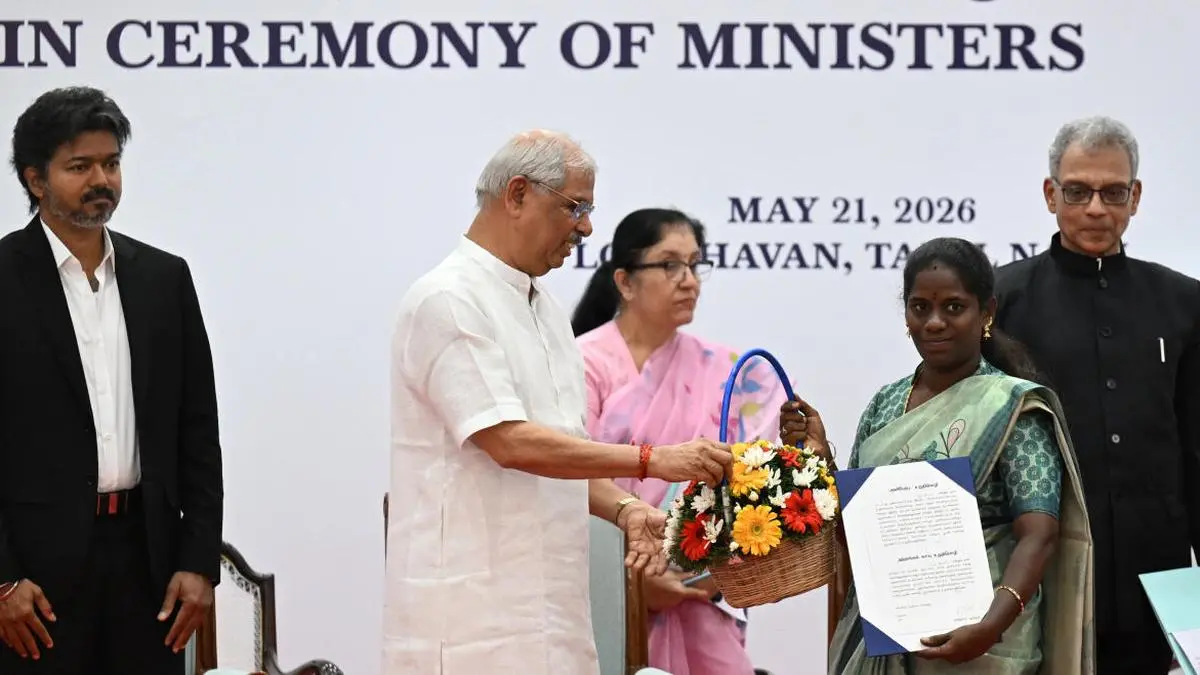
The maiden Cabinet of the new Tamil Nadu government, headed by Chief Minister C. Joseph Vijay of the Tamilaga Vettri Kazhagam (TVK), has emerged as a watershed moment in the State’s political history.
Vijay’s decision to induct eight Dalits, six from his party and one each from his post-poll supporters, namely the Congress and the Viduthalai Chiruthaigal Katchi (VCK), into his Council of Ministers is being widely hailed by Dalit activists as unprecedented. More significantly, several of those inducted have been entrusted with key portfolios, signalling an attempt to move beyond token representation in governance. The move has been viewed as a conscious effort to widen access to political power and challenge the persistent patterns of exclusion.
More than merely marking the arrival of a new political force, the Cabinet represents a decisive shift from the entrenched power structures, hitherto dominated by the Dravidian majors—the Dravida Munnetra Kazhagam (DMK) and the All India Anna Dravida Munnetra Kazhagam (AIADMK)—for over half a century.
The decision has also opened up a rare and significant political opportunity for historically marginalised communities, particularly Dalits, to secure greater representation and exercise meaningful influence within both the political and the executive spheres of governance. The Cabinet composition signals a conscious attempt to redefine the contours of power and governance, scripting a more inclusive and equitable model of administration in the State.
Dalits in Tamil Nadu have long harboured a deep and festering grievance over their limited and symbolic representation in the Ministries of successive DMK and AIADMK governments. Despite the two Dravidian parties alternating in power since 1977, Dalit participation in key decision-making positions remained minimal, with few exceptions.
This persistent exclusion has led to a growing perception that social justice rhetoric has not translated into a proportional share of power. It was against this backdrop that Vijay’s unexpected electoral triumph assumed greater significance, as it not only broke the decades-long duopoly of the Dravidian majors, it created a space for a more inclusive distribution of political power.
This raises a larger question: has Vijay, the first Christian to head a government in Tamil Nadu since Independence, succeeded in redefining the discourse on social justice that the Dravidian parties have long championed as a cornerstone of their political legitimacy? The evidence thus far suggests an emphatic yes.
Because Dalits are happy. They are satisfied that they have got their share in power with adequate representation. They are also optimistic that it might set a precedent for other dispensations in future.
Beyond rhetoric
By translating the principles of representation into tangible power-sharing arrangements, Vijay appears to have thus moved the social justice debate beyond rhetoric and symbolism, setting a new benchmark for inclusive governance.
Speaking to Frontline, D. Ravikumar, Member of Parliament and senior deputy general secretary of the VCK, said: “This marks a significant and historic achievement in the political representation of Scheduled Castes in Tamil Nadu. Dr B.R. Ambedkar made the demand for representation of the Scheduled Castes in the Cabinet at the Round Table Conferences.”
Quoting Ambedkar, he said: “The untouchables must not only have the right to be represented in the legislature, they must also have the right to be represented in the Cabinet.”
Another, and perhaps more complex, question that arises from this development is whether mere numerical representation of marginalised communities in the name of inclusive politics is sufficient to advance social justice. Does the presence of more representatives from these social groups in positions of power automatically translate into empowerment, or does meaningful participation in decision-making governance ensure representation?
This distinction lies at the heart of contemporary debates on Dalits’ political inclusion today. While numerical representation is an important first step in correcting historical imbalances, it does not, by itself, guarantee the redistribution of power. True political empowerment requires that members of marginalised communities be entrusted with the authority to influence policy and shape the direction of governance.
If numerical representation alone is the benchmark, it must be acknowledged that the outgoing DMK government under M.K. Stalin had already made a notable departure from past practice by including four Dalit Ministers in its Cabinet—the highest such representation in Tamil Nadu’s history until 2026. This was, by any measure, a significant step towards broadening social inclusion within the executive. But it should be noted here that both major Dravidian parties are reluctant to adopt the concept of coalition governance.
What distinguishes Vijay’s Cabinet from other governments is not merely the larger number of Dalit Ministers it accommodates, but the nature of the responsibilities entrusted to them in a coalition government. In that sense, his experiment is well beyond the politics of numbers and addresses the fundamental question of political empowerment.
Ambedkar believed that political representation goes beyond mere numbers in legislative bodies and that it is about empowering marginalised communities, specifically the Scheduled Castes (SCs) and Scheduled Tribes (STs), both politically and socially. He advocated for a “separate electorate” for Dalits, which led to an intense debate and disagreement between Ambedkar and Mahatma Gandhi on the subject. Ambedkar argued that the SCs should have their own separate electorate to enable them to elect their own representatives.
The Poona Pact resulted in a compromise. Supporters of Ambedkar still argue that Mahatma Gandhi betrayed them by denying the separate electorate. However, Dalits’ participation in governance was secured and incorporated into the Constitution through Articles 330 and 332, which mandate reservations for SCs and STs in the Lok Sabha and State Assemblies, in proportion to their respective populations.
According to Ravikumar, Ambedkar believed that the sufferings of the SCs were caused not merely by unjust laws but by a hostile administrative structure dominated by caste prejudices. “For this reason, he insisted that members of the SCs must be included in the higher executive so that the machinery of government would become more responsive to the interests and rights of the oppressed communities,” he added.
Sharing power with partners
In this context, Vijay’s Dalit-centric ministerial formation needs to be studied. His party was 10 seats short of a majority and in return for extending support, he encouraged the participation of all supporting parties in governance. Only the Left parties have opted to support the government from outside.
In 2006, the DMK fell short of the crucial numbers needed for a majority and sought support from the Congress, to form the government. However, it denied the Congress a share in power, which has been rankling Congress leaders and supporters ever since.
When Vijay offered to share power, the Congress, which won just five seats of the 28 it contested as part of the DMK alliance, was the first to grab it, showing no reluctance to ditch its longtime ally. The Congress’ lame reason for this act of desertion was that the BJP might manipulate the fractured mandate that arose after the election. The Congress has returned to the Treasury benches after 60 years; it was ousted in 1967 by the DMK.
Ironically, the VCK, the Congress, the Indian Union Muslim League (IUML), the Communist Party of India (CPI), and the CPI (Marxist)—all long-time allies of the DMK-led Secular Progressive Alliance, also justified their support for Vijay in forming the government primarily to prevent the BJP’s attempt to impose President’s rule..


Tamil Nadu Governor Rajendra Vishwanath Arlekar with newly elected Minister Vanni Arasu, at the swearing-in ceremony at Lok Bhavan in Chennai on May 22. Chief Minister Joseph Vijay is also present.
| Photo Credit:
ANI
But for a Dalit-centric party like the VCK and a minority organisation like the IUML, obtaining direct representation in the government without compromising their identities marks a significant shift in the State’s electoral setting. Dalit activists argue that the two major Dravidian parties have been pampering the Other Backward Classes (OBCs), who make up approximately 75 per cent of the population in Tamil Nadu. Dalit communities come second with around 21 per cent.
In fact, many Dalits view these two parties as “OBC parties” even though there is significant Dalit representation within them, but more as “party cadres” than as Dalits. Hence, there is a lingering frustration among them that they are treated as “minor partners” in grand alliances, and their votes are often exploited without proper acknowledgement. Despite their commitment, they often feel neglected and receive little in return.
Vijay seems to have eliminated that sense of neglect. For the first time since Independence, Dalits have really felt empowered to step away from the oppressive politics of Dravidian majors and experience the freedom of sharing power without restrictions. This relief is particularly evident among the dominant Dalit community of Adi Dravidars.
Diversity in representation
Vijay’s Cabinet reflects a diverse range of representation. The TVK won 23 out of 44 reserved constituencies, which is over 50 per cent. Additionally, four MLAs from other parties that support him are Dalits. However, he has also taken care to ensure that there is adequate representation of OBCs and minorities in his Cabinet.
According to TVK sources, the party’s list of candidates who contested the elections included 37 Vanniyars, 25 Mukkulathors, 12 Muslims, 10 Christians, and five Christian Nadars. Many of those who have won have been inducted. In fact, a report in The Hindu dated May 9 says that the SC/ST representation beyond reserved seats “remains limited”.
P. Viswanathan of the Congress, the lone Dalit to win from a general constituency (Melur in Madurai district), has been given the Higher Education portfolio, while the VCK’s Vanni Arasu is in charge of Adi Dravidar Welfare. The TVK’s Dalit Ministers are: A. Rajmohan (School Education), S. Kamali (Animal Husbandry), V. Gandhiraj (Cooperatives), P. Mathan Raja (MSME), D. Logesh Tamilselvan (Commercial Taxes and Registration), and K. Thennarasu (Non-Resident Tamils Welfare and Minorities).
The Cabinet also includes four women Ministers and, notably, two Brahmin Ministers—a rarity in Tamil Nadu’s Dravidian politics. Apart from former Chief Minister Jayalalithaa and Dr H.V. Hande, Brahmins have had virtually no representation in the State’s Cabinets for nearly six decades. The TVK has rectified that by appointing S. Ramesh as the Hindu Religious and Charitable Endowments (HR&CE) Minister and and P. Venkatramanan as Minister of Food, Civil Supplies, and Consumer Protection, reflecting the Cabinet’s broader social inclusiveness. In the Congress regime in the late 1960s, a prominent Dalit leader, B. Parameswaran, was the HR&CE Minister.
However, there is only one Minister each from other powerful Dalit communities such as the Devendrakula Vellalars and the Arunthathiyars.
The recent debates on the formation of this Cabinet have also sparked a shift in how political governance and power-sharing are perceived in Tamil Nadu. Observers point out that meaningful representation for Dalits in political power should not be limited to traditionally low-key departments.
History of Dalit representation
In fact, in the past, Dalits have held some significant portfolios in various administrations, including those of the Congress, the DMK, and the AIADMK. For instance, Sathyavani Muthu, a woman Dalit leader, held the portfolios of Adi Dravidar Welfare and Agriculture in subsequent DMK governments in the late 1960s and early 1970s before serving as a Union Minister for the AIADMK.
Parameswaran was the Minister for Transport apart from holding the HR&CE portfolio in the Congress Ministry. P. Kakkan, also from the Congress, was the Home Minister, while V.I. Munuswamy Pillai was another prominent Dalit member of the Constituent Assembly. Ravikumar said Munuswamy Pillai resurrected the issue discussed in the Round Table Conferences again on August 27, 1947, in the Constituent Assembly, by arguing that equal opportunities in the Cabinet were essential for genuine democratic inclusion.
Not long ago, Dr Govi Chezhiaan became the first Dalit Minister for Higher Education in the DMK’s government under Stalin. Other notable Ministers in the DMK administration included M. Mathiventhan (Adi Dravidar and Tribal Welfare), N. Kayalvizhi Selvaraj (Human Resources), and C.V. Ganesan (Labour Welfare and Skill Development), all of whom held significant portfolios. P. Benjamin was the first Dalit to serve as School Education Minister when the AIADMK came to power in 2016.
As of today, Karnataka has the most significant representation of Dalits in government, with five holding important portfolios such as Home, Excise, and Social Welfare. In Andhra Pradesh, there are two Dalit Ministers, while Telangana has three. In Kerala’s Congress-led government, two Dalits have been included. However, in States like Uttar Pradesh, once ruled by the prominent Dalit leader Mayawati, the representation of Dalits is now minimal.
Vijay’s Cabinet marks a significant shift in Tamil Nadu’s social and political engineering, reflecting how the new coalition government has reshaped the contours of power and representation in the State today. At the same time, the evolving trajectory of Dalit politics appears to be yielding tangible gains, signalling a broader transformation in the pursuit of social justice and political empowerment. It is a good beginning for social justice in the Dravidian land of Tamil Nadu.
Also Read | Vijay and the reinvention of Dravidian politics
Also Read | The throne, and the thorns


