

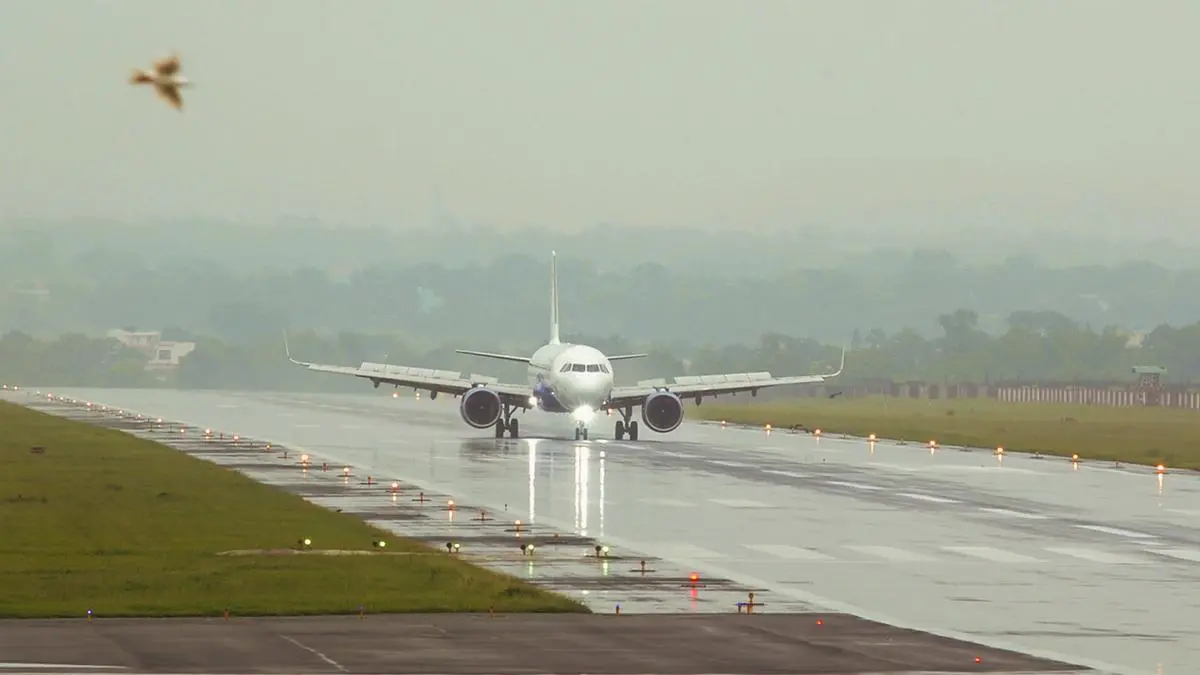

A passenger flight lands during a shower, at Birsa Munda Airport in Ranchi, on June 18, 2025.
| Photo Credit: PTI
The June 12, 2025, air crash involving an Air India Boeing 787-8 Dreamliner in Ahmedabad has turned the focus on flight safety, but aviation experts demand equal and immediate attention to another important aspect of air operations: airports. They point out that airports in the country are beset with a multitude of problems, including buildings along the funnel zone, bird menace because of garbage accumulation outside airports, inadequate attention to safety features, and lack of strict oversight on the part of regulators.
“It is time to look comprehensively at all aspects of safety,” said Captain G.R. Gopinath, a retired officer of the Indian Army who in 2003 literally changed the face of Indian aviation with his airline, Air Deccan, which has its operational base in Ahmedabad. “Encroachments and development with permission granted by local authorities on either side of the runway, and lapses in internal safety measures, bird menace because of garbage dumping just beyond the airport’s perimeter, in the approach and take-off path, are all major issues which require attention,” said the Army officer turned aviator.
Talking to Frontline, Gopinath said that crores were being spent on swanky buildings in airports in most metro cities around the country. While this was as it should be, there was an equally pressing need to focus on the “air-side” or tarmac to ensure air safety. He recalled how local authorities once permitted construction of a factory chimney in the approach funnel of the Solapur airport and said that no-objection certificates should never be given for this kind of structure.
Also Read | Air India flight crashes in Ahmedabad minutes after takeoff, over 200 feared dead
He added: “What normally comes to mind when you say ‘airport’ is the building. You look at a small airport like Shivamogga airport—about Rs.600 crore was spent on it. The problem is that they [the authorities] will not spend Rs.50 crore on the navigation aides. I am not talking about full instrument landing; I am not talking about that kind of sophistication [in Indian airports]. I am talking about ordinary aides such as night-landing lights, basic instrument landing, etc. Ninety per cent of the time [in India] an aircraft goes back [to its point of origin] because it is unable to land in a remote airport because the weather packs up and the pilot cannot see the runway because the navigational aids at these airports are really poor.”
In his view, smaller airports are critical to India because India still lives in the villages. So, the rural areas have to connect to the large hubs. He said that in addition to big swanky airports, the government should create no-frills, low-cost terminals and airports. “The costs will be lower. The rest of the focus should be on improving the runway and having parallel taxiways so that flights can land and take off easily, and perimeter walls should be properly secured,” he said.
The debris of an Air India Express aircraft that skidded off a runway while landing in Kozhikode in August 2020.
| Photo Credit:
C.K. THANSEER/AP
At the end of the runway is the funnel. But the problem in many airfields is that there are obstacles on the path. “All airports have to be surveyed, and it has to be figured out where there is encroachment, where there is construction, etc., and the runway funnel has to be cleared. For example, in the recent accident [in Ahmedabad], the aircraft sank. If those buildings were not there right in front of the runway—at least for about half a kilometre—then the pilot could have attempted a clear landing,” he said.
Structural changes needed in airports across the country
Captain A. Mohan Ranganathan, a former airline instructor-pilot and aviation safety adviser who has played many roles in the aviation sector, said that if earlier recommendations had been implemented, many of the current problems at the airport end could have been solved.
He was not hopeful that things would change: “One more accident will hardly make a difference.” He was of the opinion that major structural changes were required in airport operations across the country. Specifically, he identified two airports—Karippur (Kozhikode) and Mangaluru—as the most unsafe in India and said that no corrective action had been taken despite a series of recommendations. In the case of Karippur, he said that the airport there should operate only smaller aircraft. The nearby Kannur airport, a newer and much safer airport, should be used for the operation of larger aircraft, he added. But his advice has not been heeded to.
Also Read | Plane crashes in peak holiday season bring back questions on airline safety
In 2011, Ranganathan, who was then a member of the Civil Aviation Safety Advisory Council (CASAC), wrote to the Director General of Civil Aviation (DGCA) saying operations in Kozhikode were risky. “All the flights that land on Runway 10 in tailwind conditions in rain are endangering the lives of all on board,” he wrote.
He went on to explain in his letter what the other issues were: “Calicut [Kozhikode] runway does not have the minimum RESA [Runway End Safety Area] on one end and no RESA on the other. The runway strip is just half the minimum width laid down in ICAO [International Civil Aviation Organisation] Annex 14. This fact was known to the DGCA team that has been conducting inspections and safety assessments during the past several years.”
Despite this warning, no major corrective action was initiated at Kozhikode, he told this writer and added that he was removed from the CASAC because he was asking too many questions.
Both experts were of the view that going forward, the first step should be to implement the recommendations of the report generated following the Ahmedabad crash. This would require immense political will. Regulatory bodies must assert their authority and make it clear that no deviations would be condoned
