


The search was conducted on 14 February 2025 and yielded 1234 hits. We included records where at least two reviewers agreed. This yielded 28 records for full-text review. The same procedure was followed for the full-text review, yielding 13 included articles (see Fig. 1 for illustration of the selection process).

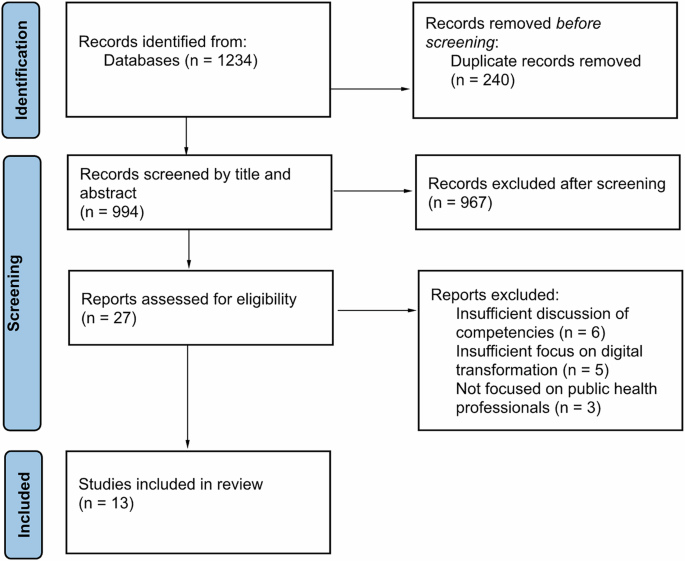
This diagram illustrates the selection process of studies for the systematic review, from initial identification through final inclusion.
Study characteristics
The characteristics of the included references are presented in Supplementary Tables 3 and 4. The study designs as reported in the studies were intervention reports (3/13)30,31,32, reviews (5/13)22,33,34,35,36, or qualitative studies (4/13)23,37,38,39. One study did not specify its study design40. Most of the studies were published in 2024 (6/13, 46%)22,30,32,33,34,40, followed by 2023 (4/13, 29%)32,35,36,37,39, and 2025 (3/13, 23%)23,31,38. Regarding the study region, the majority (8/13, 62%) of studies were published in North America, with six studies published in the US30,31,32,33,37,40 and two in Canada22,38. The remaining five were published in Asia (two from China34,35, one from Singapore23, and one from Indonesia36) and one in South Africa39. No study from Europe, South America, or Oceania has been identified.
From the 13 included articles, a total of 222 competencies were initially identified. Their focus encompasses various themes within DiPH, namely AI & data, data visualization, digital health, digital transformation in public health, public health informatics, and telemedicine.
Synthesis of competencies
During the initial assessment of the Iyamu et al. framework5, 25 competencies were included, six needed to be reframed, and 19 competencies were excluded (see Supplementary Table 5). From the Car et al. framework23, six competencies were included, nine needed to be reframed, and four were excluded (see Supplementary Table 6). By synthesizing the included competencies, a competency framework with 13 competencies was established. After screening the competencies of the other 11 studies, six additional competencies were added to the framework, resulting in a total of 19 unique competencies. The competencies were then organized into three overarching domains: (1) Health data, (2) digital public health services and functions, and (3) analytics and artificial intelligence (see Fig. 2). The full list of included competencies is in Table 1.

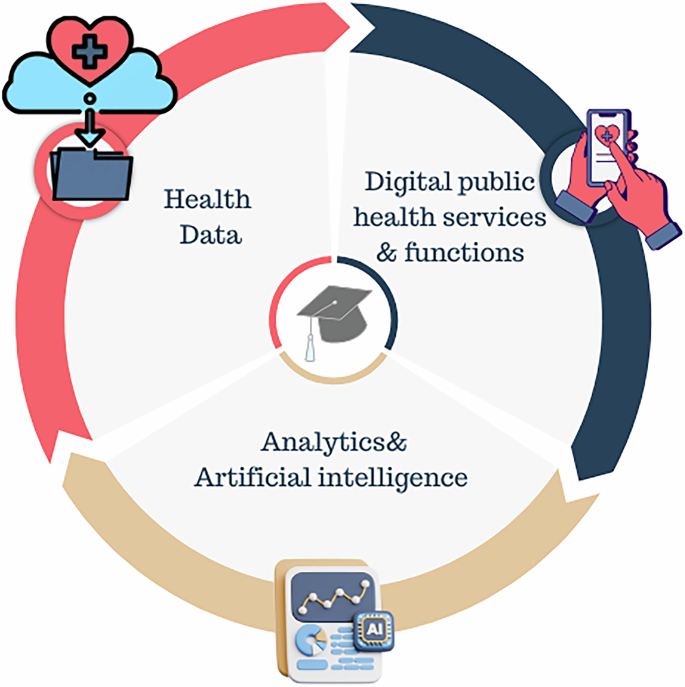
This figure displays the competency framework developed from the included competencies. It is organized across three overarching domains: (1) Health data, (2) digital public health services and functions, and (3) analytics and artificial intelligence.
The first domain, “Health data”, emphasizes the use of complex datasets and the corresponding need for public health professionals to manage them responsibly in accordance with ethical and regulatory requirements30,31,38. A complex health dataset contains data from various and new sources, such as secondary health data or big data. Competencies within this domain include the ability to manage existing datasets, as well as to generate new datasets by linking various sources and integrating data from emerging technologies such as sensors, wearables, mobile health applications, and social media platforms22,23. To enhance data sharing and large-scale data management, public health professionals should be able to identify needs, challenges, principles, and key details22,31.
The domain also highlights the importance of co-creating national health information systems that directly support public health objectives22. Public health objectives aim to improve population health, equity, and efficiency. Beyond managing and creating datasets, public health professionals should possess the skills/abilities to contribute to professional, ethical, and regulatory standards related to digital tools in public health22,23. The final competency in this domain involves applying informatics principles and strategic thinking to address public health information needs in a manner that supports organizational strategic alignment22,38.
The second domain, “Digital public health services and functions”, extends beyond the dataset itself and addresses the application of digital technologies in the delivery of public health services. The competencies highlighted here underscore the importance of fostering digital health literacy and the ability of public health professionals to meet the data, information, and knowledge needs of stakeholders22,23,38. Digital health literacy is the combination of health literacy and digital literacy competency. It refers to the ability to deal with health-related information from a wide variety of digital information sources, including the internet and other digital health-related information options, such as mobile health and AI41,42,43. Digital platforms (such as social media, the internet, and mobile applications) should be used to perform key public health functions, including surveillance, prevention, health promotion, and advocacy22,32,33,36.
Other competencies in this domain highlight collaborative and design-oriented aspects, such as co-creating tools using human-centered design and entrepreneurial approaches, supporting public health organizations in evaluating, procuring, and deploying appropriate technologies, and using digital tools to work effectively in interdisciplinary teams22,23,38. Methodological skills cover the application of systems analysis and data modeling to design digital solutions, as well as the use of digital epidemiology to explore the determinants and distribution of health and disease in populations. Finally, this domain underscores the importance of maintaining knowledge of emerging technologies and ensuring that digital solutions are implemented in a way that is robust, scalable, and sustainable at a population level22,30.
The third domain, “Analytics and artificial intelligence,” focuses on advanced analytical capacities and their ethical application in DiPH contexts30,37,38,40. Consequently, this domain encompasses competencies related to AI literacy, which is defined as “a set of competencies that enables individuals to critically evaluate AI technologies; communicate and collaborate effectively with AI; and use AI as a tool online, at home, and in the workplace”44. Competencies in this area require professionals to navigate the unique challenges of working with complex health datasets, including issues of bias, heterogeneity, and representativeness30,40. They also emphasize the application of diverse data analytic methods, including machine learning and AI, to generate insights that can inform public health programs and policies23,34,35,40. Importantly, this analytic work must be carried out in accordance with professional, ethical, legal, and regulatory standards, with explicit attention to protecting the privacy of individuals and communities. This includes not only compliance with data protection regulations but also the adoption of methodological approaches, such as data minimization to safeguard confidentiality22,23,34,40.