





The immediate priorities of Marsang Lama (46), an Accredited Social Health Activist (ASHA) from Kalimpong, West Bengal, is to talk to people in her area about their lifestyle. In a world where advice on a subject like this is measured at the rate of social media content per hour, one would imagine that Lama’s life is easy. Nothing could be further from the truth. The WHO’s data portal for non-communicable diseases (NCDs) estimates that nearly 68 per cent of deaths in India in 2019 were due to NCDs. This is close to a 100 per cent spike from less than 37 per cent in 1990.
Hence, the importance of the counselling done by someone like Lama. Across India, cases of diabetes and hypertension are on the rise. “People don’t want to stop using tobacco even if it is killing them. Compounding the hazard is the fact that the food we eat has become completely unhealthy,” Lama said, adding that getting people to take their health seriously is a challenge. But studies suggest that community health workers like Lama are best equipped to identify behavioural and lifestyle factors that are likely to cause NCDs and prevent premature deaths through regular surveillance and interventions. Lama too believes that ASHAs hold the key to ensuring a better quality of life, not just in relation to NCDs but for every kind of health threat.
In 2005, when India rolled out the National Rural Health Mission, its core aim, apart from making healthcare affordable and accessible to all, was to bring down the maternal mortality ratio (MMR) and the infant mortality rate (IMR). These goals were to be achieved by strengthening community participation, as detailed in the Declaration of Alma-Ata adopted by the WHO/UNICEF in 1978. Women from across India were identified and trained to work in their own villages and communities. This created the huge taskforce of ASHAs, whose numbers exceed 10.5 lakh now.
But most State governments chose to pay them an honorarium instead of a salary and identified them as volunteers instead of workers. This means that in all these decades, the labour of these women has not been compensated fairly.
Meagre pay
The magnitude of the work done by these healthcare workers is lost on the authorities. As more venture capitalists invest in India’s healthcare sector, the priorities of medical personnel are changing, while State and Central budgets are tipping towards privatisation. The original vision of prioritising primary healthcare, which evolved from 1978 to 2005, is now on the wane. Rural healthcare bears the brunt of this backsliding.


Illustration by Soniya Pondcar
| Photo Credit:
Soniya Pondcar
Over the years, ASHAs have brought lakhs of people, especially women, closer to the public healthcare system. Lama’s responsibilities in relation to the reduction of infant and maternal mortality begin right at the stage when a couple gets married. She invites them to the medical sub-centre and briefs the woman about the precautions to be taken if she were to conceive. Once she does, Lama continues to counsel them at the sub-centre, switching to home visits after 29 weeks of pregnancy.
Lama educates the expecting mother about the importance of institutional delivery, besides providing her with prenatal supplements and insisting on basic nutrition. Closer to the delivery date, Lama accompanies the woman to the government hospital in Kalimpong. After delivery and discharge, a new regimen starts for Lama, wherein she checks on the new mother and child every week.
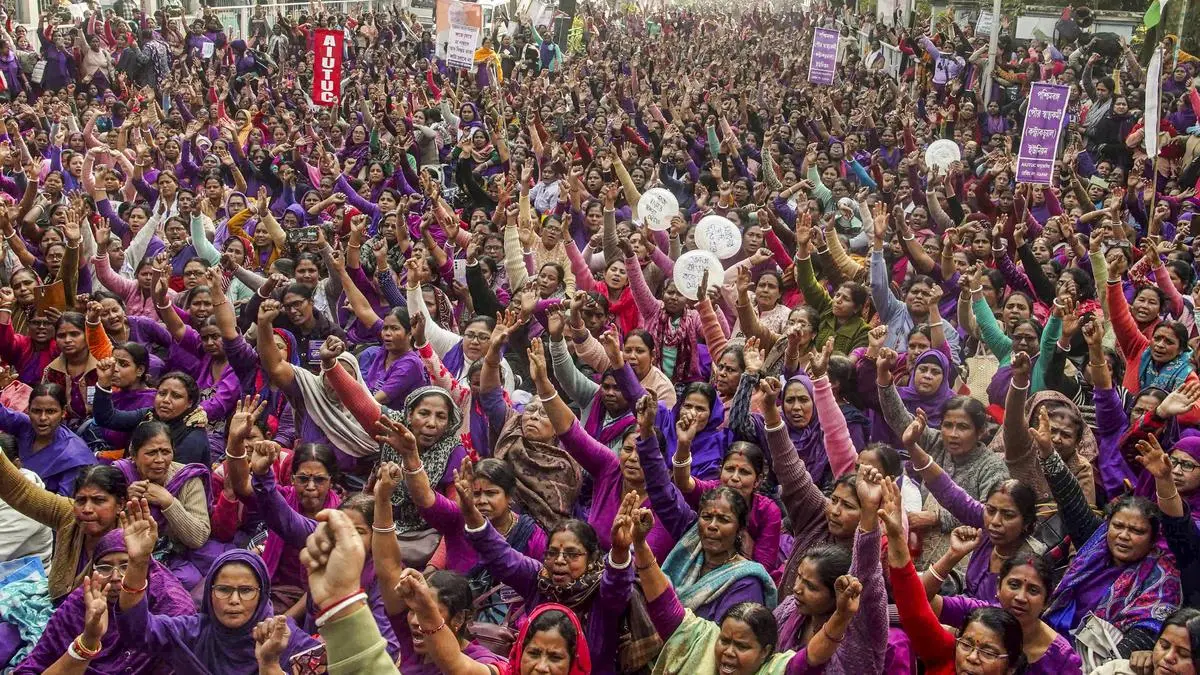
The role of ASHAs in arresting the MMR and the IMR was internationally acclaimed when they received the Global Health Leaders Award from the WHO in 2022. Yet ASHAs continue to strike and protest across the country for fair compensation. ASHAs in Telangana have been protesting since March 28, 2026, demanding regularisation and an increase in their honorarium. They have been striking every year since 2015, with workers across the State marching towards the Legislative Assembly in Hyderabad.
Lama was part of a similar strike in West Bengal in 2025–26, demanding an increase in honorarium from Rs. 5,250 to Rs. 15,000 and regularisation as permanent healthcare workers. When the government promised a hike of just Rs. 1,000 in the interim budget, ASHAs took to the streets again on February 6, 2026. The pay is worse in States like Uttar Pradesh.

A village healthcare nurse and an ASHA cross a river in an elephant corridor inside the Mudumalai Tiger Reserve, Tamil Nadu, on their way to tribal hamlets, in 2025. They have to walk for one hour to reach.
| Photo Credit:
SATHYAMOORTHY M
The Kerala ASHA Health Workers Association (KAHWA) led an unprecedented day-and-night-long strike over 266 days in 2025 asking for an increase in their compensation from Rs.7,000 to Rs.21,000 per month and other benefits. “We have played a critical role in helping Kerala cope with one medical disaster after another, be it the Nipah or the COVID-19 outbreak, but the government mostly disregarded the strike,” said Shalini, a KAHWA leader. At the end of the strike on October 31, 2025, the workers secured a Rs.1,000 increase in their monthly honorarium.
The ASHAs are indispensable not just in case of sudden outbreaks of disease but also for looking after the elderly and the infirm, especially in a State like Kerala, where the ageing population is on the rise. Many elderly women abandoned by their families would have been left completely adrift, without medical care, had it not been for ASHAs. Widowed women who live by themselves with no support from their children or relatives rely entirely on ASHAs, who help bring them under the purview of Arike, the State’s updated palliative and geriatric care programme.
Contractual appointments
Arike operates through three levels: primary, secondary, and tertiary, with the primary stage being the most important. Community healthcare (palliative care) nurses enter the picture at the primary stage. An Arogya Keralam factsheet pegged the number of those enrolled in the programme at 2,29,780 in 2021 while reiterating that “home based care is the cornerstone of palliative care programmes”.

ASHAs agitate outside the Kerala State secretariat on the completion of the 100th day of their protest by holding a symbolic march with 100 lighted torches. Thiruvananthapuram, May 20, 2025.
| Photo Credit:
NIRMAL HARINDRAN
Leading the system of home-based care is the community nurse, to whom the ASHA passes on her baton. These nurses have huge workloads, beginning with monthly home visits. The visits are planned in such a way as to ensure that every patient receives at least one thorough check-up and is then monitored for oral and perineal hygiene and the prevention of bed sores. Other tasks include giving bed baths (in case of the bedridden), catheterisation, taking care of wounds, inserting Ryle’s tube, and so on. Alongside this is the regulation of medicine intake, counselling to ensure compliance, and linking a patient to secondary care when needed.
The nurses also coordinate drug supplies, ensuring doorstep delivery for those who live by themselves or are from lower-income groups. They also have to instruct patients or ASHAs on the protocols for the disposal of biomedical waste. In addition, they provide psychosocial support not just to patients but also to family members. The documentation and paperwork involved in all this is another matter altogether. The nurses have to find time for that too.
Despite the workload, nurses hired under Arike on a contractual basis remain woefully underpaid. After multiple strikes over two decades, their salary was revised. Until 2022, government orders referred to their salaries as an honorarium. In 2022, the compensation for community nurses with nursing qualifications was revised and officially referred to as “salary”, with payments brought on par with those of their contractual counterparts. The salary was Rs. 24,520, as of June 2023. Permanent nursing staff in Kerala and Tamil Nadu are paid upwards of Rs. 40,000, excluding benefits.
“Have doctors in Tamil Nadu ever been hired on contract? Why are we scapegoated every time the government wants to cut costs or to pretend that it is cash-strapped? We are the ones who play a critical role in healthcare at each level, from the villages of Tamil Nadu to the cities,” said Valarmathi, general secretary of the Tamil Nadu Government Nurses Association. Since 2015, nurses have been hired contractually, with the promise of regularisation after 11 months, by the Tamil Nadu Medical Services Recruitment Board.
Repeated protests by nurses’ unions have called the government out for refusing to regularise workers and for wage discrepancies between contractual and permanent nurses, who both handle the same amount of work. Lack of finance is a stock excuse given by the authorities, which continue to appoint nurses on a contractual basis.
Public healthcare in Tamil Nadu is lauded for its rural outreach and sound infrastructure. “What went into building this is a strong vision to make healthcare accessible to all,” said Dr P. Saminathan, president, Service Doctors and Post Graduates Association.

ASHAs presented with umbrellas and food kits in Bengaluru during the COVID-19 lockdown in 2020.
| Photo Credit:
SOMASHEKARA GRN
The entry of individuals from under-represented communities into medicine through reservation has created a strong foundation for public service over the decades.
“We built our system using models like the National Health Service in the UK and the healthcare system set up by Fidel Castro in Cuba. Now we are tilting towards a US insurance model, which is going to destroy all that Tamil Nadu has achieved,” said Dr Saminathan. He also criticised the Chief Minister’s Comprehensive Health Insurance Scheme (CMCHIS), initially introduced as Kalaignar Kaappittu Thittam in 2009.
He said that this scheme has created disparities in a system that was otherwise functioning seamlessly by introducing a new player: insurance companies. “If government health systems are inefficient, checks and balances have to be introduced. What was needed was the allocation of resources for strengthening manpower and the filling up of vacancies across the State. This programme has only complicated access to healthcare,” said Dr Saminathan.
For instance, government hospitals are supposed to provide services for free in any case, but the new insurance scheme divides users into two groups: those with and those without an insurance card. Preference is given to cardholders, as this allows a facility to file claims against services availed. The requirement has disrupted emergency healthcare, forcing those in dire need to go to private facilities instead.
Dr Saminathan said that the shift in priorities can be understood as a systemic upheaval, from the medical surveillance- and care-based approach at the primary level that taps into the network of healthcare workers to a claims-based approach. This has restructured budgetary spending in a way that has resulted in front-line healthcare workers being sidelined and forced to accept contractual jobs. Government health budgets have also been shrinking when it comes to allocating resources for hiring healthcare workers. “The hiring of workers by government hospitals is no longer centralised. Each institution has to claim funds under the CMCHIS to pay a contracting agency, which will then hire the workers,” said Dr Saminathan.
Privatisation push
The Tamil Nadu government has introduced services such as dialysis under the public-private partnership (PPP) model, which hires its own staff on a contractual basis. Dr Saminathan felt that this would weaken the public health infrastructure, as has happened in other States where almost all diagnostic and testing services are offered by private agencies. But the government has been projecting the shift to PPP and the lapse of permanent jobs as a budgetary masterstroke that helps it cut costs.
In neighbouring Karnataka, fears of private corporations such as Narayana Health and Biocon influencing the government to lean more towards privatisation loom large. Devi Shetty, chairman of Narayana Health, is a part of many committees advocating PPPs. The conflict of interest, though glaring, seems to go unnoticed.


“Karnataka is the best example of the failure of PPP, starting from grave allegations of irregularities against the Karuna Trust in managing primary healthcare centres to the dismal performance of various district hospitals managed by private colleges. But private doctor lobbies are able to use their political clout to influence the government,” said Dr Sylvia Karpagam, a public health doctor and researcher. “Doctors who are taking to the streets against private practice being regulated have never done the same for the rights of patients. Doctors in India are detached from their sociopolitical realities, and the caste difference is stark in healthcare. After all, doctors are at the forefront of anti-reservation protests,” she added.
The importance of grassroots healthcare workers needs to be understood here. In rural India, where healthcare is still largely inaccessible, an ASHA represents the government. The class prejudices apparent in public healthcare institutions tend to keep people away. The ASHAs serve as the bridge between the government and the people. Being a part of village communities, they are best suited to persuade people to avail themselves of the services.

ASHAs during a home visit in Bengaluru in 2013.
| Photo Credit:
By special arrangement
Even though private and public players boast about the progress in healthcare, certain indicators tell a different story. Government schemes meant to help women often become a means of profiteering for unscrupulous doctors, who, for the sake of money, might perform procedures that permanently alter a woman’s life. A report titled “Instilling fear makes good business sense: unwarranted hysterectomies in Karnataka” by Teena Xavier, Akhila Vasan, and Vijayakumar S., published in Indian Journal of Medical Ethics in 2016, said: “In Bihar, an investigation into the alarming number of hysterectomies (5503 out of 14,851 procedures) under the Rashtriya Swasthya Bima Yojana (RSBY) between 2010 and 2012 in 16 empanelled hospitals found that hysterectomies constituted 37%–50% of all procedures in some hospitals. Similar stories emerged from Rajasthan, Chhattisgarh, Gujarat, and Andhra Pradesh.”
Dr Karpagam said, “Women from lower-income groups and marginalised communities are made to feel as if the system is doing them a favour by providing them with healthcare.” She asked, “We might have brought MMR and IMR under control, but what about the health of women, especially marginalised women, post-delivery?” she asked.
Critical interventions by ASHAs
Such gendered questions have been largely overlooked, but the ASHAs have been tackling them in their own way. G. Annapurana (52), from Eluru district in Andhra Pradesh, completed 20 years as an ASHA in 2026. “In my area, I make sure that a hysterectomy doesn’t happen without a woman being fully informed of what it entails,” she said. Annapurna, like Lama, has been instrumental in reducing the fear of public healthcare among people.
Annapurna regularly accompanies patients, especially reluctant pregnant women, to primary health centres or hospitals. “Everybody listens to me,” said Annapurna. ASHAs are required to work from Monday to Saturday, but even on Sundays, they are often expected to support other departments in activities like door-to-door tax collection. After all this work, Annapurna is paid the meagre sum of Rs. 10,000 a month. ASHAs in Andhra Pradesh have been demanding a hike in their salary to Rs. 26,000, accompanied by regularisation.
If we study the successful healthcare models in different States, one thing seems clear: increasing person-to-person interaction through community outreach services is the only way to ensure a better quality of life and achieve the target of universal healthcare. In the age of social media, when medical misinformation spreads rapidly, only front-line healthcare workers can apprise people of facts, helping them make the right choice. The need of the hour is to strengthen these workers on the ground by training them and compensating them for a job well done, which also creates a sense of ownership. Replacing these systems with those driven not by concerns of welfare but by considerations of profit will only make healthcare more inaccessible to the majority.
Greeshma Kuthar is an independent journalist and lawyer from Tamil Nadu.
Also Read | Pay to heal
Also Read | Patriarchy’s health wreck needs women in charge now


