





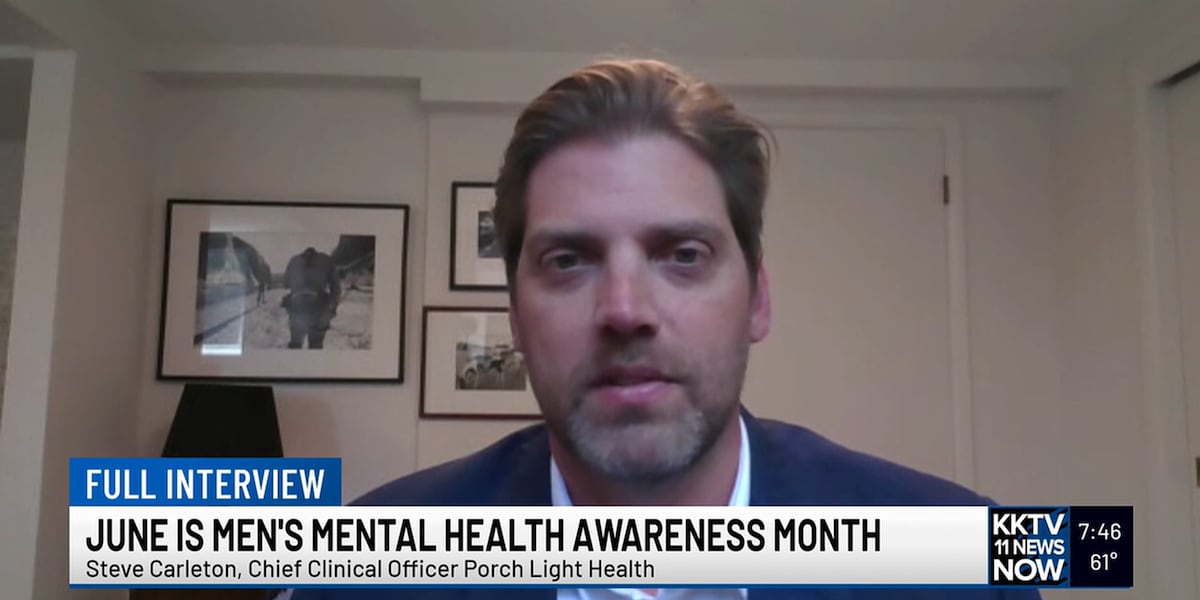
COLORADO SPRINGS, Colo. (KKTV) – June is Men’s Mental Health Awareness Month, and Digital Content Producer Aspen Andrews spoke with Porch Light Health Chief Clinical Officer Steve Carleton about the importance of looking out for loved ones and breaking the stigma when it comes to men’s mental health.
KKTV: Why is it important to talk about this topic?
Carleton: It’s a great topic. And thanks for bringing some attention to it. You know, I think the biggest reason this is an important topic with men’s mental health is because most men, depending on when you grew up, even still to this day, are taught to be self-reliant. They’re taught to be individualistic. They’re taught to take care of problems on their own. And while these messages aren’t bad on the surface, they do make it harder for men, especially, to reach out for help. And especially when they’re struggling mentally, right? If they’re dealing with depression, anxiety, or are overwhelmed, just culturally, it’s harder for men to reach out because of some of these messages that we often perpetuate.
KKTV: Suicide is a big issue. NAMI reports that men are four times more likely to take their lives than women. What are some signs someone might be considering suicide?
Carleton: That’s right. And it’s a really sad statistic, but men are four times more likely to die by suicide. And that’s why this is such an important topic and one to share with people. And some of the signs, you know, they can vary a lot. And I think, first off, it doesn’t always show up in a uniform way. It doesn’t always show up the same way when people die by suicide. There might be no signs at all. And so it’s important to put that out there just in case people have experienced that and really felt like it came out of nowhere. For others, we do look at signs like isolation. People just being suddenly cut off from other people can be a sign that people are heading down a depressed path. We also know that people use substances much more often when they’re depressed, and they’re headed down sort of that path to suicide. So that’s something to look out for. Just in general, if you’re noticing significant behavior changes in a man or a man that is in your life, it’s always a good sign to… It’s always a good time to ask, right? And to just take note and say, ‘hey, I’ve noticed you seem more down. You seem more depressed. Do you want to talk?’ Those are some things to look out for.
KKTV: If you see these signs, how do you talk to someone? What should you say?
Carleton: You know, what you want to do most often is validate. Like, ‘I’m so glad you brought this up. I’m really happy that you felt safe and comfortable talking to me about it.’ Validating just the act of somebody reaching out and saying they’re struggling, like saying ‘I’m not doing well,’ is the most important piece. What you want to avoid, and it’s really common in conversations, is ‘you have so much to be grateful for,’ or ‘why would you want to do that?’ What you don’t want to do is invalidate people and, you know, talk to them in a way that makes them feel not seen, makes them feel like what they’re going through is abnormal, right? So, really just encouraging people to talk. The number one thing we can do to prevent suicide is get people to say, ‘I’m thinking about suicide.’ If you are worried about someone who’s really depressed in your life, it’s important just to ask the question as directly as possible. ‘Are you thinking about killing yourself?’ ‘Are you thinking about suicide?’ The more you can be direct in that question, the more likely you are that somebody is going to be honest with you, and open up and share that. In which case, you know, you can potentially save somebody’s life.
KKTV: Why do alcohol and drugs often creep in when someone is having mental health issues?
Carleton: Drugs and alcohol, I mean, they’re the most common way that people medicate themselves. It’s the most common way people regulate emotions. If you’re depressed, sort of just, it’s normal that in social circles, families and communities, drinking becomes that outlet for people to find relief. And so that it’s just so normalized in our culture. And that’s why it’s so common. And it’s a great short-term solution. For most people, when they use a substance, at least in the immediate, they feel better, right? They don’t feel as depressed or anxious. And it’s only long-term, as people do that more and more often, that those other consequences show up, like increased tolerance, withdrawals, consequences in their social and occupational life.
KKTV: Stigma is a big issue when we talk about men’s mental health. How do we break that?
Carleton: Exactly, right? Stigma is the biggest, the biggest sort of thing here. And I think acknowledging that the vast majority of Americans will have a mental health struggle at some point in their lifetime. This is not uncommon. You know, many more than half will have diagnosable depression or anxiety at some point in their life. And if we can all sort of acknowledge that and understand that and appreciate that, then we can make it more safe for people to talk about it. And for people to relate and share their own experiences dealing with depression and anxiety. You know, the key here is really understanding that your mental and emotional health is a part of your health, similar to any other physical condition. And so if we can just normalize that and have people sort of talk about how they’re doing mentally in a more normalized way, that will really move the needle.
KKTV: Where can people find more help?
Carleton: PorchLightHealth.com is a great place to start if you’re struggling with a substance use disorder. We’re right in your backyard in Colorado Springs and some other surrounding satellite clinics. I think NAMI has a great website. You can find some good resources there.
And then obviously, if people are having an emotional crisis or they are thinking about suicide, Colorado and nationally, we have the 988 suicide hotline. So that’s a space that people can call and have somebody to talk to without sort of concern that somebody is going to send a police officer or emergency services over to their house. 988 is a great safe haven for people who are struggling and don’t have another outlet to talk to somebody.
Copyright 2026 KKTV. All rights reserved.


