

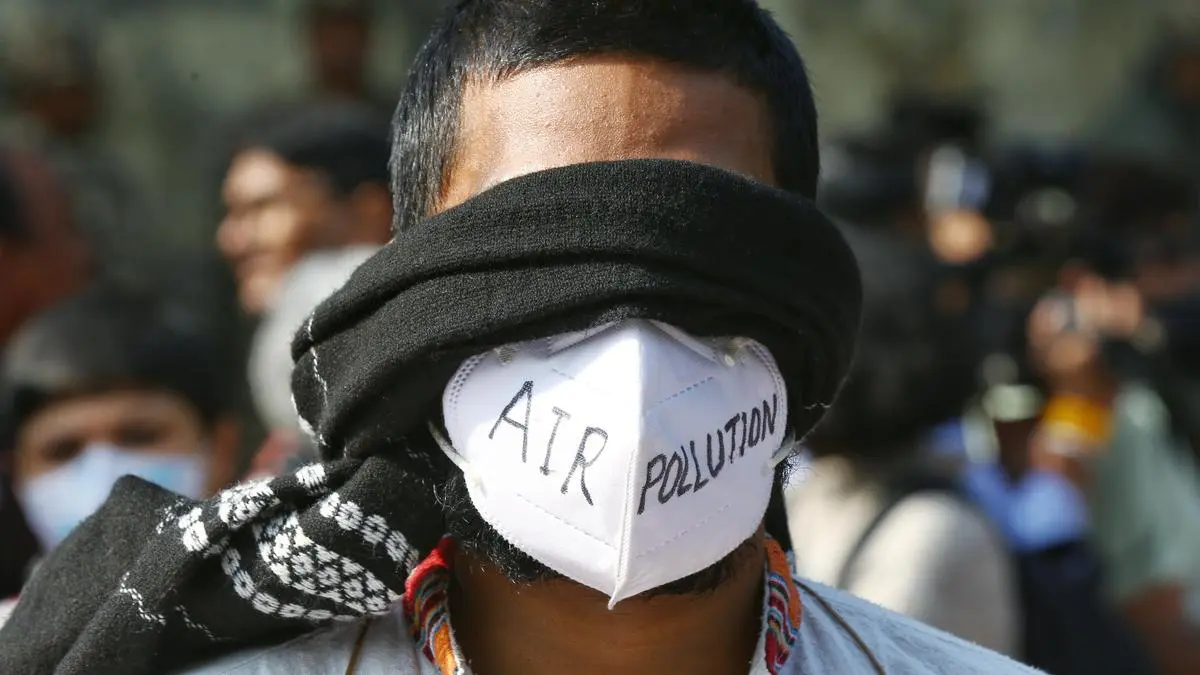
Delhi’s residents have grown familiar with the thick blanket of smog the city wears every winter. What now appears as a seasonal crisis increasingly points to structural failure. On December 14, the city’s average air quality index (AQI) climbed to 461, marking its most polluted day this winter and the second-worst December air quality day on record.
The majority of Delhi’s Continuous Ambient Air Quality Monitoring Stations (CAAQMS) reported “severe” pollution levels, according to data from the Central Pollution Control Board (CPCB). Wazirpur and Rohini recorded the maximum possible AQI of 500, while Ashok Vihar, Jahangirpuri, and Mundka logged 499. A day later, on December 15, visibility plummeted to near zero as dense fog combined with hazardous pollution levels, creating toxic smog that disrupted daily life across the National Capital Region (NCR). That day, Delhi’s 40 monitoring stations recorded “severe” air quality at 38 stations and “very poor” levels at two, with Jahangirpuri recording an AQI of 498.
More than 400 flights were delayed and at least 60 cancelled, rail services were affected, and road accidents linked to zero visibility left at least four people dead and over 35 injured across NCR. While air quality marginally improved over the following days, it remained in the “severe” to “very poor” category, leaving residents—especially children, the elderly, and those with existing health conditions—struggling to breathe.
Also Read | Slow poison nation
Doctors and environmentalists have described the situation as a public health emergency. Countries such as Singapore, the United Kingdom, and Canada issued advisories for their citizens travelling to the capital city, yet the crisis went unaddressed in the ongoing Parliament session. Instead of urgency and long-term planning, Delhi’s air pollution crisis continues to be reduced to a political slugfest marked by denial, blame-shifting, and reactive measures.
A growing health burden
The health consequences of Delhi’s air pollution are no longer anecdotal. An analysis of Global Burden of Disease (GBD) 2023 data found that air pollution is the single largest health risk in Delhi, accounting for nearly 15 per cent of all deaths in the city. This means that roughly one in every seven deaths in Delhi was linked to long-term exposure to fine particulate matter (PM2.5). The analysis, conducted by researchers at the Centre for Research on Energy and Clean Air (CREA), also showed that deaths attributable to air pollution in the capital have risen steadily—from 15,786 in 2018 to 17,188 in 2023.
Official data underlines the scale of the crisis. In a written reply to the Rajya Sabha on December 2, Minister of State for Health and Family Welfare Prataprao Jadhav revealed that hospitals in the national capital treated over 2,00,000 patients for acute respiratory illnesses between 2022 and 2024. Emergency department visits for acute respiratory illnesses across six major Delhi hospitals stood at 67,054 in 2022, rose to 69,293 in 2023, and remained high at 68,411 in 2024. Hospital admissions for respiratory illnesses increased from 9,878 in 2022 to 10,819 in 2024.
These figures align with findings from the Indian Council of Medical Research, which has noted a direct association between rising pollution levels and increased emergency room visits. A 2024 study published in The Lancet Planetary Health estimated that, on average, 7.2 per cent of daily deaths in 10 of India’s most polluted cities—including Delhi, Mumbai, and Bengaluru—were attributable to PM2.5 levels exceeding World Health Organisation guidelines. Delhi had the largest fraction of daily and yearly deaths attributable to PM2.5 air pollution, with approximately 12,000 annual deaths linked to such exposure.
The Indian Council of Medical Research has noted a direct association between rising pollution levels and increased emergency room visits. Here, the AIIMS hospital covered in smog as the AQI hit “severe” category, in New Delhi on November 17, 2025.
| Photo Credit:
ANI
Doctors across specialisations have sounded the alarm. Pulmonologists and cardiologists report a clear surge in pollution-linked symptoms—from persistent cough, throat irritation, and breathlessness among otherwise healthy young people, to acute emergencies among those with pre-existing heart and lung disease. Speaking to a news agency, Dr G.C. Khilnani, chairman of the PSRI Institute of Pulmonary, Critical Care and Sleep Medicine, said he was seeing unusually high airway inflammation even in patients with no prior respiratory illness. Pollution-related cough and breathlessness, he said, do not respond to antibiotics.
Cardiologist Amit Mittal flagged a sharp rise in cardiac stress during periods of poor air quality, including higher blood pressure, disrupted sugar levels, and an increased risk of heart attacks. At AIIMS, Dr Anant Mohan, head of pulmonary medicine and sleep disorders, described Delhi’s pollution levels as life-threatening, pointing to increased outpatient visits, emergency admissions, and even ventilator use. Doctors have cautioned that children, the elderly, and those with asthma or heart disease are the most vulnerable, urging authorities to treat the situation as a public health emergency rather than a seasonal inconvenience.
Despite this body of evidence, the Central government has continued to downplay direct links between air pollution and mortality. In February 2025, Minister of State for Environment Kirti Vardhan Singh told the Lok Sabha that there was “no conclusive data” establishing deaths exclusively caused by air pollution, describing it as just one of many contributing factors to respiratory diseases.
Sources of pollution remain unchanged
Experts argue that the sources of Delhi’s pollution are neither new nor poorly understood. According to air quality researcher Dr Sarath Guttikunda, founder and director of UrbanEmissions.info, Delhi’s pollution profile has remained remarkably consistent over time.
“The sources haven’t changed—only their intensity,” Guttikunda told Frontline, drawing on three decades of source-apportionment studies dating back to 1990. Across multiple studies, five sectors repeatedly emerge as the dominant contributors to PM2.5 pollution: vehicle exhaust, industrial emissions, household cooking and heating, road dust, and open waste burning. Of these, vehicle emissions, industry, and household fuel use account for the largest share, while road dust and waste burning contribute comparatively less.
This long-term consistency, he argued, undercuts claims that pollution spikes are sudden, unpredictable events. “We have known what pollutes Delhi’s air for decades,” Guttikunda said, adding that the persistence of the problem reflects governance failures rather than scientific uncertainty.
Meteorological and geographical conditions further worsen pollution during winter. Weak winds, low temperatures, and the city’s basin-like topography trap pollutants close to the ground, particularly in colder months. The absence of rain and frequent fog episodes exacerbate the situation, as seen this December when the India Meteorological Department issued multiple dense fog alerts.
Data from Punjab and Haryana showed a 77 per cent drop in stubble-burning incidents this October, largely due to floods. Yet Delhi’s air quality saw little improvement—underscoring that farm fires alone cannot explain the city’s toxic air.
GRAP: Emergency response, not a solution
As pollution levels worsened across Delhi-NCR this winter, authorities invoked Stage IV of the Graded Response Action Plan (GRAP), bringing the strictest set of emergency restrictions into force. The measures came into effect in mid-December as the AQI remained in the “very poor” range, around 358.
Stage IV of GRAP includes all curbs prescribed under Stages I, II, and III, and is meant to be triggered during “severe” or “severe plus” pollution episodes. Under these restrictions, the entry of vehicles carrying construction material is prohibited, all construction and demolition activities are to be halted, government and private establishments are required to operate with only 50 per cent staff working from offices, and schools in Delhi are directed to shift to hybrid classes not only for primary students, but also for higher grades. Mandatory pollution-under-control (PUC) certification for vehicles was also enforced.
A petrol pump checks the pollution certificates of bikes before providing customers with petrol, in Delhi on December 19, 2025. Vehicle emissions, industry, and household fuel use account for the largest share on PM2.5 pollution.
| Photo Credit:
Sushil Kumar Verma
Introduced in 2017, GRAP lies at the centre of the government’s response to pollution spikes in Delhi-NCR. It functions through four escalating stages of actions—ranging from restrictions on construction activity and diesel generators to bans on certain vehicle categories—each linked to predefined air quality thresholds and implemented by the Commission for Air Quality Management (CAQM).
Subject experts argue, however, that while GRAP is presented as decisive action, its implementation remains delayed, inconsistent, and largely reactive.
Environmentalist Bhavreen Kandhari said there has been no meaningful change in how GRAP has been handled this year, despite it being the first winter under a BJP-led Delhi government. “There is nothing fundamentally different,” she said. “The core problem remains the same—GRAP is not activated at the right stages.”
What has changed, Kandhari noted, is the attempt to cast doubt on air quality data itself. She said that during a meeting at the Delhi Secretariat earlier this week, officials insisted that Central Pollution Control Board (CPCB) data showing severe pollution levels was “absolutely false”. From her perspective, Stage IV restrictions should have been imposed much earlier.
“GRAP is invoked only because the underlying pollution drivers remain unaddressed,” she said, describing the process as a vicious cycle. Instead of acknowledging systemic failure, she argued, authorities appear to delay or dilute action.
Guttikunda similarly described GRAP as inherently reactive and scientifically limited. “GRAP is triggered only after certain AQI trends persist for 48 hours,” he said, calling the timing “somewhat arbitrary.” Expecting sharp improvements by temporarily banning select activities, he argued, ignores the structural nature of Delhi’s problem.
“It’s overly ambitious to think pollution levels will meaningfully change when the root of the issue is the energy demand of more than 20 million people and around 10 million vehicles,” Guttikunda said. These demands—for transport, cooking, heating, and industry—operate year-round, not just during pollution emergencies.
Kandhari echoed this view, pointing out that even during GRAP IV—when all construction is meant to halt—work continued at Central Vista sites. “When that happens, GRAP becomes meaningless,” she said.
What is missing, Kandhari argued, is sustained long-term planning: cleaner transport systems, strict dust control at construction sites, and enforcement of existing laws. Without coordinated regional policies, she warned, reactive fixes would continue to fail.
She also expressed concern over what she described as widespread disinformation around pollution this year—ranging from monitors being shut down, to repeated claims that spraying water can resolve the crisis.
This denial, she believes, has backfired. “People have stopped trusting the authorities,” she said. “When you misrepresent the crisis, people stop trusting all information,” she added, calling it especially dangerous given the public health stakes.

Delhi’s residents have grown familiar with the thick blanket of smog the city wears every winter. Here, people perform yoga amidst early morning smog in a park, in New Delhi on November 18, 2025.
| Photo Credit:
Manish Swarup/AP
According to Kandhari, a false narrative was set early on, leading to widespread complacency. Mask usage has dropped, she said, and even institutions such as the higher judiciary continued activities like marathons during peak pollution periods. “If the government truly cared, it would issue continuous advisories—on phones, on radio, everywhere—just like during COVID,” she said. “We keep calling this a public health emergency, but it is not being treated like one.”
While Delhi’s dense air-quality monitoring network is often cited as evidence of improved governance, Guttikunda said the real constraint is not data but action. “Increasing the number of monitors does not solve the problem,” he said. “Real progress comes only when you act on what the data already tells you.”
“There is no ambiguity about the severity of the crisis or its sources,” he added. “The bottleneck is the absence of institutional commitment.” Delays in acting on this information, he warned, carry steep public health costs and make future interventions even harder.
Guttikunda also stressed that Delhi’s air pollution cannot be solved within city limits alone. “This has always been a regional problem,” he said, noting that a significant share of the pollution affecting Delhi originates outside its administrative boundaries. “Policy responsibility has to be regional,” he said, adding that fragmented governance remains a major obstacle. Cities that have successfully cleaned their air, he noted, did so through decades of sustained investment—particularly in public transport, walking and cycling infrastructure, and progressively stricter industrial standards. “These changes don’t happen overnight,” Guttikunda said. “They require persistence, not emergency measures or unrealistic expectations.”
Supreme Court calls response a ‘total failure’
On December 15, a Supreme Court bench comprising Chief Justice Sanjiv Khanna and Justices Joymala Bagchi and Vipul M. Pancholi took note of submissions by senior advocate Aparajita Singh, acting as amicus curiae, in a plea concerning the worsening air pollution levels in Delhi-NCR. While preventive measures formally exist, the amicus pointed out that the core problem lies in poor implementation by authorities. The matter was listed for further hearing on December 17.
The bench reiterated that air pollution petitions cannot be treated as routine or seasonal matters confined to winter months, stressing the need for year-round attention. On December 17, the court observed that the measures implemented by authorities had been a “total failure” in curbing escalating pollution levels. Any meaningful reduction, the bench said, would require broader and long-term planning rather than ad hoc responses.
The court directed the CAQM to revisit and strengthen its long-term action plan. It also withdrew protection for end-of-life vehicles in the region, particularly older and higher-emission vehicles. The judges underlined that emergency measures—such as traffic restrictions, school closures, and temporary construction bans—may buy time but do not reduce pollution in the long run. Instead, the court called for systemic interventions focused on prevention, including improved urban planning, cleaner fuels, stronger public transport systems, and robust enforcement of existing laws. It also asked authorities to examine pragmatic steps to cut emissions at Delhi’s entry points, including the temporary closure or relocation of toll plazas to ease congestion and reduce vehicular pollution.
Continuous political blame game
As air quality in Delhi worsened, residents took to the streets demanding accountability and systemic action. Political responses, however, remained mired in deflection and finger-pointing.
Also Read | Inside Delhi’s pollution protest
The controversy deepened after Chief Minister Rekha Gupta appeared to describe AQI as “a kind of temperature” measurable by “any instrument”, drawing sharp criticism from opposition leaders. The Aam Aadmi Party accused the BJP government of downplaying the severity of the crisis and masking pollution levels through cosmetic measures such as water sprinkling near monitoring stations.
The BJP, in turn, blamed the previous AAP government for Delhi’s pollution, arguing that years of inaction on waste management, road dust, and urban infrastructure had left the capital vulnerable. As parties traded charges, residents continued to breathe hazardous air, underscoring the widening gap between political rhetoric and public health urgency.
