





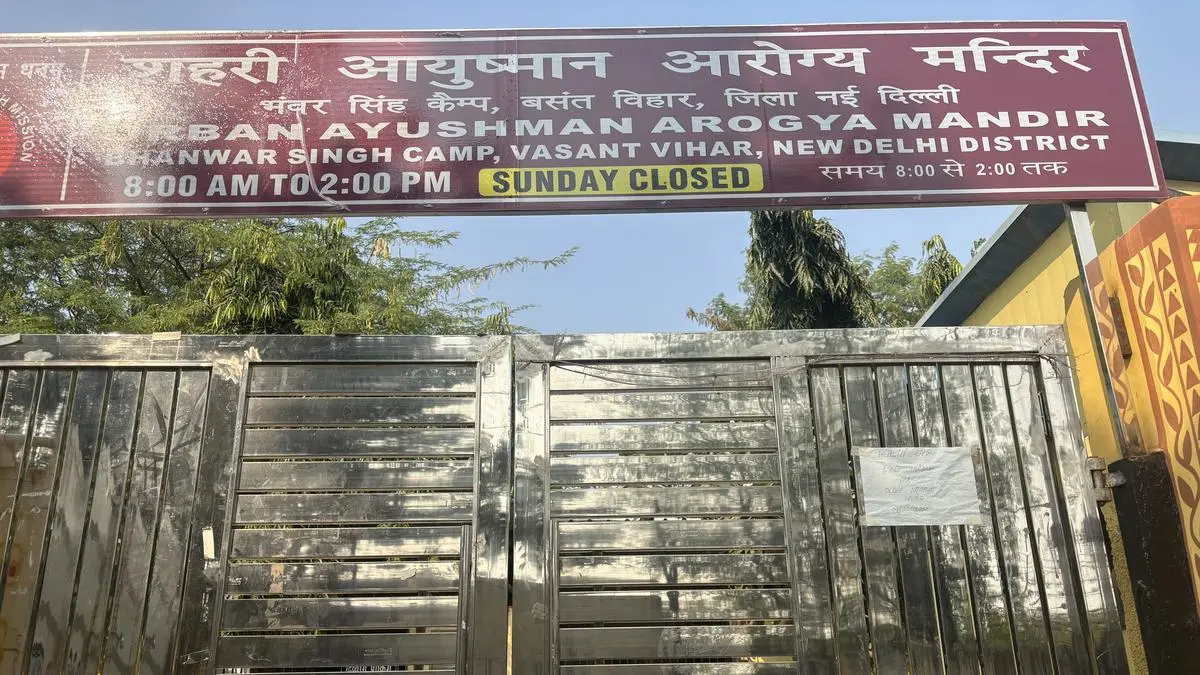
“Earlier, this clinic served as the answer to all our problems. Now we would rather travel 2 kilometres to a private clinic and spend our own money than seek treatment here,” said Manisha Kumari, a resident of Bhanwar Singh Camp in South Delhi’s Vasant Kunj. She was expressing her disappointment with the Ayushman Arogya Mandir in her colony, which was earlier a Mohalla Clinic.
The Mohalla Clinic scheme was the Aam Aadmi Party government’s flagship healthcare initiative for delivering free primary care to the national capital’s urban poor. The Ayushman Arogya Mandir (formerly known as Health and Wellness Centre) also aims to provide free primary healthcare to the country’s working class and is part of the BJP government’s Ayushman Bharat Scheme.
The Ayushman Arogya Mandir promises several features that set it apart from the Mohalla Clinic. It offers in-house diagnostic facilities, with 14 types of medical tests available at the clinic itself. It also boasts an outsourced testing option, allowing patients to access 79 additional diagnostic tests through the centre. Yet, on the ground, these assurances collapse well short of reality.
A spot check by Frontline found the Ayushman Arogya Mandir at Bhanwar Singh Camp—one of the first to be inaugurated by the BJP—shut well before its scheduled closing time. “I had an accident recently, and they told me to get it treated elsewhere. The doctors who were here earlier [when it was a Mohalla Clinic] were far better. They actually treated us well and cared about us. Now it’s just from one window to another,” lamented Anuj, another resident of Bhanwar Singh Camp.
Also Read | Ayushman Bharat PMJAY: A health scheme that needs healing
While the scheme promises 13 staff members, including a doctor, at each centre, residents insist they have never seen more than 3. “Forget getting tests, we don’t even receive medicines here. Earlier, the Mohalla Clinic supplied free medicines, but now we get nothing. All they do is scroll on their phones all day. I was once 10 minutes late for an appointment, and they told me to come back the next day. It was eight in the morning, and I am a working-class man. I have a family to feed. I cannot afford to take leave like this,” said Anil Singh Chauhan, who works at the Delhi High Court and is a resident of the camp.
Cosmetic changes
The Mohalla Clinics were launched in 2015 by the AAP government. A decade later, the new BJP government endeavours to replace them with its own Arogya Mandirs. While many expected these centres to be better equipped, testimonies from the ground reveal that little has changed beyond the fresh paint and the new symbols.
The BJP now finds itself in the midst of another political row. The Directorate General of Health Services has started closing down Mohalla Clinics (with a notice period of 14 days), and the capital is set to lose over 200 of them. The move stems from the government’s decision to decommission centres operating out of portable cabins, leaving hundreds of healthcare workers apprehensive about their future.
Jitendra Kumar, president of the Mohalla Clinic Union (a union of the staff of what used to be Mohalla Clinics), told Frontline that nearly 200 clinics across the capital had been issued termination notices. “There are four people employed in every clinic, meaning around 800 people will lose their jobs. We submitted a petition before the Central Administrative Tribunal, which has granted us a stay until December 4,” he said. While the stay on the abrupt termination process means that the staff are still employed, they do not go to work because the clinics are closed.

Arvind Kejriwal during the inauguration of a Mohalla Clinic in Delhi’s Keshopur Sabzi Mandi in 2023. The present government has decided to decommission clinics operating out of portable cabins, rendering hundreds of healthcare workers apprehensive about their future.
| Photo Credit:
Shiv Kumar Pushpakar
According to Jitendra Kumar, Chief Minister Rekha Gupta had said at a Janta Darbar that Mohalla Clinic employees would be absorbed in the Arogya Mandirs. “Now, why is she going back on her word? They have issued termination letters to the employees. Some are told just over the phone that they don’t need to come to the clinic any more,” he said.
At a press conference, the AAP’s Delhi president Saurabh Bharadwaj said: “First, the BJP government terminated 31 Mohalla Clinics in August, and now it has resolved to close 170 more. All of this has been executed covertly, in keeping with the BJP’s old habit of operating behind closed doors. On an average, each clinic attends to between 100 and 200 patients a day, meaning roughly 20,000 patients will now be impacted daily. These patients will no longer access the free consultations, medicines, and diagnostic tests that were extended under the Arvind Kejriwal government. Calculated monthly, nearly six lakh people will now be deprived of essential healthcare services near their homes.”
“The Mohalla Clinic scheme was the Aam Aadmi Party government’s flagship healthcare initiative for delivering free primary care to the national capital’s urban poor.”
Recalling former Chief Minister Arvind Kejriwal’s warning to Delhi residents, he said: “When the BJP was contesting the Delhi elections, Arvind Kejriwal had repeatedly cautioned Delhiites that if they assumed power, they would gradually dismantle Mohalla Clinics and other welfare facilities. At that time, the BJP dismissed these allegations.”
AAP MLA Kuldeep Kumar echoed the sentiment. “There were five Mohalla Clinics in my own area. How many Arogya Mandirs has the BJP opened? Not a single Arogya Mandir has been established. Secondly, why did you shut the facilities that were already functioning? If you want to start a new centre, you can proceed with it. Who has prevented you from doing so? If the public receives the benefit of two doctors instead of one, then what is objectionable about that? It is not as though hospitals in Delhi are lying vacant. If you examine the current load in each hospital, you will find that OPDs [outpatient departments] are 99 per cent full,” he told Frontline.
“In Delhi, when our government assumed office, there was no concept of Mohalla Clinics. We did not close any existing facilities. There must have been some services in place earlier, there must have been something, but we did not shut anything in Delhi. Common people are suffering. “Common people are anxious. In many parts of Delhi, large numbers of migrants reside; everyone is a low-income worker. For such a person, where there were once two Mohalla Clinics in the neighbourhood, today there is not a single one. So, people will be forced to return to quacks,” he added.
There were around 545 Mohalla Clinics in Delhi during the AAP regime, and 300 dispensaries. The Mohalla Clinic Union alleges that the government intends to shut all Mohalla Clinics, replace a few with Arogya Mandirs, and retain only the dispensaries.
Jitendra Kumar said: “Seventeen Arogya Mandirs have been inaugurated, but they are converted facilities. They were earlier Mohalla Clinics, yet the government refuses to acknowledge this. The shift is being concealed from the public domain. Even the staff is not the same: the earlier workforce has been removed. Nothing else has changed. There are no additional staff or workers, despite the promises. They advertised 110 vacancies for doctors but imposed an age limit, capped at 55.” He explained that these vacancies are filled only through interviews
“When we were recruited, we had to give an exam. All the staff in the Mohalla Clinics—the medical staff, the paramedical staff—sat for examinations conducted by IP [Guru Gobind Singh Indraprastha] University. There was a merit list, and we secured our jobs on that basis. Now they are removing all of us and handing positions to people through an interview-based system. And we all understand what transpires in such interviews: those with connections will acquire the jobs,” he said. The union alleges that the government has also accused it of corruption and claims it to be in league with the AAP.

During a routine working day at a Mohalla Clinic, then newly opened, in Delhi’s Pusa area, in January 2024.
| Photo Credit:
Shiv Kumar Pushpakar
Jitendra Kumar said the government was deliberately politicising the issue. “You can visit any Arogya Mandir; it will either be closed or provide only the bare minimum. One sees the Arogya Mandir on television, but in reality, there is nothing there. There is only so much one can deliver in primary healthcare, and the Mohalla Clinics have been doing that for years.”
The Mohalla Clinic employees are all contractual workers, hired on annual terms. Contracts issued after February 2025 have an additional clause that states: “Whenever new manpower is recruited, the contractee is liable to be removed.”
Jitendra Kumar said: “We have been working for more than six years. How does a government justify that? It has been almost 10 years since the scheme began. We had always received our salaries on time—until they sent Kejriwal to jail and transferred the powers to the Lieutenant Governor. After that, our salaries started getting delayed, at times by three months. Many people left their jobs because of this. These are extremely sinister tactics to force us out.” He added that even medicine supply was halted under the Lieutenant Governor’s watch
Experts warn that closing Mohalla Clinics in peak pollution season, without establishing adequate alternatives, will have grave consequences for the capital’s already fragile healthcare system, ultimately impacting the working class.
Dr Chandrakant Lahariya, who was closely associated with the conceptualisation and development of the Mohalla Clinics, underscored the importance of accessible primary healthcare units in working-class neighbourhoods. “The Mohalla Clinic as an idea was different, and it remains different from other facilities because, by its very design, it brings healthcare closer to the communities that require it. Unlike most health facilities, where people must travel long distances to access services, the Mohalla Clinic embodies the principle that healthcare should be located where people actually live. Theoretically, this should be true for every health facility, but it has never been so explicitly articulated in India’s public health planning.”
The Basti Dawakhana is a similar initiative in Telangana, which has expanded fairly effectively. Both these models affirm that health services must be embedded within communities, especially for underserved populations.
Dr. Lahariya further remarked that while renaming schemes is not novel, in India such changes often inflict more harm than good. “Most of the time, governments end up overhauling the entire system and, in the process, straying from their commitment to the public. Here, the government has not clarified whether all the Mohalla Clinics they plan to close will eventually be converted into Ayushman Arogya Mandirs—we simply do not know. The second issue is that these facilities were designed and selected after careful consideration. If you shift them elsewhere or deliver services in a different manner, it is not going to work. The commitment embedded in the earlier model does not manifest in these new facilities.”
He explained that the Mohalla Clinic model transformed primary healthcare into a politically propelled priority, embedding it firmly within the electoral imagination and governance agenda. When the Mohalla Clinics gained traction—and inevitably political currency—nearly 15 States began planning their own iterations of community-based clinics.
In that sense, the model elevated the very idea of primary healthcare to a new threshold. “For the first time,” said Dr. Lahariya, “the political class, the elected leadership, started to contemplate primary healthcare as a deliverable. This resulted in a range of State-specific variants, such as Madhya Pradesh’s and Rajasthan’s Apna Clinics, Hyderabad’s Basti Dawakhana, and many others. The model acquired political visibility, and it pushed primary healthcare higher on the political agenda.”

Mohalla Clinic doctors protesting against delayed salaries at a rally in New Delhi in October 2024.
| Photo Credit:
Shashi Shekhar Kashyap
He added that while this was not a strictly causal relationship, the rise of Mohalla Clinics coincided with global conversations on primary healthcare. India, at the time, was also drafting a new National Health Policy. He asserted that the Mohalla Clinics contributed to the heightened attention around primary healthcare—an emphasis that ultimately reflected in the National Health Policy. With its focus on primary-level services, the policy eventually informed the design of the Ayushman Bharat programme.
Health, always a neglected area
As experts have noted, in India, health has never truly occupied the status of a political priority. Paradoxically, however, political leaders and elected governments are keen to extract mileage from the health sector; they speak about health and showcase it but are mostly content with very little reforms. Because health is low on the political hierarchy, the doctor argues, politicians rarely invest in meaningful change and instead resort to small adjustments within existing services.
There is another aspect that is important: funding. Although health is a State subject, the Union government finances a significant share of State-level health programmes through mechanisms such as the National Health Mission. The Mohalla Clinics, however, were an exception: it was an initiative that was conceived, funded, and led entirely by the State government.
The previous Delhi government chose not to subscribe to the Ayushman Bharat scheme, which meant it did not receive Central funding. As Dr. Lahariya said, if that funding had been in place, there would have been pressure to engage in the usual cycle of tweaking, rebranding, and alignment with central norms.
“I have no objection: take 500 Mohalla Clinics and rename them however you wish. But then establish another 500. Identify the actual health needs. Do not merely concentrate on renaming, rebranding, or repurposing existing facilities. This moment could have been used as an opportunity to expand the system. That crucial link is missing,” he said.
The current moment could be an opportunity for the new government to broaden the scope of primary healthcare in Delhi. But that would call for a stronger and more functional collaboration between the State government and municipal corporations, and this is particularly important given the long-standing tensions between the two.
“Set up more facilities, whatever you choose to call them,” said Dr. Lahariya. “But place them closer to the communities that need them, expand the range of services, and honestly confront the shortcomings and bottlenecks that were identified in the Mohalla Clinics. A change of name or a fresh coat of paint is not the point. What matters is accessibility, continuity, and the assurance that the promised services remain available and free of cost.”
Also Read | Health for sale?
According to the policy analyst Tehmeena Rizvi, political parties routinely undervalue both the gravity and the inherent fragility of India’s healthcare system before intervening in it.
“Ultimately, it is the public that bears the cost,” she said. “When you dismantle an existing system and begin establishing new Arogya Mandirs, the entire primary healthcare structure is effectively frozen. Even if the transition takes just three or four months, illness does not wait. Where are people meant to go in that interim? In reality, they are pushed towards secondary or tertiary care, where costs are far higher and often beyond what working-class families can afford.”
Rizvi, however, noted one positive shift under the Arogya Mandir model: in the longer run, these centres would be integrated with the Ayushman Bharat scheme.
“That linkage is, in principle, a good thing,” she explained. “Earlier, Mohalla Clinics were not tied to any national programme; they functioned solely under the Delhi government and were funded entirely by it. Associating Arogya Mandirs with Ayushman Bharat could, at least structurally, bring them into a wider health-financing framework.”
Queries sent by Frontline to the Ministry of Health and Family Welfare regarding the issue did not elicit a response.


