

In the last conversation that Ananya Vajpeyi, the academic, had with her father, the Hindi poet Kailash Vajpeyi, before he died, he counselled her to “go within”. She was pacing a small garden attached to the university guest house in Santiniketan, daunted by the prospect of lecturing on Rabindranath Tagore and his nephew Abanindranath Tagore at the very institution they had founded a century earlier. She was especially nervous about how the arts and literature departments would respond. “Weave the interior thread,” her father said to her over the phone to soothe her. “Follow it to wherever it takes you.”
We do not know if she took his advice that day, but this is precisely what Vajpeyi, the essayist, has done now in Place: Intimate Encounters with Cities. In every essay, she stands before us in a way that academics rarely allow themselves to. She weaves the interior thread of her life and follows it to wherever it takes her. Place then becomes a map as much of her internal landscape as of the geography of the cities and countries she treads and traverses.
This is a book that defies categorisation. It sits at the confluence of memoir and travelogue, spinning history and philosophy into the large canvas of politics. Vajpeyi does not set out to write an ethnographic book, but you come away with an understanding of the people who make up the places she writes about. Undergirding her writerly curiosities are her scholarly impulses with which she probes the systemic problems of caste and class, organised religion and authoritarianism.

Place sits at the confluence of memoir and travelogue, spinning history and philosophy into the large canvas of politics.
Vajpeyi’s essays span more than two decades—some of them written long ago, others written exclusively for this book. Her travels take us to a dozen cities, including New York, Delhi, Venice, Pune, Bengaluru, and Banaras. They take us equally into the tears and fears that accompany her en route, the break-ups and the make-ups, the loves and the losses.
Vajpeyi walks and walks, and we walk with her, watching her paint cities in all their fullness. We see the Bosphorus split Türkiye into Europe and Asia. The twin rivers of Mutha and Mula give us, too, reasons to love Pune. We see Istanbul through Orhan Pamuk’s eyes and Delhi through Amir Khusro’s. But the cities in Vajpeyi’s essays are not places in and of themselves; they are palimpsests of histories and geographies, both personal and collective.
Place: Intimate Encounters with Cities
By Ananya Vajpeyi
Women Unlimited Ink
Pages: 239
Price: Rs. 625
Her individual concerns are not of the confessional sort; she places them in the larger goings-on of the world. They are more questing and searching than all-baring. “I couldn’t decide if the world is boundlessly enchanted or sunk so deep in the ocean of historical time that there is no hope of surfacing into the present,” she writes. But she yanks back the world from the depths to the surface over and over, as she does with herself, too. In one essay, she plants her pain of lost love firmly into the Second World War ravages of the German city of Dresden and emerges in the present, blooming in the flush of new love in the 21st century version of that city.
For a long-time admirer of the writer W.G. Sebald like Vajpeyi, the past, in true Sebaldian fashion, is hauntingly present. She invokes Sebald’s protagonists for whom the world was “unheimlich, not homelike—radically alienating and strange—because the place they sought had long ago ceased to exist, or had never come into existence”.
Vajpeyi, too, longs for a place in the past, but hers is not a futile nostalgic longing. She harks back to the good that existed in the world and the hope that was tangible and within reach, which is now elusive. As a historian and political theorist who came of age in a pre-globalised world, Vajpeyi is acutely attuned to the changes currently sweeping the globe, the last flickering of a humane global order. “It was an era of a nation’s innocence,” she says of the India of her and her father’s childhood. It would not be a stretch to say she wishes for an era when innocence still encapsulated not just India but the whole world.
There is a painful reckoning that the world is at the precipice of breakdown and collapse, where cities as diverse as Venice, Istanbul, and Banaras merge in the similarities of their problems of tradition trying to coexist with modernity, and right-wing regimes twisting history to fit their ideology.
Vajpeyi quotes James Baldwin: “People are trapped in history and history is trapped in them.” In her essays, these two are inextricably linked. She finds a deep discomfort in the normalcy of places where evil things once happened. She goes to museums but not to actual sites of violence. The most painful memory she invokes is of Kashmir, “which till today conceals its wounds in lovely flowers and snow peaks”.
Pain and evil, too, are inextricably linked. “Why did I have to know evil and be broken by it, and why must I carry about with me from now on this broken life, like a child that must be carried in a desert until one of us drops dead from thirst?” she writes. Such meditations can drive an arrow into the heart of anyone who has known a time before pain or evil annihilated them and forced them to awaken to a completely rearranged world.
Place is also Vajpeyi’s intellectual journey. It is full of mentions and anecdotes of her heroes, both dead and alive. She says she has learnt more from conversations with her neighbour and mentor Ashis Nandy than she has from books. In Amsterdam, she finds a guru in the media theorist Geert Lovink.
She does not have to look too far for inspiration, as the book makes amply clear. Vajpeyi was born into cultural, social, and intellectual capital; her biggest hero is her father, whom she describes as “irrepressibly creative and inherently rebellious”. And she seems to be following in her father’s footsteps, whether planned or unplanned. As a young man, her father travelled through Europe in the 1970s to meet several literary figures, including Simone de Beauvoir, Jean Paul Sartre, and Eugène Ionesco. His most successful encounter was with a reclusive Samuel Beckett, whose work he knew intimately.
Several years later, Vajpeyi, too, went looking for a reclusive genius she herself admired. It took a lot of pulling of strings and drawing on connections before she finally secured a meeting with the Italian philosopher and political theorist Giorgio Agamben. In a beautiful essay titled “Waiting for Giorgio”, an obvious nod to Beckett’s Waiting for Godot, she details both her and her father’s experiences and how they intersected decades apart.
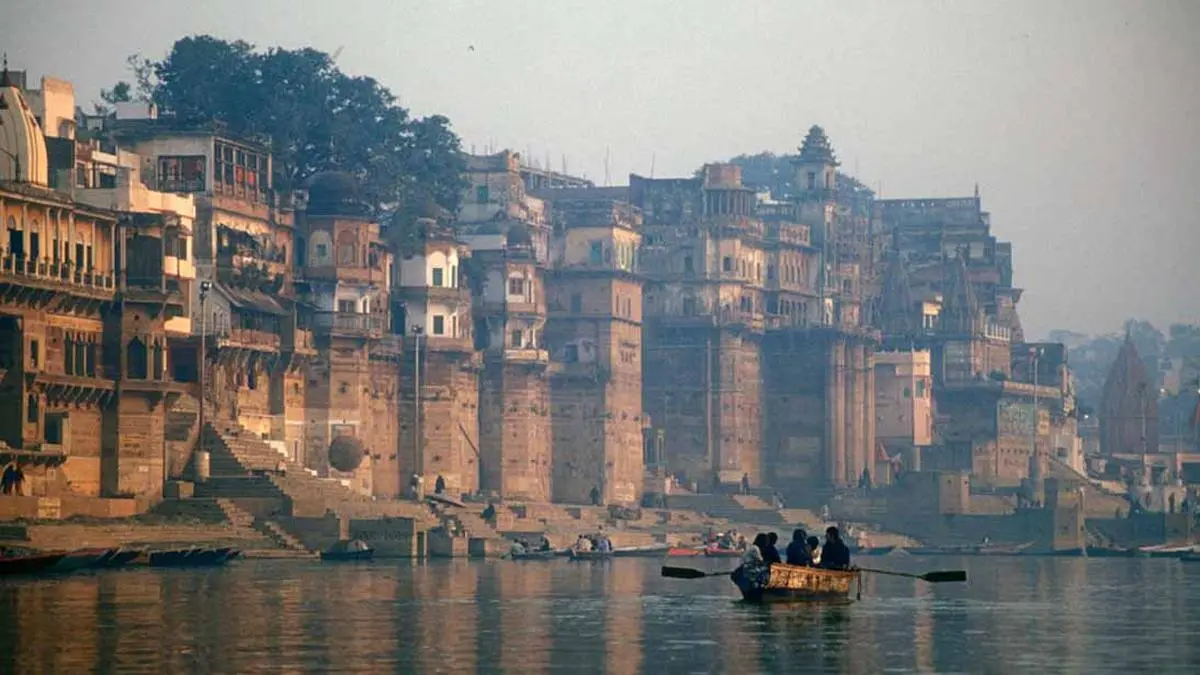
Death permeates almost every essay in Place: “One of us is dead, and the other, dying”; “there’s the dying, to which we are all subject, and then there is the dying, of which some of us are made brutally and irreversibly aware.” But it is when Vajpeyi writes about the love she had for her parents and the raw animal pain of losing them that her prose is most luminous. She writes about immersing their ashes in the Ganga: “Into the same river they went, he first, upstream, she later, downstream, with me as their witness. I sat in the boat in a reverie, transported from present death to past life, reversing the arrow of time.”
She mourns not just personal losses but also the notional deaths of systems and institutions. There is a certain hand-wringing when she writes of sites of Indian education born out of a “certain nationalist ethos and utopian vision of what teaching and learning are all about… politics produced these institutions and politics has done them in”.
Vajpeyi has the voice of a friend who shares her experiences to guide others in similar situations. These are not prescriptive tools but gentle nudges of acknowledgement that seem to say, I see you, I hear you. For the broken-hearted, she says: “I learnt how to travel to forget, rather than to remember—a most useful skill for the heartbroken.”
Advice comes from various other people too. From Lovink, her guru in Amsterdam: “Take the path that takes you forward.” On the cycle of life from her father: “Since drowning is inevitable, never trust the boat, but do trust the river.”
Because the essays are written across swathes of time, there are repetitions and the tonality is not always consistent. The writing, however, is consistently radiant. For a book that has so much to do with memory and remembrance, this mosaic of tone and perspective gives the essays a sense of timelessness. The repetition and inconsistency are of a piece, even if unintentional, with the themes, which is why they work.
In the end, one wonders if cities are not just a medium for Vajpeyi to ask and try to answer the fundamental questions that plague her: How do we lose what we lose? Why do we love whom we love?
Sukhada Tatke is a writer and reporter based in Edinburgh. She writes on books, culture, immigration, and history.
Also Read | The divine and the mundane: Banaras down the ages
Also Read | Why some passports open more doors: A look at global travel inequality
