

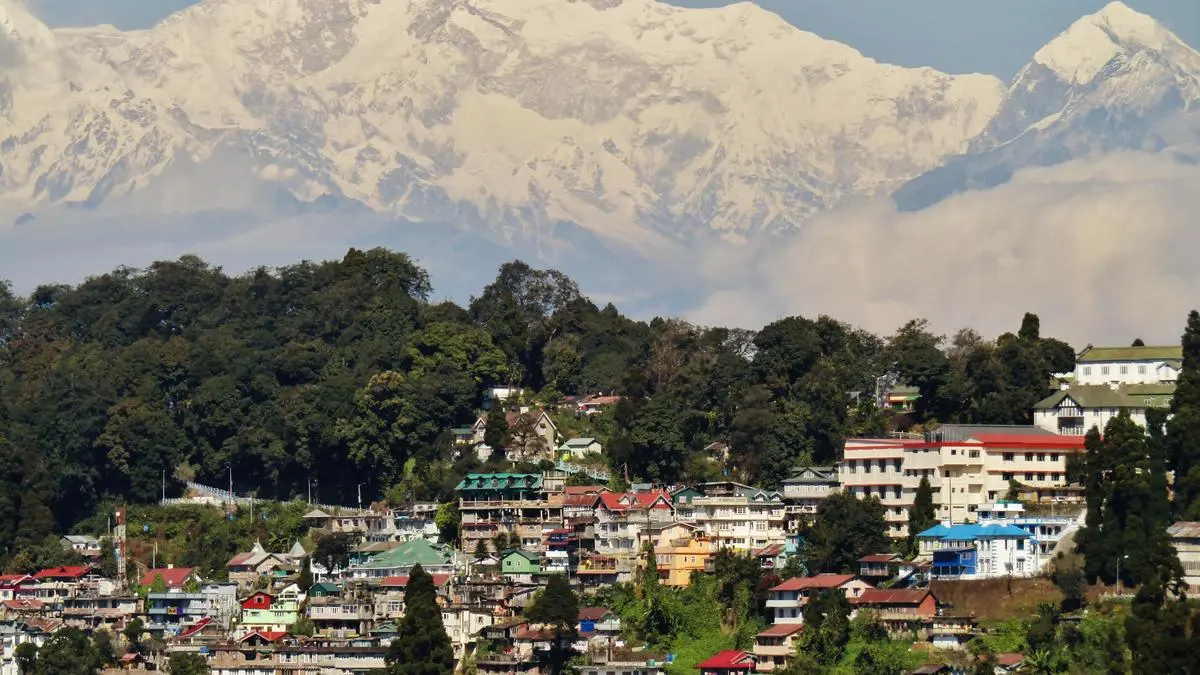

Kanchenjunga, the world’s third highest peak, as seen from Kalimpong in West Bengal.
| Photo Credit: Getty Images/iStock
I visited Kalimpong, a hill town in north Bengal. I had heard so many stories about the place from my friend Zubeda, who was from Kalimpong, that I had a map of the town in my head much before I set foot there for the first time in November 2023.
In the 1930s, Zubeda’s grandfather, a young man of Irish and Nepali-Muslim descent, had joined the Indian National Congress, inspired by the freedom struggle. To fire up the patriotic spirit of the people of Kalimpong, he printed and distributed pamphlets on the streets. And that is where he met the fun-loving Catholic Christian girl he would go on to marry and raise children with.
Now Zubeda herself was getting married in Kalimpong, and I was invited to finally see her hometown with my own eyes.
This being my first trip to the eastern Himalaya, I did not hesitate to pay more for a window seat on the flight from Bengaluru to Bagdogra. After about two hours of flying, I was alerted by the pilot’s announcement to look outside to get a clear view of the Kanchenjunga range. “This is also known as the Sleeping Buddha because the outline of the peaks looks like Buddha lying down,” he said. It is said that nothing can prepare a traveller for the first sight of the Himalaya. I too was taken aback by how glorious Kanchenjunga looked as it emerged from the white clouds.
Also Read | The river I never left
At Bagdogra airport, I met a mutual friend who had flown in from Delhi. A cab had been sent to pick us up, and we soon started on the three-hour drive to Kalimpong. This journey took longer than usual because the roads had recently been damaged by flash floods on the Teesta river. In many places, the highway was being repaired, blocking one side of the road. Our Nepalese driver, Milan, kept us engaged with fascinating stories from his adventurous life.
It was dark by the time we reached Kalimpong. We retreated to our hotel rooms to get some rest and acclimatise ourselves to the cold.
The next morning, I went downstairs for breakfast and took a table by a window. Far away on the horizon gleamed a snow-capped peak that seemed familiar to me. To be sure, I asked the waiter if that was Kanchenjunga. He replied: “Indeed it is, and we are lucky that we can see it today as the skies are clear.” We were told that travellers do not always get to see the peak because of the unpredictable mountain weather. I promptly took some pictures and sent them to my loved ones.
Share taxis keep plying up and down the winding roads of Kalimpong throughout the day, making local transport affordable. But I chose to walk, to discover the town at my own pace. That is how I found out that there are shortcuts at regular intervals in the form of narrow stairs running between buildings.
Walking also allowed me to stop and take pictures of the pretty houses perched delicately on the slopes. Many of the verandas were adorned with flowering plants, adding cheery splashes of colour to the busy town.
A lively wedding
Zubeda’s nikah ceremony was held on the lawns of a large hotel offering a panoramic view of the Kanchenjunga range. Since the groom’s family could not participate in large numbers, I volunteered to join their ranks. As we were introduced to Zubeda’s family members, I noticed that some of them had non-Muslim names. I was told that her mother is Tibetan Buddhist, and some of her aunts are practising Hindus. The hundred-odd family members and friends participating in the Islamic ceremony thus included Buddhists, Christians, and Hindus.
Many of the verandas were adorned with flowering plants, adding cheery splashes of colour to the busy town.
| Photo Credit:
Getty Images/iStock
Zubeda’s uncle gave me a short local history lesson: “The British understood the value of Kalimpong’s proximity to Nepal, Tibet, Sikkim, Bhutan, and Kolkata. As they developed this place into a trading hub, they also built schools, colleges, and other institutions. All of this attracted people to migrate and settle here.” He added that social events in Kalimpong are almost always multicultural affairs.
Also Read | A poem is a place
After the ceremony, the bride and the groom cut a cake. Everyone danced to Nepali traditional wedding songs as well as to popular Bollywood and Nepali numbers. A multi-cuisine lunch followed, with piping hot soup, steaming momos, appetising roti-curry, and lip-smacking Indo-Chinese dishes.
Later, as the newly-wed couple continued to get their pictures taken in the soft afternoon light, I sat and marvelled at the countless factors that had fallen in place for a ceremony like this to happen.
I also felt pleased with myself for having travelled the distance to sign on the nikahnama as a vakeel, a witness, thus becoming a part of Zubeda’s rich family history.
Karthik Ballu is an educator and blogger living in Bengaluru.
