

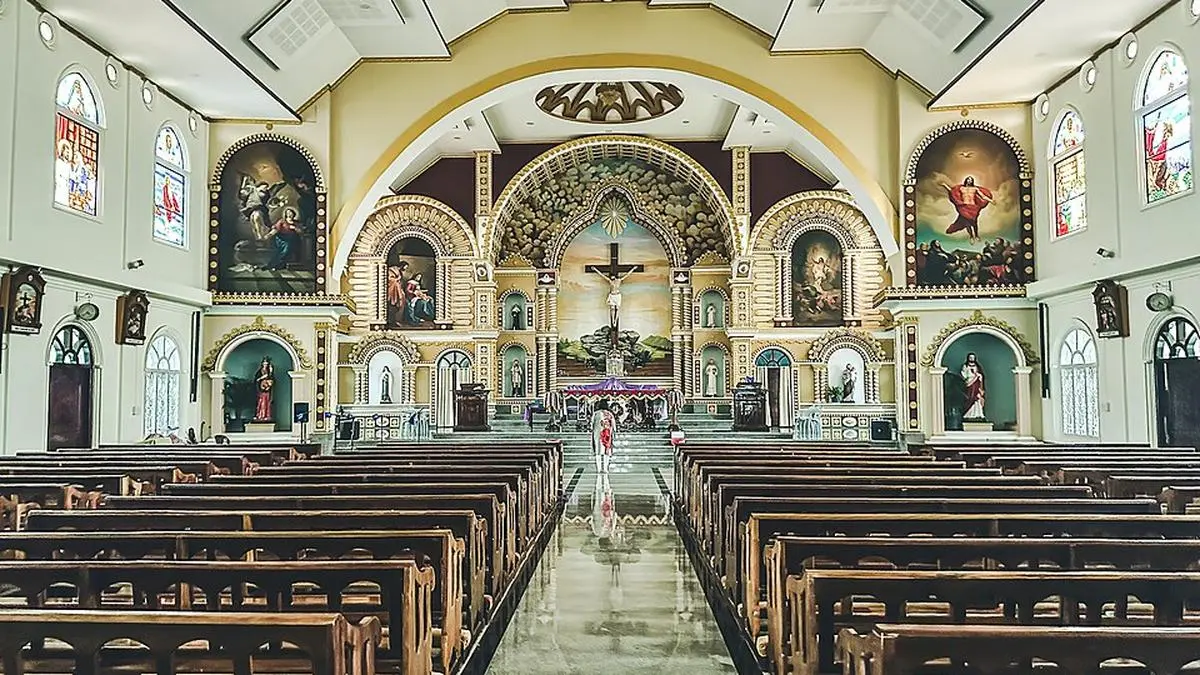

The Roman Catholic Diocese of Itanagar (Dioecesis Itanagarensis) in India was created on December 7, 2005, by splitting it from the Diocese of Tezpur.
| Photo Credit: Wikimedia Commons
The Christians of Arunachal Pradesh are rightly aggrieved over the attempted resurrection of the Arunachal Pradesh Freedom of Religion Act (APFRA), 1978. The Act was passed nearly five decades ago but the rules were not framed, making the law unenforceable. Although it is not clear why the rules were missing, one can surmise that there was not enough support for the Act to justify their framing. And now the BJP-led State government wants to start the process of notifying and framing the rules, following a 2024 Gauhati High Court directive. There was no public consultation behind the initiative, which seems designed to appease certain sections of the population who adhere to indigenous faiths and are under the impression that Christianity would dilute their customary practices and cultural traditions.
If the Act is implemented, it would prevent forced conversions. On the surface this might seem innocuous, but beneath it lies a sinister attempt to stop people from converting to Christianity. Christians are the second-largest religious minority group in India, making up about 2.3 per cent of the country’s population. Christian missionaries maintain that their purpose is to bring people to the faith so that they give up blind beliefs, including in unscientific health practices, and seek modern, scientific healthcare, which Christian mission hospitals provide. Across the north-eastern region, missionaries had spearheaded the setting up of schools and healthcare services at a time when many mainland Indians were not even aware of the existence of this part of the country. Arunachal Pradesh especially, known as “the last frontier”, was outside the purview of the Indian mainstream.
The APFRA prohibits conversions through “force”, “fraud”, or “inducement”. Christians who have accepted the faith say with conviction that they were not tempted, induced, or forced to become Christians. They dismiss the word “fraud” as an attempt to taint the Christian missionaries. Critics of the APFRA say that words like “inducement” could be misinterpreted or intentionally interpreted to describe the charitable activities and social services that missionaries across the globe engage in, particularly in the fields of education and healthcare. Even today, the elite classes from the seven States take pride in sending their children to schools run by Christian missionaries. It is a fact that missionaries devote their lives to serving others. In most cases, when people convert to Christianity, they are responding to the kindness shown to them by missionaries.
Of course, forced conversions are unacceptable. But in the case of the APFRA, the main fear is that it would be implemented with a heavy hand. The attempted revival of the APFRA should be seen in conjunction with the recent proposal of Sangh organisations to delist all the tribal people who convert to Christianity. The Christians of Nagaland and Mizoram, who form about 99 per cent of the respective State’s populations, are yet to react to this proposal, which is being seen as an attempt by the Sangh Parivar to subsume tribal identities into the larger Hindu fold and weaken all minority religions. In Meghalaya, about 75 per cent of the population are Christians; in Manipur it is 41 per cent; Tripura has just 4 per cent Christians while Assam has the least, at just 3.7 per cent
Disturbing facets
In Arunachal Pradesh, critics of the APFRA fear that officials may start treating voluntary conversions as suspicious, thereby discouraging people from freely choosing a new faith. APFRA is seen as targeting Christianity in particular since its adherents have grown significantly over the last five decades. Christian organisations like the Arunachal Christian Forum believe that the law disproportionately affects Christians because most conversion-related scrutiny is likely to focus on Christian missionary activity.
In Arunachal Pradesh, the majority of the Adi tribe follows the Donyi Polo religion, which is closely associated with natural elements such as the sun and the moon.
| Photo Credit:
By special arrangement
Some facets of the Act are particularly disturbing. It requires that every religious conversion be reported to the district authorities. Faith has always been a personal choice. Why is individual liberty and the right to privacy, which are the sine qua non of democracy, being taken away? However, it is true that religious freedom as guaranteed by the Constitution extends to indigenous faiths too. In Arunachal, adherents of the indigenous faith Donyi Polo fear that large-scale conversion would reduce them to a minority. In Meghalaya, practitioners of indigenous faiths like Niam Khasi and Niam Tynrai have been asking for formal recognition as separate groups because they are classed as Hindus. The BJP-RSS has been fishing in these troubled waters, trying to win over adherents of indigenous faiths by peddling the idea that anyone who has not converted to Christianity or Islam is a Hindu.
The tribes of the north-eastern region should take serious note of the delisting process which the NDA government seems keen on implementing. The question to be considered here is: How do tribal Christians suddenly lose their social, economic and educational backwardness? Religion is a matter of faith. It does not promise a better economic life or employment opportunities and does not turn an illiterate villager into a progressive, educated, well-placed individual. The right-wing argument is that tribal Christians avail themselves of the opportunities accruing both from their minority status and their Scheduled Tribe (ST) status. They get educated in missionary schools and then make use of ST reservation to get government jobs. The aim of delisting, they argue, is to prevent children of affluent tribals from getting the benefits of the quota system. The stated purpose hides the real agenda—to remove all tribal identities by labelling them all as Hindus
Although the Constitution guarantees the freedom of religion, since 2014, there has been a steady erosion of all freedoms. The BJP and the RSS are determined to appease their Hindu constituents, who are also their main supporters. Hindus have been taught to believe that the Constitution has somehow been unfair to them notwithstanding the fact that theirs is the majority religion. The APFRA calls for a nationwide debate. It should be stopped in its tracks before it drives a wedge among the tribal communities of Arunachal Pradesh.
Patricia Mukhim is currently Editor, The Shillong Times, and a political commentator and author.
Also Read | ONE: A political dream defying realpolitik
Also Read | A bird in the bush
