

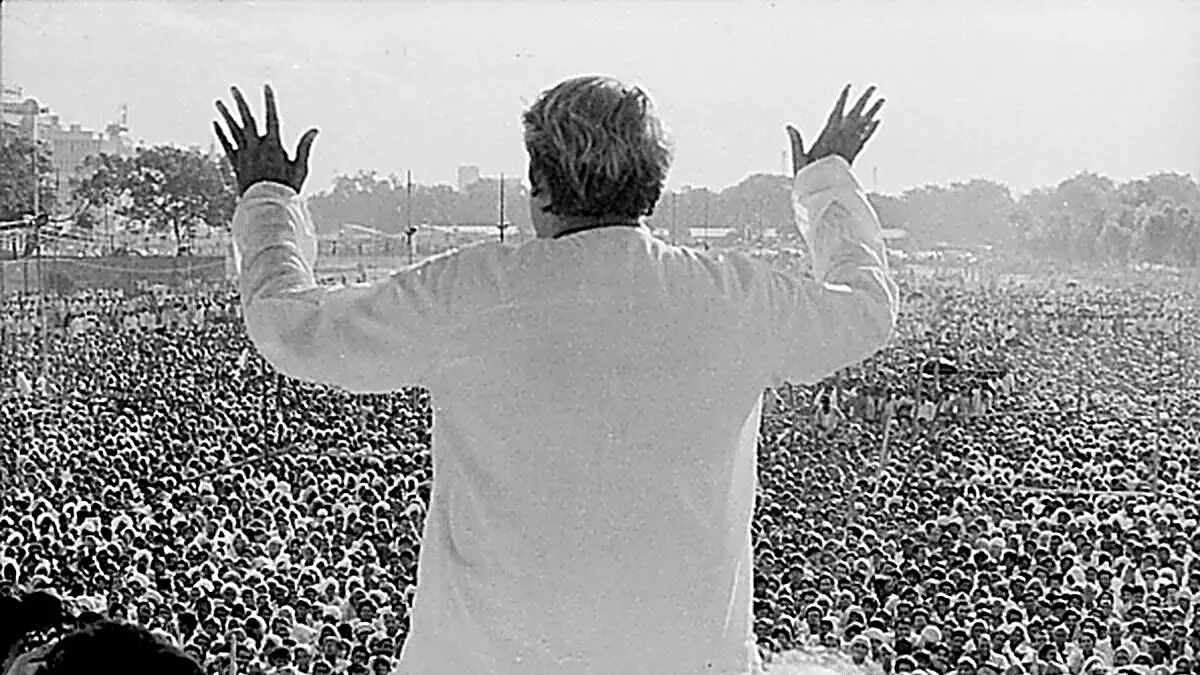
The black-and-white photograph features a garland-laden Atal Bihari Vajpayee, clad in a light-coloured achkan and standing in an open jeep during a victory procession after the Lok Sabha elections in 1957. In that election, Vajpayee had contested on a Bharatiya Jana Sangh (BJS) ticket from three seats—Lucknow, Mathura, and Balrampur—and won from Balrampur. With this victory, he entered the Lok Sabha for the first time.
The picture captures the arrival of Vajpayee as a leader to reckon with in national politics. It is also a throwback to a very different time in Indian politics, when elections were a far less expensive affair. Vajpayee ran his campaign with just Rs.41,000, a few volunteers, and two jeeps. He toured rural areas extensively by foot, bicycle, and even horseback, to connect with the electorate.
What stands out about that election, however, is not Vajpayee’s inexpensive campaign but his appeal to the voters of Mathura. In a rare show of integrity, Vajpayee asked them to support his opponent, the freedom fighter Raja Mahendra Pratap Singh. The appeal provided a glimpse into Vajpayee’s much-celebrated capacity to transcend the political divide, a quality that is extremely rare in today’s political landscape.
The photograph and the details about Vajpayee’s modestly-funded election campaign are part of Atal Bihari Vajpayee: The Eternal Statesman, a pictorial biography of the leader curated by senior BJP leader Vijay Goel. The photographs are complemented by lesser-known details about the leader in the accompanying text written by Goel, who had a long personal and political association with Vajpayee.
Atal Bihari Vajpayee: The Eternal Statesman
By Vijay Goel
Heritage India Foundation
Pages: 311
Price: Rs.4,000
The coffee-table book becomes much more than a collection of photographs to flip through during leisure time because of its subject: the life journey of Vajpayee, one of the most significant leaders in the right-wing sphere, and who, together with L.K. Advani, brought the BJP to the pinnacle of power. The book highlights Vajpayee’s saffron association, his commitment to the values of the RSS, of which he was a member since childhood, and the role he played in the genesis and growth of the BJP.
But it also keeps coming back to how Vajpayee was a true statesman—evident in his ability to reach out to his political opponents, collaborate with them on important issues while transcending ideological boundaries, and sustain deep and long-lasting friendships across the political divide.
Goel recalls an occasion when Vajpayee invited Chandra Shekhar and Charan Singh to accompany him during a padayatra to appeal for peace after a communal riot in Sadulpur, Uttar Pradesh. “I innocently asked why he had invited them—wasn’t he giving them publicity? Atalji smiled and replied, ‘Their presence will strengthen our issue. That is what matters.’ This was one of my earliest lessons in statesmanship—Atalji placed national interest above political advantage,” Goel writes.
Vajpayee’s political nature was that of a moderate and a seeker of common ground with his political opponents. This is brought out well by the photographs as well as the accompanying text in the book.
A black-and-white photograph shows Vajpayee sharing a hearty laugh with an array of political opponents—S.R. Bommai, K.R. Narayanan, Ghulam Nabi Azad, and V.P. Singh, as well as party colleague Murli Manohar Joshi. “Political opponents often humoured Vajpayee by telling him he was ‘the right man in the wrong party’, a testament to the warmth and respect he commanded across political lines despite ideological differences,” notes the accompanying text.
Above partisan lines
The book carries a photograph of Vajpayee walking with the then Prime Minister Indira Gandhi around the time of the India-Pakistan war of 1971. The two leaders seem engrossed in a serious conversation. As the war erupted, Vajpayee, who was then president of the BJS, rose above partisan lines to declare: “The Prime Minister must now lead the country to total victory over the enemy. If the government wanted to secure any more powers to handle the situation, this party would not hesitate to accord its fullest cooperation.” He hailed Prime Minister Gandhi’s handling of the war, and the moment continues to be cited as an example of his remarkable statesmanship.
Vajpayee’s readiness to mingle with party workers—sharing space with them and reaching out to them through the course of the BJS’ political trajectory, and later the birth and growth of the BJP—is well-documented in the photographs. Among them is a photograph of Vajpayee dressed in a dhoti and kurta, sleeves rolled up, serving food to party workers at the BJS’ Kanpur session in 1975.
There are numerous photographs capturing Vajpayee’s ascent to the Prime Minister’s chair and the important events during his tenure at the helm, including the nuclear tests at Pokhran in 1998, the historic bus trip he undertook to Lahore in February 1999, and the Agra Summit of 2001 where he led summit-level talks with visiting Pakistan President Pervez Musharraf—though he was left disappointed by Musharraf’s position on the Kashmir issue—and the terrorist attack on Parliament later that year.

The pictorial biography of Vajpayee explores the moderate roots, cross-party friendships, and historic legacy of the BJP icon.
| Photo Credit:
Special Arrangement
The book devotes a separate section to the complicated association Vajpayee had with Prime Minister Narendra Modi. There are photographs which hark back to the good old days in their relationship before Vajpayee wanted Modi to step down in the wake of the communal riots in Gujarat in 2002.
There were many facets to Vajpayee’s persona—he was a poet, a foodie, a cinema lover, and a man with a keen sense of humour. The book brings out these very human aspects of his character. Goel recollects anecdotes that throw light on Vajpayee’s fun-loving nature and his ability to laugh at himself. He writes that after being inducted as Minister of State in the Prime Minister’s Office in 2001, he had an opportunity to work closely with Vajpayee and witness at close quarters his humour, discipline, and humility: “On a flight once, I asked what he missed most. He immediately replied, ‘Faka-masti’—remaining cheerful even during difficult times.”
On another occasion, Vajpayee asked Goel how the government was running. Goel replied light-heartedly, “People feel it is not functioning at all.” Vajpayee, Goel writes, burst into laughter. Goel writes that Vajpayee, despite being a gifted orator, prepared every speech meticulously, including his Independence Day addresses. He personally corrected files and read every letter carefully. His dedication and humility reflected his deep respect for public duty.
The book encompasses a life well-lived, one that left an indelible imprint on India’s political history. It also transports the reader to a bygone era in Indian politics when political opponents were not treated as enemies.
Also Read | A.B. Vajpayee: A charismatic RSS ideologue
Also Read | Exploring an enigma: Review of ‘Vajpayee’ by Abhishek Choudhary
