





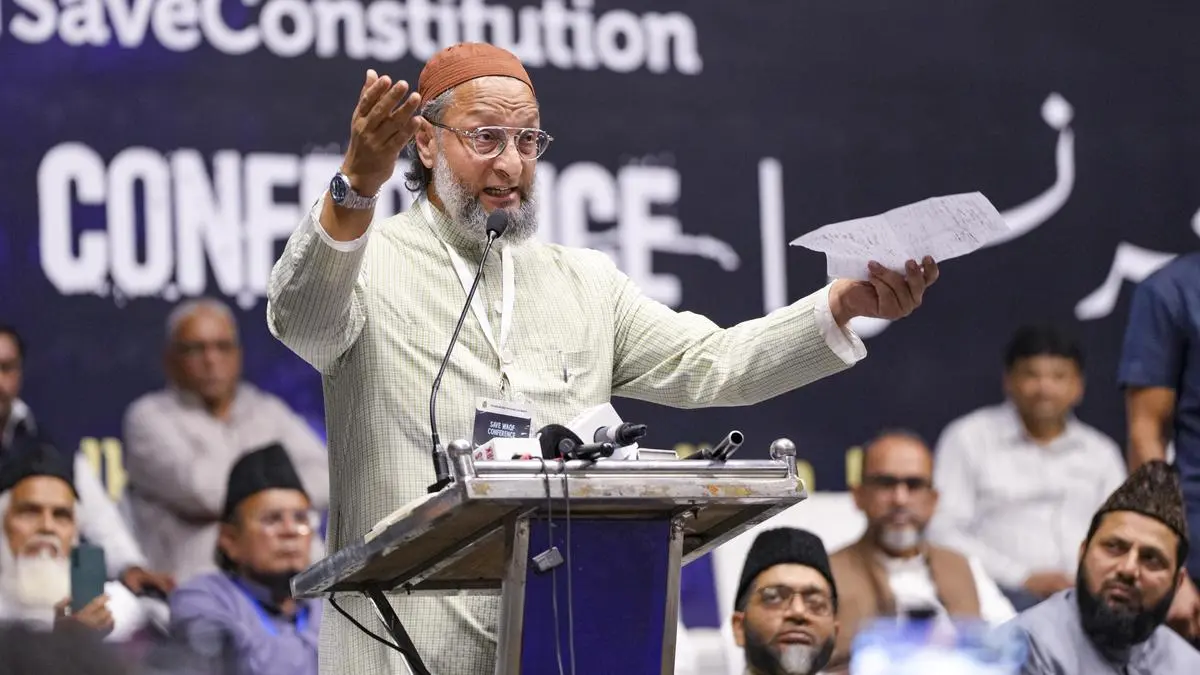


AIMIM chief Asaduddin Owaisi speaks during the Save Waqf Conference, organised by the All India Muslim Personal Law Board in protest against the Waqf (Amendment) Act, 2025, in New Delhi, on April 22, 2025.
| Photo Credit: Atul Yadav/PTI
A recent meeting of the INDIA bloc was held at Delhi’s Constitution Club, bringing together representatives of 23 political parties. The gathering aimed to highlight what opposition leaders describe as the BJP’s systematic use of state institutions and political mechanisms to constrain the opposition’s space in Indian politics. Another key objective was to project the alliance as a bulwark against communal polarisation, which many believe has increasingly divided the country along Hindu-Muslim lines.
The INDIA alliance presents itself as a broad coalition of secular parties. Yet, notably absent from this coalition since its formation on July 18, 2023, is the All India Majlis-e-Ittehadul Muslimeen (AIMIM), a party that also claims to uphold secular and constitutional values. This absence raises an important political question: why has AIMIM remained outside the alliance despite its stated commitment to many of the principles the INDIA bloc champions?
In an effort to understand Muslim opinion on AIMIM’s continued exclusion and Asaduddin Owaisi’s evolving political position, the author engaged in conversations with community members, Islamic scholars, and clerics—in person and over the telephone—while also visiting several Islamic institutions. The responses reflected a broad range of perspectives, underscoring the absence of a monolithic Muslim political voice and revealing the debates that shape contemporary Muslim political engagement in India.
The mixed reactions were hardly surprising. A significant number of those consulted—roughly 60 per cent—continue to view AIMIM as the BJP’s “B-team”. Their argument is that the party has consistently refused to coordinate with national and regional opposition parties, despite full awareness of the polarised political environment the BJP has created, in which elections are increasingly framed along communal fault lines.
Those who support AIMIM and Owaisi offer a different reading. They argue that he remains one of the few political leaders who speaks unapologetically on issues affecting Muslims, both inside and outside Parliament. For his supporters, the larger question is not why AIMIM seeks to expand electorally, but why secular parties are reluctant to accommodate it during seat-sharing negotiations. If coalition politics is built on inclusion and representation, they ask, why should AIMIM alone be treated as politically untouchable?
An equally pointed observation emerged during these conversations. Several respondents questioned whether the hesitation of secular parties stems from a fear of reinforcing the BJP’s narrative that opposition politics is driven by minority appeasement. This, they argued, has made AIMIM’s inclusion politically inconvenient despite its professed commitment to constitutional and democratic values.
One senior Islamic cleric offered a more considered assessment. While defending AIMIM’s right to expand its political footprint, he cautioned against the use of overtly religious symbolism and Islamic slogans as instruments of electoral mobilisation. Such an approach, he argued, risks blurring the distinction between faith and politics. Taken together, these perspectives reveal a deeper tension within contemporary Muslim politics: while there is no consensus on AIMIM’s role, there is broad recognition that the language of secular politics leaves limited room for overt religious mobilisation, regardless of which community employs it.
Owaisi at the crossroads
Today, Owaisi and AIMIM stand at a political crossroads, watching the direction of India’s shifting electoral winds while waiting for the “B-team” label to finally fade. The debate gains further complexity when the credibility of the INDIA alliance itself comes under scrutiny. Critics often point to legislators from so-called secular parties who once accused AIMIM of indirectly benefiting the BJP, only to later defect to the BJP themselves, abandoning both their parties and the positions they claimed to uphold. The contradiction becomes sharper in Telangana, where Owaisi shares a largely cordial relationship with the ruling Congress, yet is treated as a political outcast in the national arena. To his supporters, this reflects selective targeting; to his critics, it reinforces questions about his political strategy and broader electoral impact.
For many Muslims, the issue remains deeply confusing. On one hand, AIMIM presents itself as a vehicle for independent Muslim political representation. On the other, a significant section of the community remains unconvinced that such a strategy effectively counters the political challenges and insecurities they have faced in the BJP era. The dilemma is therefore not merely about Owaisi, but about the future direction of Muslim politics in India itself.
The central question is whether Owaisi will eventually embrace political pragmatism—much like the Indian Union Muslim League in Kerala, which has sought accommodation within larger opposition coalitions—and expand his relevance beyond identity-based politics. Or he may continue to pursue an independent path centred on Muslim political assertion, even at the cost of remaining isolated from broader secular alliances.
The verdict on Owaisi’s strategy will ultimately be delivered not by television debates or social media, but by electoral realities. Whether AIMIM emerges as a bridge to greater political representation or remains confined to the margins is a question only the voters can answer.
Sayed Rashad Ikmal is an independent researcher and columnist on national and international affairs.
Also Read | Dairy milk for politicians
Also Read | Is INDIA blooming or withering?


