





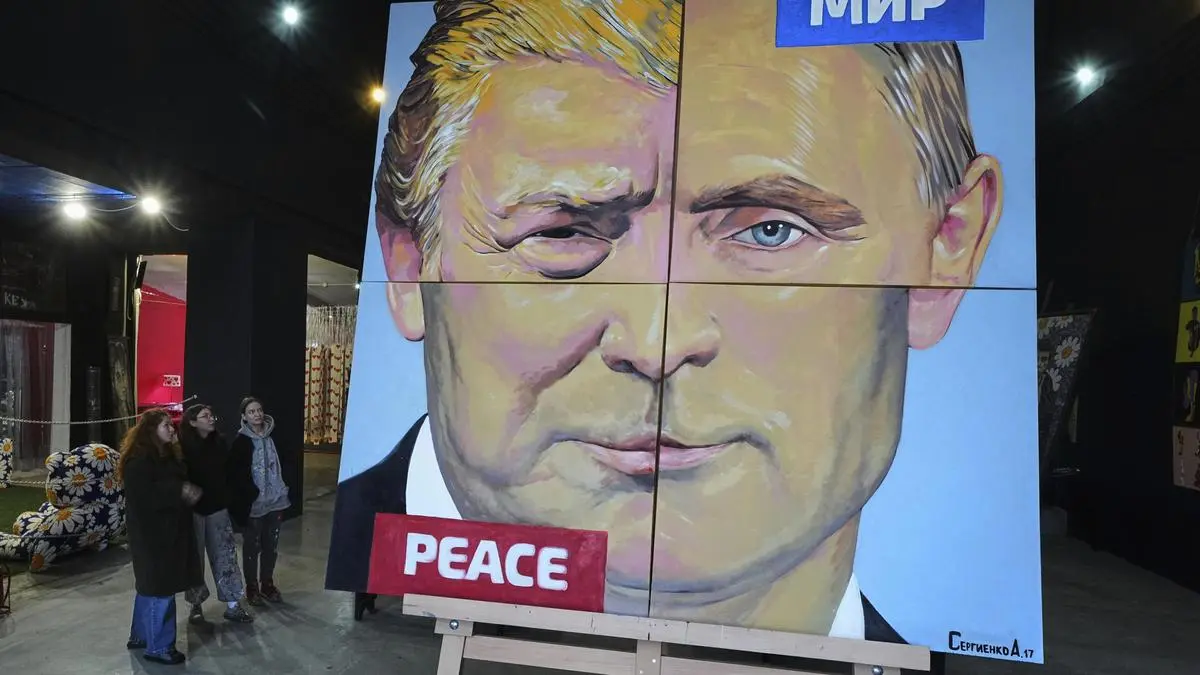


“Peace to the World”, a painting created by Russian artist Alexei Sergienko, depicting a combined portrait of Russian President Vladimir Putin and US President Donald Trump, is on display at the Sergienko Gallery in St Petersburg, Russia, on March 14, 2025.
| Photo Credit: DMITRI LOVETSKY/AP
Bourgeois democracy, which is a democracy of political parties and the only kind of “working democracy” we have known until now, entails active politics for a very small percentage of the population. Even when many people vote, say, 80 per cent of the electorate, the vast majority of these subside into non-political life the day after the election. Maybe 2 per cent of the population stays politically active in the running of parties and governments, with an active “party” cadre that is seldom over 20 per cent of the population in a working bourgeois democracy.
Hence, when persistent and serious problems, usually of an economic nature, afflict such nations, the vast “apolitical” majority grows sceptical of and finally hostile to the small political minority. With the rise of unemployment, inflation, etc., this “apolitical” majority has both time and cause to look for putative solutions. But it is not politically conscious, and it is actually scornful now of those who are or were politically conscious, the minority (leftist, centrist, liberal or conservative) that it now blames, with some validity, for the problems.
This is where the “strong leader” steps into a working democracy. The “apolitical” majority does not really care to involve itself in politics—it wants a “strong leader” who is in some way seen to be “above” politics. It does not connect to other voters in order to try and devise real working political solutions; instead, it connects to the “strong leader” who can unite everyone in the way that a puppeteer unites his puppets—with discreet lines of connection, not between the puppets but between each puppet and the puppeteer.
It has to be noted at the start that the “strong leader” who comes to power in any working democracy, no matter how flawed, is not the same as a strong monarch or conqueror of the past. Whether Chinggis Khan or Akbar or Ashoka, they were all “strong” in ways that do not carry much weight in a working democracy. At worst, they had the sheer physical strength of the leader and his supporters; at best, it was a slightly more sophisticated combination of physical strength rooted in material and social factors.
In that sense, Trump, Putin, or even Hitler or one of the many “strong leaders” of Asia, Europe, Africa or America—they came to power in a democracy, regardless of what they did to the democracy later on—belong to a breed different than that of a Nadir Shah or Ashoka. This latter breed can only be understood in the light of a failure of politics, not of cannons, matchlocks, horses, or armour. That failure of politics is the inability of bourgeois democracy to involve the masses in political action more than once in four or five years, when elections are held.
The main characteristic of the “apolitical” majority is, per definition, its inability to have a real political consciousness. This means, in effect, that even if they act as a mob, they remain a congregate of atomised individuals. Hannah Arendt claims that this is a characteristic of any mob: it is a collocation of atomised individuals. So, what is it that makes a mob surge in one direction and not in another, or dissolve in a hundred directions? No matter what the slogans, a mob’s surge is not an ideological motion; it follows an individual or group (led by an individual) who is at the head of it.
For the apolitical mass, this strong leader is the gathering point. The mass’ lack of politics and its corollary lack of connections with other individuals are both satiated by the strong leader. The strong leader directs, but the strong leader also connects. And then this apolitical majority is not just a mass, and, if the strong leader so wishes, it is a mob.
The individual’s loyalty in such a situation is not to another individual, but solely and totally to the strong leader, as Arendt has noted. The putative “politics” then, to the extent that it comes into verbal existence, depends entirely on the leader. It can change daily without effecting the loyalty of the follower, as this loyalty is to the leader and not to any real ideology. We have seen this in operation with Trump and the MAGA crowd, to give just one example.
As is clear, the strong leader who takes over any working democracy is not an anomaly of bourgeois democracy. He is the direct result of its failures. He is its consequence even. Therefore, castigating the “mob” that hails him, and fails to see his failures, does not work. The mob’s failure to register the strong leader’s growing list of failures is based on the institutional failures of bourgeois democracy; above all, its structural failure as essentially a parochial democracy, a once-in-a-few-years democracy.
Politicise
The only way to avoid this is to organise political power in such a way as to actively politicise the majority on a regular basis. This was achieved in limited ways in nations like Denmark, Finland and Sweden, with their careful gardening of communes and local self-decisions: even today, housing committees, neighbourhood organisations, cooperatives, unions, etc. play a large role in such places, and municipal elections are a serious enough matter. Consequently, strong leaders have not been evoked by the masses in such nations. Although this might change—I think it is already changing—as local North European democratic institutions are whittled away by capital and centrist bureaucratisation, a process that began in the 1990s.
It is important to remember that the mob is not separate from the masses, as Arendt, making a similar argument, erroneously implies; it is embedded in the masses, with its generalised apoliticality, which grows rather than diminishes in periods of prosperity. The greater the peace and prosperity in a bourgeois democracy, the more apolitical the masses get. When such periods end, the pressure of changed circumstances enables the mob to rise from the masses. The apolitical masses, unable to become political, disdainful of politics, look for a solution—as this cannot be politics, it is the strong leader, who fights, thinks, and does the politics on their behalf. A bourgeois democracy with “representative” politics gives rise in due course to the dictatorial strong leader—and the mob. The only way to avoid it is to find ways of making democracy more than just an occasional electoral exercise.
Tabish Khair is an Indian novelist and academic who teaches in Denmark.
Also Read | Fascism, Indian style
Also Read | FIFA’s own goal in America


