


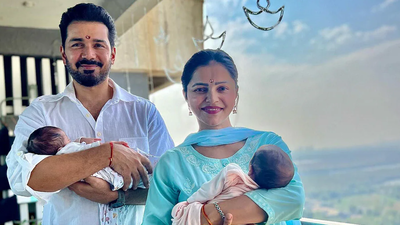
Rubina Dilaik has found herself at the centre of a social media debate after remarks from her appearance on SCREEN’s Dear Me interview series began circulating online. During the conversation, the actor spoke about parenting responsibilities and said that if a child wakes up at night, it is the mother’s responsibility to attend to them, while the father should sleep because he works hard throughout the day. The comment quickly sparked discussions across social media, with many users debating traditional gender roles, shared parenting and the expectations placed on mothers and fathers. Scroll down to read more…
The context around her comments
15 Jun 2026 | 12:57
Is spending lakhs on a child’s birthday party reasonable or insane?
The conversation comes at a time when Dilaik has been speaking openly about motherhood in several interviews. In a recent profile, she described life after becoming a mother as emotional, transformative and deeply reshaping and said she and her husband, Abhinav Shukla, manage parenting with support from family, including her mother. She also spoke about mom guilt, balance and the pressure that can come with trying to be present both at work and at home.
Why the remark struck a nerve
The reason the line has sparked such strong reactions is simple: it touches a raw nerve around gender, labour and parenting. For some, the statement sounds like an old-school belief that still places the heaviest nighttime and caregiving load on mothers. For others, it may read as a reflection of how many families are still arranged in practice, especially when one parent is seen as the primary caregiver. That tension is exactly what made the clip travel so fast.
More than just a parenting opinion

What makes the discussion bigger than one celebrity quote is the larger question underneath it: should parenting duties be divided by biology, by work schedules, or by mutual choice? Dilaik’s comments have been interpreted in different ways online, with some seeing them as a candid expression of maternal instinct and others reading them as a reminder of how unevenly care work is still distributed in many homes. That split reaction shows how easily personal views on motherhood can become public arguments about equality.
The larger debate it opens up
The debate is not really about a single night of interrupted sleep. It is about who is expected to sacrifice, who is allowed to rest, and how much of childcare society still assumes belongs to women by default. In that sense, the reaction to Dilaik’s remark says as much about public attitudes toward parenting as it does about the actor herself. Her comments may have been personal, but the response has turned them into a wider conversation about modern families, shared responsibility and the language we still use around motherhood.
What parents can take away from the conversation
Beyond the headlines and social media reactions, the discussion offers an opportunity for parents to reflect on what works best for their own family. Every household functions differently, and there is no single formula for raising children. What matters most is clear communication, mutual support and a willingness to share responsibilities in a way that feels fair to everyone involved.Parenting experts often point out that children benefit when caregiving is viewed as a partnership rather than a fixed set of roles. Whether nighttime duties are handled primarily by one parent or shared equally, the key is ensuring that neither parent feels overwhelmed, unsupported or solely responsible for the emotional and physical demands of raising a child. In the end, the debate sparked by Dilaik’s comments highlights a broader truth: successful parenting is less about following traditional rules and more about finding a balance that works for the family as a whole.
