

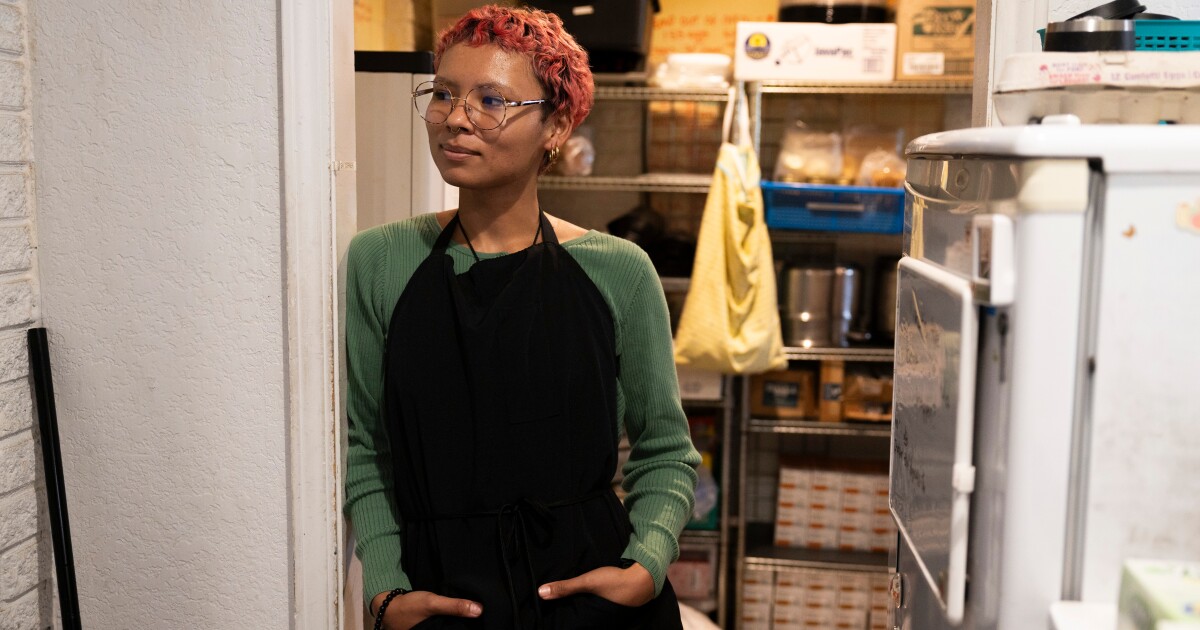
Every morning at Brentwood Social House, there’s a glimmering case full of fresh-baked bread and pastries ready for customers dropping by before work. What customers don’t see is all the heavy lifting that made it happen: lead baker Thi Nguyen says slinging around all that flour and sugar isn’t light work.
“If you sign up for any food service job, one of the first things that you’ll sign off on is that you can lift 50 pounds and you could stand on your feet for eight-plus hours,” Nguyen said.
Nguyen wakes up before dawn five days a week to start the morning bake. She says she loves the work, but it is physically taxing. And until recently, she was putting off regular check-ups because she didn’t have health insurance. Her health plan was basically crossing her fingers — hoping for the best and worrying about the worst.
“Like if I get sick, will I be OK?” Nguyen said. “If I’m stuck with a huge bill, is it gonna break me?”
That changed this year after Nguyen was accepted to a new pilot program through Good Work Austin, a nonprofit with a mission of improving conditions for local food workers and businesses. Good Work Austin partnered with the local, publicly-funded organization Central Health this year to cover insurance premiums for a small cohort of food workers, including Nguyen.
“Our city kind of depends on that industry,” said Kara Hanaoka, executive director for Good Work Austin. “We’re known as this food city now. We’re known for our Michelin stars. That’s our tourism, and in turn our sales tax, and in turn that’s what funds our city government.”
How it works
Hanaoka draws parallels between Austin food workers and Austin musicians, two groups which are integral to the city’s culture, but may struggle to afford its cost of living. Both groups also rarely receive employer-provided health insurance.
“A lot of times musicians … don’t have a stable employer. They’re kind of bouncing around, and a lot of times food workers are really similar,” Hanaoka said.
Musicians in Austin have an established resource available: the Health Alliance for Austin Musicians, or HAAM, which provides insurance premium assistance for thousands of people each year. This served as the model for Good Work Austin’s Healthcare Access Pilot.
It started small, with just 25 participants. To qualify, they had to make between $19,562 and $31,300 per year — the federal limits to qualify for the Advanced Premium Tax Credit, which offsets the cost of Affordable Care Act marketplace health plans for low-income earners.
Pilot participants enrolled in insurance from Sendero Health Plans, Central Health’s marketplace insurance option. Central Health paid the balance of their premiums after the Advanced Premium Tax Credit was applied.
Moving forward, Hanaoka would like to expand the pilot to make these benefits available to more people — and to brainstorm ways to support those who make too much money to qualify for the pilot.
“Quite a few people who applied for the program made a little bit too much to be able to be eligible,” she said. “It’s a lot of people that are in that $40-45,000 range that are just kind of being forgotten.”
Many people in that income bracket, Hanaoka said, decide that out-of-pocket costs for marketplace plans are too costly and choose to forgo insurance.
Soon, that group could include Nguyen. Last year, her income was low enough to qualify for the pilot. But she’s since picked up a second job to bring in some more money.
“I’m going to get the most use out of it I can right now,” she said. “[I’ll] get all my physicals done while I have this free healthcare, because I won’t be broke enough to qualify next year.”
The future of Brentwood Social House, Nguyen’s primary employer, is up in the air as the owner has announced plans to move on. Nguyen has begun looking for new positions and is hoping for one that offers health insurance.
Next steps
Hanaoka already has some ideas about other ways to support healthcare access in Austin’s food industry. That includes a proposal for the city of Austin to create a tax rebate program that would offer incentives to food and beverage businesses that invest in healthcare access, paid leave and living wages for employees.
She’s also already looking toward year two of the Healthcare Access Pilot. She briefed the Austin-Travis County Food Policy Board on early takeaways from the program Monday and will present to Central Health later this month.
A Central Health representative said early results from the pilot have been “encouraging.”
“Central Health is currently evaluating next steps for the program, and we expect to have more to share in the coming months,” said Alex Boos, a communications representative for the organization.
