





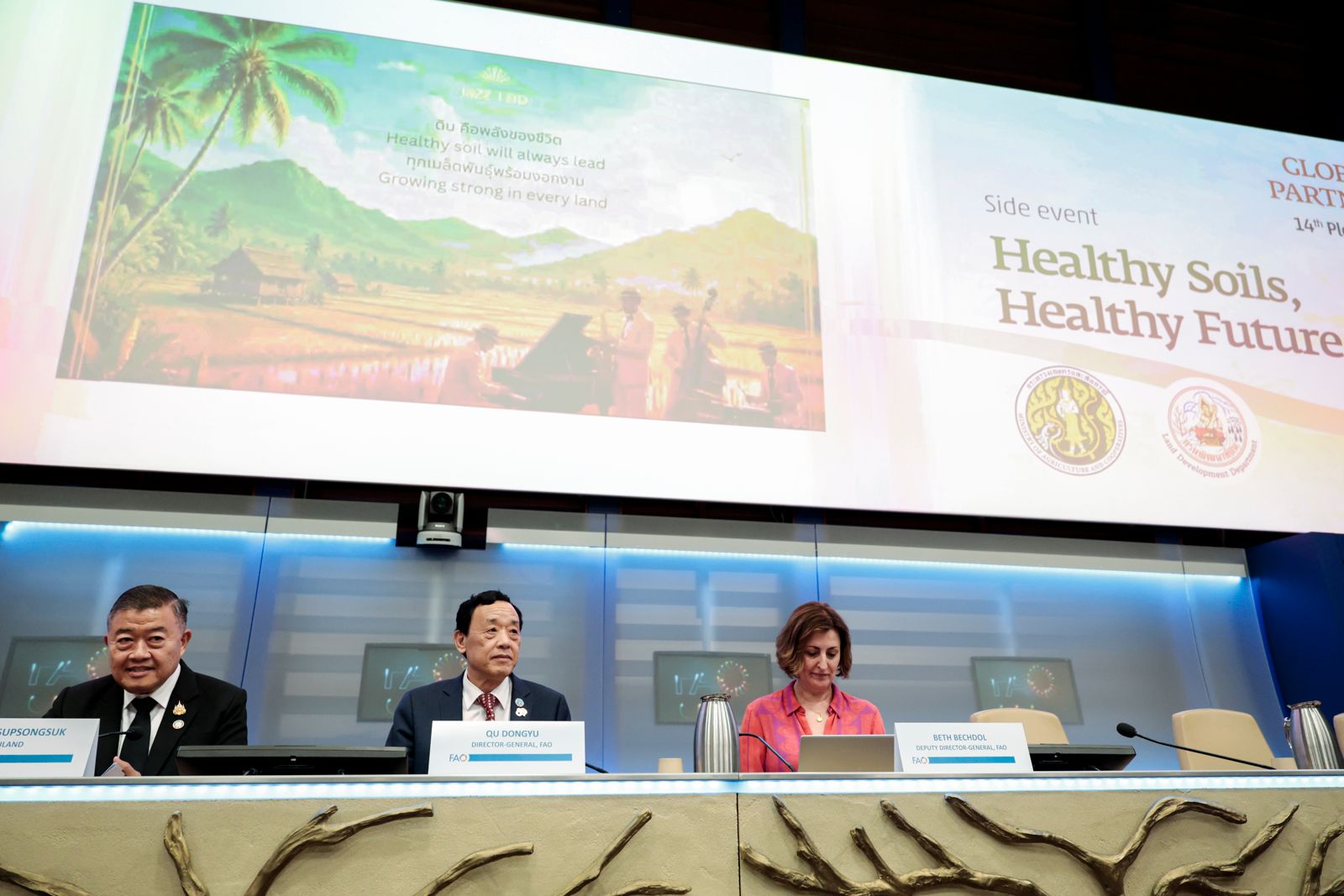
Rome – FAO Director-General QU Dongyu stressed the need for critical investments in soil research and knowledge sharing as he addressed a side event highlighting how governments and farmers are working together across regions to promote sustainable soil management.
The event, titled “Health Soils, Healthy Future,” took place on Thursday during the 14th Plenary Assembly of the Global Soil Partnership (GSP), held from 17 to 19 June at FAO headquarters in Rome.
The session showcased success stories in effective soil stewardship and examined key challenges and support needs. It also demonstrated how national sustainability policies can be translated into effective local action, highlighting the role of farmers as key stakeholders in both policy development and implementation. Across regions, farmers are helping to deliver innovative, scalable and locally adapted soil management practices.
In his address, the Director-General noted that recent shocks affecting food production and agricultural inputs have highlighted the vulnerability of agrifood systems. At the same time, productive land is being degraded, water resources are under increasing pressure, and farmers are being asked to produce more with fewer resources.
“These challenges remind us that every harvest begins with healthy soil,” Qu said, since “healthy soils underpin food production, sustain biodiversity, help farming systems withstand shocks and support rural development.”
He stressed that when soil health declines, productivity, food security and economic opportunities are all affected. Therefore, “protecting and restoring soil health must remain a global priority,” he added.
Achieving this requires sustained investment in soil information systems, including mapping, monitoring, research and knowledge sharing. Different soils have different characteristics, and farming systems require tailored approaches, the Director-General said, underlining that sound decision-making depends on reliable data. “Soil literacy is fundamental,” he noted.
The Director-General also thanked the Government of Thailand for its longstanding leadership and commitment to soil health.
Since the establishment of the Global Soil Partnership in 2012, Thailand has been a strong and valued partner. Through its leadership, the importance of soils has gained greater recognition on the global agenda, QU said.
The Director-General also expressed his appreciation for the legacy of His Majesty the late King of Thailand, “whose commitment to sustainable agriculture and land stewardship continues to inspire people around the world.”
“The King Bhumibol World Soil Day Award is a lasting reminder of the importance of leadership, innovation and commitment in protecting our soils for future generations,” he said.
The annual award is sponsored by the Kingdom of Thailand and is granted to individuals or institutions that have made significant contributions to promoting the importance of healthy soils and sustainable soil management.


