

On the morning of October 2, 2024, Bilal Ahmad Dar left his home in Laharwalpora village before dawn. He climbed onto a friend’s motorcycle for the 70-kilometre journey to Srinagar, where he worked for the Municipal Corporation. It was the day after the third phase of Assembly polling in Bandipora constituency.
At 8:45 am, barely seven kilometres from home, a JCB bulldozer crashed into the motorcycle. Bilal was thrown to the ground. His left leg, shattered. “I remember checking the time minutes before the accident,” Bilal says. “After that, I don’t know what happened until I woke on a ventilator in the Bone & Joint Hospital in Srinagar, with my leg hanging in a bandage.”
Surgeons operated for hours, but the damage was too severe. Doctors now suggest amputation. The family has already spent more than Rs.14 lakh on surgeries and hospital bills, raised through donations and lifetime savings. “They say my leg won’t heal here and needs to be amputated,” Bilal tells Frontline. “Who will take care of my ailing mother and sisters if that happens?”
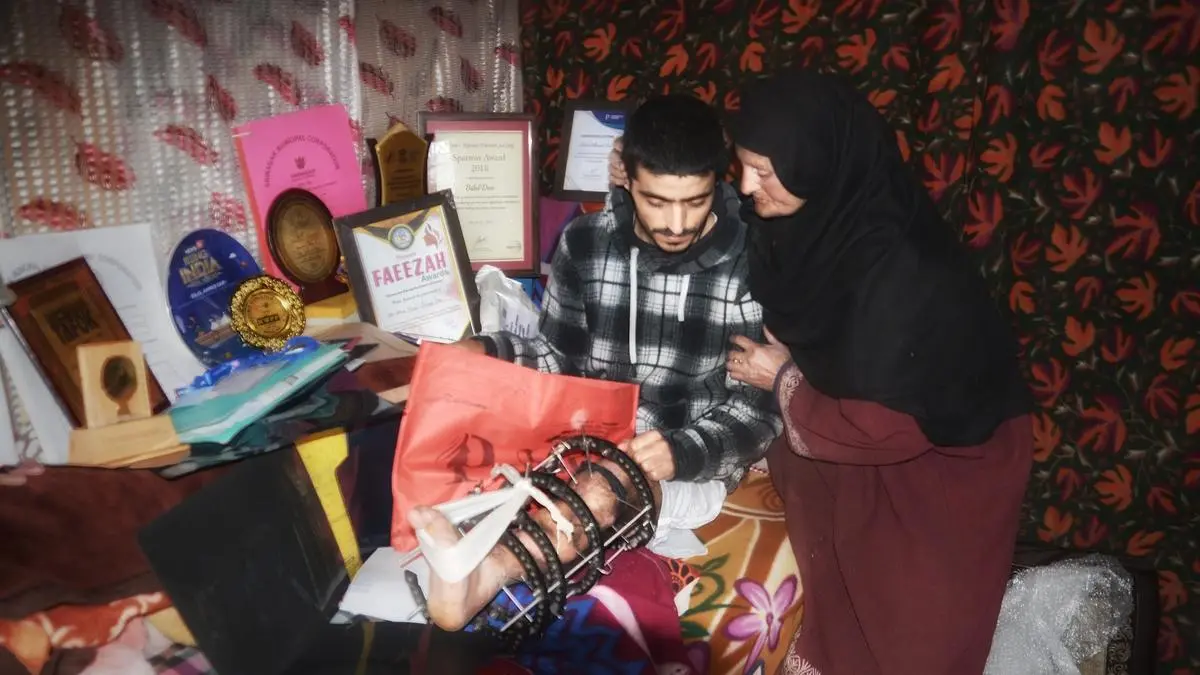
At home, his mother Mugli Begum, 75, watches her son waste away. She feeds him a piece of flatbread, her hands trembling. “They came in crowds when he was cleaning the lake,” she says. “Now, no one has stepped through our door in two years to ask if we are even alive.”
Basic healthcare feels like a distant luxury. Every Monday, Bilal must travel to GMC Srinagar for checkups. He can no longer walk or stand. Neighbours carry him on their shoulders to reach the car. “They lift me on their shoulders,” he says, looking away. “That hurts more than the injury.”
Each hospital visit costs Rs.6,000 in vehicle fare alone. “Our situation became so desperate that we were arranging to sell the only piece of land where our tin-shed house sits, just to pay for one more surgery,” Bilal says.
A village forgotten
Laharwalpora is a hamlet forgotten by development. The narrow road to Bilal’s home is riddled with potholes and has no pavements. According to the 2011 census, roughly 7,000 people live here. Most depend on Wular Lake for survival, fishing its waters and selling their catch at market.
Bilal lost his father in 2008, when he was still a child. The 2014 floods destroyed the family home and left them sleeping under the stars. “It felt like God was testing us again and again,” Begum recalls. “But my son never complained.”
By age 12, Bilal had taken to the lake. He formed a team of eight local boys to scour Wular’s shoreline. When his mother asked why he spent hours in the water, Bilal would quietly answer that his father had died of a water-borne illness. Cleaning the lake honoured that memory. “His father died of cancer caused by contaminated water,” Mugli says. “Bilal used to say, ‘If the lake were clean, maybe Abba would still be alive.’”
With no money for school, Bilal became the man of the house by Class 7. He remembers asking his mother for the next term’s fees and watching her silently cry as their kitchen lay bare. He dropped out that day.
Bound by the steel rings of an Ilizarov apparatus, Bilal Ahmad Dar looks out from his doorway. His injury and subsequent abandonment underline how Kashmir’s working poor are mobilised for optics, then erased from policy and care.
| Photo Credit:
Majid Raina
Bilal spent his early teens doing manual labour—working in garages, as a helper in a roadside hotel. When owners learned he was a child, they turned him away. With no land and no formal work, Bilal felt he had only one place left: Wular Lake itself. Each morning before sunrise, Bilal would borrow an old boat and push into the reeds and shallows of Wular. He did not cast nets for fish. He hauled plastic. “I was pulling out plastic, polythene, glass, whatever was choking the lake,” he says.
For five years, he removed 15–20 kilograms of trash daily: discarded bottles, broken nets, polythene bags, plastic ropes. He piled the haul on the muddy bank and took it to scrap dealers, earning barely Rs.150–200 for a full bag. That meagre sum kept the family hearth burning and saved a little for his sisters’ weddings.
The moment of recognition
In July 2017, a video of Bilal hauling garbage out of Wular went viral online. By September 2017, Prime Minister Narendra Modi mentioned him in the 36th episode of Mann ki Baat. Modi praised the then-18-year-old boy as an inspiration and noted that the Srinagar Municipal Corporation had made him their brand ambassador for cleanliness. “That was the day I thought nature had been kind to me,” Bilal says. “I couldn’t believe it. People were calling from everywhere.”
The Srinagar Municipal Corporation (SMC) presented Bilal with a uniform, a small vehicle for public-awareness drives, and an Rs.8,000 monthly honorarium. Most importantly, officials promised him that once he turned 18, he would be given a permanent government job. “They told me, ‘Once you turn 18, your job will be permanent,’” Bilal says. “They said my future was safe.”
In 2018, Kashmiri filmmaker Jalal Uddin Baba released Saving the Saviour, an award-winning documentary about Bilal’s campaign to clean Wular Lake. The film won the Golden Beaver award at the 6th National Science Film Festival in Mumbai. It brought international attention to his work but translated into no concrete help for Bilal.
For a time, it seemed Bilal’s fortunes had turned. He became a celebrated speaker at school assemblies and public rallies. “We were so proud watching our own Bilal on TV,” remembers a neighbour who takes Bilal to hospital every Monday.
But after the spotlight faded, little changed. From 2017 through 2024, his monthly stipend remained Rs.8,000, year after year, while prices soared. Every time he visited the SMC office to ask about regularisation, officials gave the same reply: “Process is ongoing,” or “Wait for the next order.”
Caught between fame and poverty
Bilal was too famous to return to rag-picking, yet too poor to sustain his family. He had become a voice box for the State, a poster boy to display progress, while his own life stayed stuck in the mud of his village.
Although Bilal was routinely invited to national ceremonies on Republic Day and Independence Day, including events at the Red Fort, the awards and recognitions never translated into lasting security. “Like every year, I received a call from Delhi this Republic Day as well,” Bilal tells Frontline, pausing as his gaze drifts towards the medals and certificates stacked in a corner of the room. “But this time, I told them I am bedridden.” He sighs. “Awards cannot help me walk again.”
Today, Bilal Ahmad Dar is bedridden. He cannot row into Wular, nor walk to the SMC office to plead his case. His only mobility is the slow turning of wheelchair wheels or the sway of a hospital gurney. The government has spent hundreds of crores on schemes to dredge and restore Wular Lake, but its most dedicated young guardian lies forgotten in a tin-roofed hut.
His mother and two younger sisters, Kulsuma and Ruksana, sit nearby in silence. Their futures remain as uncertain as Bilal’s. He holds onto one slender hope: that a specialist outside Kashmir might save his leg, if only his family had the means. “I served them honestly for eight years,” Bilal says, his voice thick with pain. “I cleaned the Jhelum, the streams, and the Wular. I told people not to litter while I didn’t have enough to eat myself. Now, I am a burden to my mother. I am 23, and I have nothing in writing to prove I ever worked for them.”
Bilal hopes the government, or the people who once lifted him up as a national hero, will help him meet his medical expenses so that he may walk again. “I can’t see my mother working any more,” Bilal says, his voice breaking as tears roll down his cheeks. “I can’t make my sisters go door to door for my treatment.” He pauses. “If the government can just help me stand on my feet again, I will go back to the waters. Those waters made me who I was, and I am.”
Frontline reached out to the SMC seeking an official response to Bilal Ahmad Dar’s case, but no reply had been received at the time of filing this report.
Mohsin Mushtaq and Arsalan Shamsi are freelance journalists based in New Delhi.
Also Read | Climate change in Kashmir: Floods and human cost
Also Read | With Jammu’s sacred Tawi River facing extinction, all is not quiet on the waterfront
