


Nearly half of men treated for cancer – as well as up to 90% of those treated for prostate cancer – experience erectile challenges or other sexual dysfunction, but the issue is often not raised in the doctor’s office. Cleveland Clinic psychotherapist Theresa Callard-Moore, PhD, LISW is working with the Cancer Center and Urology teams to create a culture of acceptance in discussing these sensitive topics.
Advertisement
Cleveland Clinic is a non-profit academic medical center. Advertising on our site helps support our mission. We do not endorse non-Cleveland Clinic products or services. Policy
Causes of sexual function issues
Radiation or surgery for testicular cancer may lower levels of testosterone, which can affect everything from sexual function to muscle mass. Additionally, patients receiving any type of chemotherapy or radiation are likely to feel fatigued or nausea, and a diminished quality of life. “When we’re in pain or discomfort, sexual health takes a back burner. It’s important to bring this up, because it’s often not talked about, to the detriment of patients,” says Dr. Callard-Moore.
Patients often suffer in silence, or worse, may not go forward with their cancer therapy out of fear of losing the ability to have sexual pleasure. The reality is that these issues are often very treatable though. From nerve sparing surgical techniques to erectile dysfunction medications, there are many options to alleviate these symptoms.
Helping patients and providers to open up
“For many patients, it’s really difficult to be vulnerable and ask for help,” says Dr. Callard-Moore. “We’re taught not to talk about these things, and that’s one of the biggest hurdles. Most of us did not receive good sex education growing up, so we didn’t learn about pleasure and our bodies. We’re coming from this taboo topic and often there’s shame and privacy issues on top of that. There’s all these layers that people have to get through to even bring it up.”
Communication barriers
Providers may be equally reticent to mention the issue due to time pressures, or if they don’t have all the answers. They don’t need to know everything about sexual health themselves, however. They can raise the topic and refer patients who have questions or concerns to a psychotherapist or sex therapist on staff.
At Cleveland Clinic, providers from urologists and oncologists to sex therapists and pelvic floor physical therapists work together as a team to support patients with issues ranging from erectile dysfunction to urinary incontinence.
Communication tools
“If the doctor doesn’t bring up sexual health and the patient is too afraid or embarrassed to do so, then we missed an opportunity to help,” says Dr. Callard-Moore. She encourages providers to follow the PLISSIT model to start the conversation.
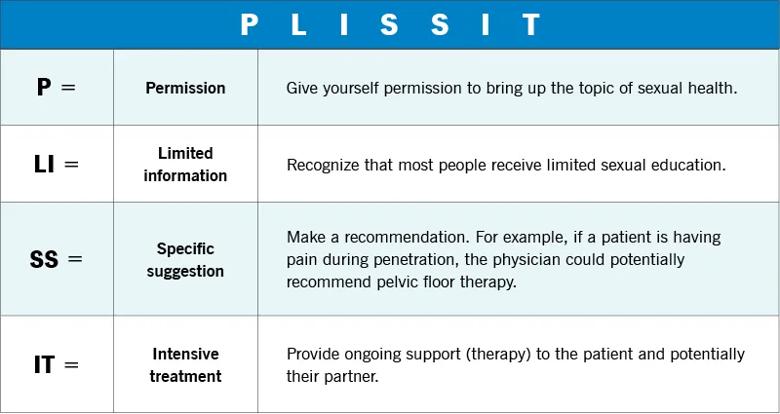
Image content: This image is available to view online.
View image online (https://assets.clevelandclinic.org/transform/5d8b5ccb-3a56-4b13-b705-d3168f2f5594/sexual-health-issues-and-cancer-chart)
PLISSIT communication tool chart
“The permission piece is key,” she says. “Asking open-ended questions like do you have any sexual health concerns can help the patient know this is a safe space to bring it up.” If the patient does have an issue, the doctor can refer them to a sex therapist. The therapist can take it from there and talk directly with the patient, and their partners if they wish, to understand what’s going on and make specific treatment recommendations.”
Discussion timing
Providers often aren’t unclear when the right time is to discuss sexual health. Dr. Callard-Moore recommends bringing it up at multiple points in the patient’s cancer journey.
“If the doctor mentions it at the time of diagnosis, this may not necessarily click since the patient is facing something very scary, but it plants a seed so they know it’s ok to bring it up,” she says. “Patients need to be informed so that when they get to survivorship, they have a way to cope with those changes because they knew they were coming.
During treatment, they may not be feeling great, so the chances of sex being top of mind are low, but the patient still gets the message that they can talk about any sexual concerns. It’s usually in survivorship that patients and partners want to understand how to have a pleasurable sex life going forward.”
Treatment options
Today, there are many approaches to helping patients to preserve sexual function.
- Nerve-sparing techniques help those undergoing bladder cancer surgery to preserve erectile function without compromising tumor removal.
- Daily or one-time doses of erectile dysfunction (ED) medications like sildenafil and tadalafil are effective in roughly 60% of cases.
- Medical-grade penile vacuum pumps pull blood into the penis and employ a flexible band at the base of the penis to hold the blood in place to maintain an erection. Since this isn’t a pill, there are few chances of side effects. This option can also be used in conjunction with an ED pill.
- Prescription penile injection therapy involves the patient using a very small needle to inject a small dose of a vasodilator into the base of the penis before sexual contact. (Note: This is different from platelet-rich plasma injections, which have not been scientifically proven effective.)
- Penile implants are a permanent surgical option that may be considered if other alternatives have not worked. Some studies found patients who underwent this procedure had greater improvements in their Erectile Function score than those who received injection therapy.
Key points
Educating patients about treatment options and time-to-improvement is advantageous. “We want people to know all their options so that they don’t get frustrated if one thing doesn’t work,” says Dr. Callard-Moore. She notes that:
- Treatment isn’t one-size-fits-all. For example, dosing of ED medications can vary, and if one approach doesn’t work, providers can make adjustments accordingly. Sometimes treatment involves talking with a psychotherapist to find different ways to achieve pleasure.
- Recovery can take time. Usually, patients see improvement one to two years after cancer treatment.
- Men can still have an orgasm without an erection. “There are things we can do that are pleasure-centered that don’t require an erection.”
Addressing medical and psychological issues
Sexual dysfunction may involve a combination of medical, emotional and relational issues. “It’s usually a combination of factors influencing the situation,” says Dr. Callard-Moore. “Is the patient worried about disappointing their partner? Are they feeling anxious? This can cause sexual dysfunction because their body is in fight or flight mode. Our goal is to understand the underlying causes and support them in achieving intimacy, connection and pleasure.”
