




For years, ready-to-drink cartons carrying images of apples or oranges led people to confuse flavoured electrolyte drinks with oral rehydration solution (ORS) options for children. Pharmacies and retail outlets frequently pushed these drinks instead of actual ORS options onto unsuspecting parents, who were unaware of the distinction. What the parents thought was a treatment for diarrhoea and dehydration was only worsening the health of their children.
When many of her patients (children) with diarrhoea were not getting better despite consuming what they assumed was ORS, Dr Sivaranjani Santosh of Hyderabad traced the cause to these electrolyte drinks. Thus began her journey, nearly six years ago, against deceptive branding.
A renowned paediatrician and public health activist, Dr Sivaranjani has found several allies among her peers and in the public in the years that followed. The movement has gained momentum both online and offline. In 2022, she filed a public interest litigation petition in the Telangana High Court and has regularly appealed to national regulatory bodies to act on brands that put children at risk.
On October 14, 2025, when the Food Safety and Standards Authority of India (FSSAI) banned misleading ORS labels across the country, it seemed like the movement had won. But the victory was short-lived, as the saga of misleading branding continues.
Over the past two weeks, Dr Sivaranjani and others have once again intensified their campaign, at the heart of which is the rebranding strategy of Kenvue, which public health advocates are calling deceptive and harmful. (Kenvue was earlier the Consumer Healthcare division of Johnson & Johnson.)
Sneaky rebranding
For years, Kenvue’s ORSL has dominated India’s flavoured electrolyte drink market. Subsequent to the ban on misleading ORS labelling, JNTL Consumer Health, Kenvue’s subsidiary in India, rebranded ORSL as eRZL, but also retained the ORSL trademark. On January 21, 2026, the company announced that this was its “dual brand strategy”. As per the latest announcement, Kenvue will now sell WHO-recommended ORS under the ORSL label, whereas what was previously sold as ORSL will now be sold as eRZL. (Image 1)


Image 1
| Photo Credit:
By Special Arrangement
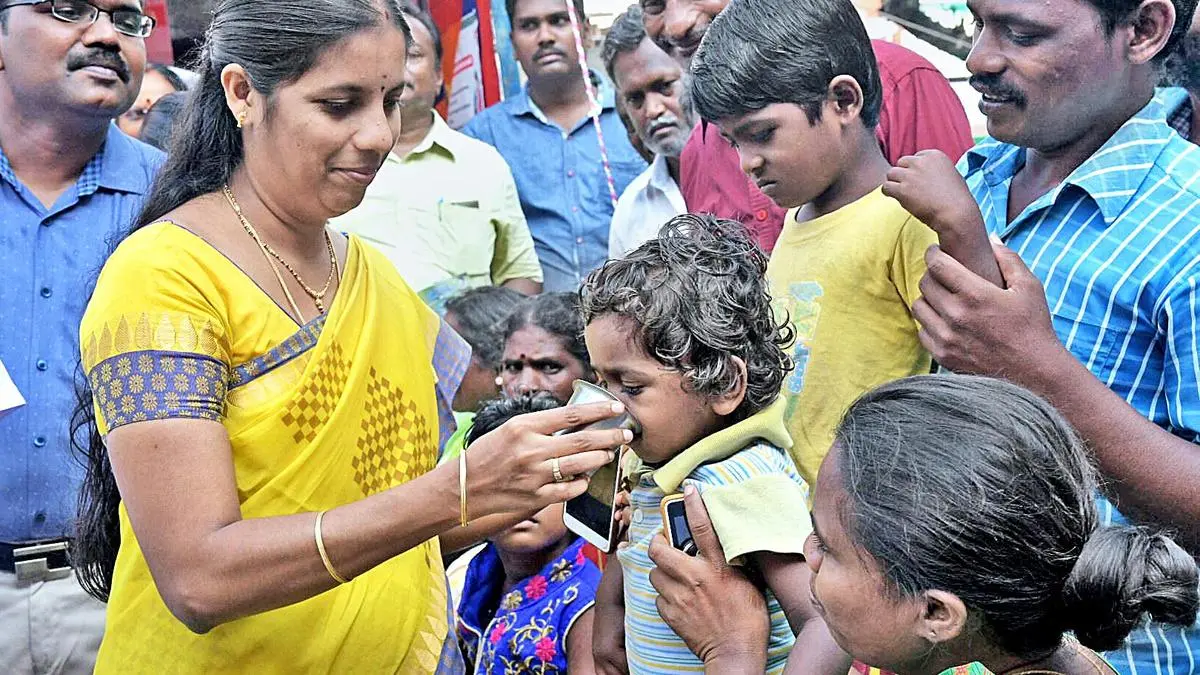
Public health activists like Dr Sivaranjani are sounding the alarm and taking pre-emptive steps to prevent accidental consumption of non-ORS drinks by sick children.
Kenvue in spotlight
In an email exchange with Frontline, a Kenvue spokesperson said that the company has always been in compliance with FSSAI’s orders and directions. “Further, to comply with the latest directions of FSSAI requiring use of brand names not containing the term O-R-S, we have rebranded our electrolyte drinks under completely a new and distinct brand name, ‘eRZL’. We have, thus, already duly addressed the potential concerns of the food authorities,” the spokesperson added.
However, public health advocates argue that the new name is merely a superficial change designed to maintain brand recognition among the public while technically complying with the letter of the law. Kenvue did not respond to Frontline when asked about the rationale behind the virtually identical packaging.
While swapping ORSL with eRZL may fulfil regulatory requirements, the visual similarity cannot be dismissed. In fact, Johnson & Johnson Pte Ltd itself flagged such visual similarity in the past.
In 2023, Johnson & Johnson filed a suit in the Delhi High Court seeking a permanent and mandatory injunction against Abbireddi Satish Kumar (and others) for using “ERSI” in their products. The grounds for the case were deceptive similarity to Johnson & Johnson’s registered trademark and trade dress and the likelihood of customer confusion. The company won the case and Rs.1.21 crore in damages in July 2025. (Image 2)


Image 2
| Photo Credit:
By Special Arrangement
Kenvue is not the only brand with a similar design for ORS and non-ORS ready-to-drink tetrapacks, but the concern with Kenvue appears to be greater because it dominates the market.
Speaking to Frontline, Dr Sivaranjani said: “The font design of eRZL links to the memory of the previous name ORSL, and this association should be removed. Companies should not be allowed to label their fruit juices or energy drinks as ORS or anything similar—be it DRS, GRS, QRS, URS, CRS, or eRS (where the ‘e’ looks like ‘O’), or basically anything that the people may mistake for ORS, the life-saving solution.”
Dr Sivaranjani has written to the Registrar of Trade Marks (on January 18), requesting that the eRZL trademark be refused. On January 22, she wrote to Rajit Punhani, CEO of FSSAI, about the same concerns.
ORS formulation and how it works
The WHO-recommended ORS formulation is backed by decades of evidence and has saved the lives of millions of children worldwide. The fundamental issue here is that the formulation of flavoured electrolyte drinks does not adhere to the scientific formulation for rehydration and can actually worsen the health of children in the event of accidental consumption.
WHO’s ORS is an elegantly simple formula that leverages a sophisticated molecular mechanism to treat dehydration. A 20.5-gram ORS sachet contains about 13.5 grams of glucose (anhydrous dextrose), 2.6 grams of sodium chloride, 1.5 grams of potassium chloride, and 2.9 grams of sodium citrate.
This formula ensures that the osmolarity of ORS is 245 milliosmoles per litre. Osmolarity is the measure of the number of dissolved particles in a liquid and the WHO recommendations are based on decades of evidence about the optimal osmolarity for efficient absorption.
Also Read | Can Arogya Mandirs replace Mohalla Clinics?
The risk of diarrhoea in children is associated with dehydration. The younger the child, the higher the risk of dehydration-related fatality, as rapid fluid loss shocks their organs and other vital functions. Dehydration can also rapidly deteriorate in children under two. In India, in the under-5 age group, 13 out of 100 deaths are caused by diarrhoea.
The precise balance of glucose and sodium in WHO-recommended ORS activates the sodium-glucose co-transporter, which enables water absorption into the bloodstream. During diarrhoea, when young children undergo rapid dehydration, ORS helps rehydrate them and maintain fluid balance. Plain water does not work the same way.
How electrolyte drinks harm kids
Pre-packed electrolyte drinks that do not use the WHO-recommended formula do not have the same effect as ORS. In fact, they are counterproductive and put children with diarrhoea in harm’s way, because high sugar content in pre-packed electrolyte drinks pulls excess water into the gut rather than into the bloodstream, thereby worsening diarrhoea. Instead of improving, getting rehydrated, and slowly recovering, children suffer prolonged, worsening diarrhoea, with some requiring hospitalisation. The impact of such drinks on children with diabetes is also a growing cause of concern.
Speaking to Frontline about the risks of such high-sugar electrolyte drinks, Dr Chetan Ginigeri, a children’s emergency and ICU specialist based in Bengaluru, said that in oneinstance, a child who was a burn patient developed diarrhoea after being put on oral fluids during the recovery phase. Dr Chetan’s team initially thought it was an infection but later discovered the child had consumed a tetrapack electrolyte. In another instance, a diabetic child needed to be hospitalised after consuming ORSL while suffering from diarrhoea and vomiting. Numerous such case studies shared by concerned doctors are available on social media platforms.
In the face of criticism over high sugar content, some brands have launched low-sugar, stevia, and zero-sugar versions of their flavoured electrolyte drinks.
In a January 21 update, eRZL (Kenvue) stated that its relaunched drink now had “87 per cent” less sugar. However, the fine print shows that it now uses sucralose, an artificial sweetener. Such products do not help in rehydration during diarrhoea as they ignore two principles: an osmolarity of 245 milliosmoles per litre and the glucose-sodium co-transporter. Artificial sweeteners fail to activate the ORS mechanism and can, in fact, cause bloating or vomiting, leaving children inadequately rehydrated, Dr Sivaranjani said.
Also Read | India’s broken oath of care
Paediatricians are against artificial sweeteners in children under two, and these products are not recommended regularly even in older children. Dr Sivaranjani is now investigating if brands selling ready-to-drink packs of WHO-recommended ORS are using artificial sweeteners as excipients (to enhance palatability). “It doesn’t matter whether it is less sugar or more sugar. If it is not the WHO-mandated ORS, we don’t want people, especially parents, to mistake it for ORS,” Dr Sivaranjani said.
Corporate greed
A key factor in the widespread adoption of WHO’s ORS worldwide is that it is the most cost-effective, medically approved treatment for dehydration (in children). The ready-to-drink electrolytes, however, have a much higher profit margin than ORS formulations. Corporate greed is part of the equation here and fighting it is an uphill battle.
According to reports, the country’s oral rehydration solution market is estimated to be worth around Rs.1,000 crore a year. Kenvue’s eRZL, formerly ORSL, is an electrolyte sold only in India. The company had originally acquired the product from an Indian company called Jagdale Healthcare in 2014.
Regulatory gaps
The Central Drugs Standard Control Organisation (CDSCO) is the country’s regulatory body that oversees drugs, cosmetics, and medical devices, imports of drugs, new drugs, clinical trials, and many related products and processes. For years, companies have bypassed CDSCO and registered electrolyte drinks under the FSSAI as food products. Experts pointed out that there is no provision for inter-departmental coordination between CDCSO and FSSAI to monitor misleading products.
There is a provision in the Trade Marks Act,(1999, to refuse trademark registration if it “is of such nature as to deceive the public or cause confusion” as per Section 9(2(a)). However, there is no provision in the Act that allows refusal of a trademark if it resembles the name of a drug.
Companies have exploited regulatory loopholes for years, but the problem goes beyond regulation.
Dr Chetan said: “The resistance is from multiple sides. It is not easy to solve just by regulation. Often, patients may not trust what medical field practitioners prescribe. The public is mistrustful of the medical community. Prescriber and seller integrity is as important as consumer awareness.”
Also Read | The next step in universal care
Criticism of IAP
For years, public health activists have appealed to the Indian Academy of Pediatrics, a professional body with over 47,000 members and branches in all States, to take an official stance against ORSL (now eRZL) and other such drinks. However, IAP has sponsorship links with Kenvue. At an IAP conference in January 2025 in Hyderabad, Kenvue introduced a ready-to-drink WHO-recommended ORS while hosting a stall for ORSL as well.
Dr Chetan said: “In a system where elections become the way to select members of an academic body, it’s all a matter of bringing more votes, bringing popularity, rather than science per se. If a member who is supported by one of these companies is a key stakeholder in the professional body, how is he likely to stand up and say that what is happening is wrong?”
Dr Sivaranjani said: “Why does IAP need sponsorship from a company that is jeopardising the lives of children? They can raise funds through other ethical companies. Why do they need funds from this company? Everything is about money.”
Frontline contacted IAP over email, and the former IAP president, under whose term the recent sponsorship tie-ups happened. They had not responded at the time of filing of the story.
Regulatory loopholes, conflicts of interest, high profit margins, corporate greed, and social media-fed misinformation make it harder to fight ORS-related mislabelling with bans alone, but they are the first step in that direction. And doctors like Sivaranjani are in no mood to end their fight. “I cannot give up. I have to fight for this tooth and nail,” she said.


