





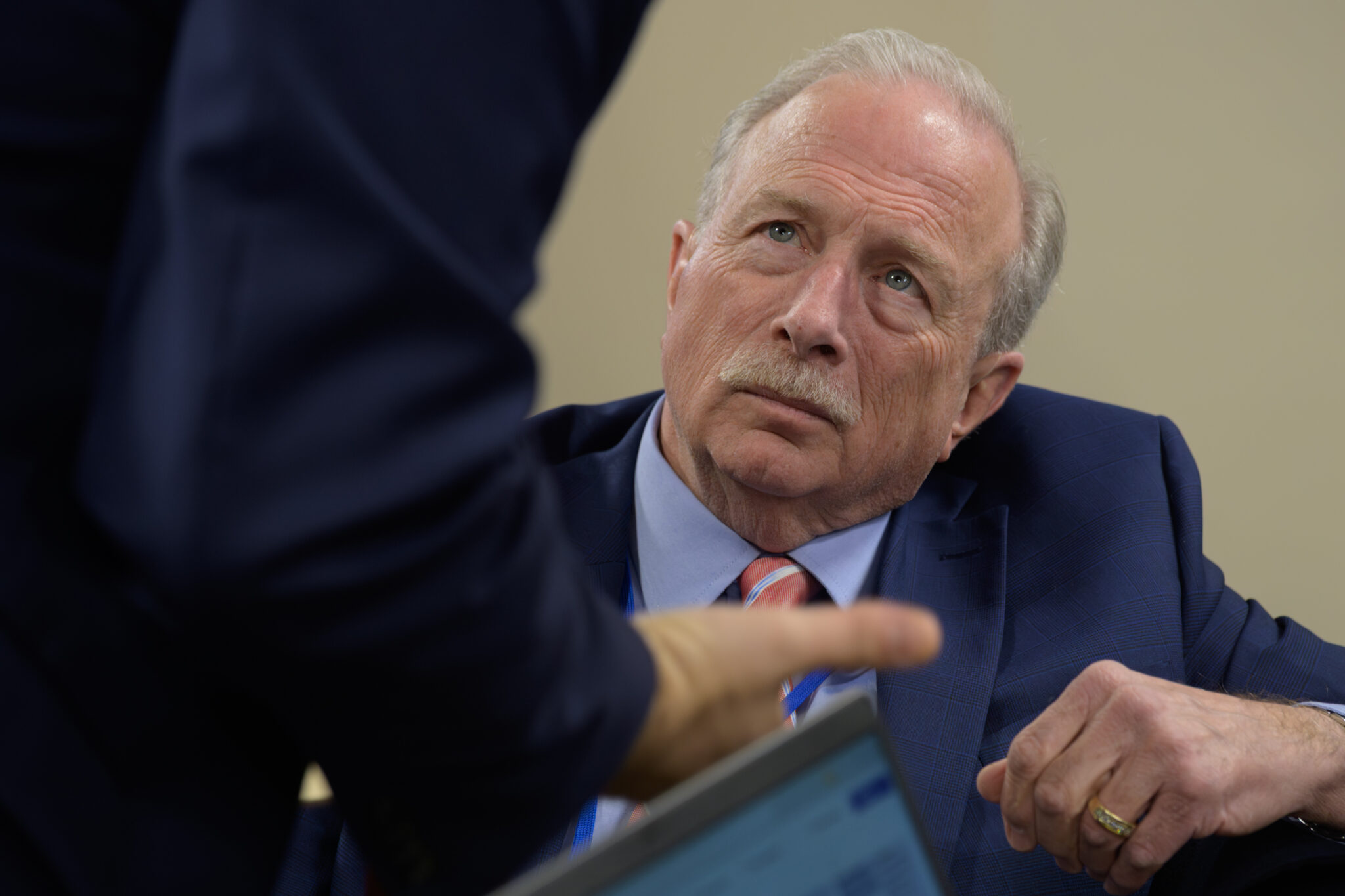
Rhode Island Health and Human Services Secretary Richard Charest isn’t retiring after all.
At least, not on July 3, as McKee’s office previously announced.
Details of the reversal were first reported in a June 10 social media post by the Providence Journal’s Katherine Gregg and confirmed independently by Rhode Island Current.
Kerri White, a spokesperson for the umbrella health and human services agency, said the decision came from “thoughtful discussions” between the agency and McKee’s team about the need for continuity in the leadership team.
“With major priorities underway – including new federal laws impacting Medicaid, the Rural Health Transformation Project, and the long-term acute care hospital work – maintaining stable leadership is important,” White said in an email.
Charest was unavailable to comment.
McKee said he asked Charest, 74, to “stay as long as he could,” praising his cabinet leader for his five-year record with the state, first at the Department of Behavioral Healthcare, Developmental Disabilities and Hospitals, and then as head of the sweeping health and human services agency that encompasses a $5 billion Medicaid program along with social and health programs for some of the state’s most vulnerable residents: children, low-income families, veterans and people with mental health needs and disabilities.
“I asked him to come on for a year, it’s been five years so he’s given me more than I asked for,” McKee said in an interview Friday. “But I said, ‘Look, stay on as long as you can, we’ve got some things we need to address.’”
As he continues in his $238,597-a-year job, Charest will be charged with keeping track of state spending of the $156 million federal grant for rural healthcare, along with implementing massive policy and funding changes for federal Medicaid and Supplemental Nutrition Assistance programs.
In announcing his retirement in April, McKee’s office praised Charest for distributing grants to primary care practices, coordinating overdose prevention efforts and setting up an outpatient behavioral health program. But Charest faced criticism last fall for reaching out to Prime Healthcare, his former employer and owner of Landmark Medical Center in Woonsocket, to gauge its interest in buying Roger Williams Medical Center and Our Lady of Fatima Hospital when a deal was already pending to another operator. Charest served as president and CEO of Landmark from 2007 to 2017, including through its receivership and sale to Prime.
McKee on Friday referenced their shared Woonsocket connections — the governor ran a health and fitness center in Woonsocket for 30 years — as the start of their relationship.
“I know him personally,” McKee said. “He’s done good work.”
The McKee administration had not begun interviewing candidates to replace Charest, with the temporary plan to promote someone internally as an acting secretary akin to the Rhode Island Department of Transportation, McKee said. Bob Rocchio took over as interim director of the transportation department in March after longtime director Peter Alviti Jr. retired.
McKee did not say how long Charest will extend his tenure with the state but suggested it may be short.
“We’re going to extend it a little bit and we’ll see what happens,” he said.
A new timeline for Charest to retire has not been determined, White said in an email Monday.
Charest, who has a bachelor’s degree in pharmacy from Northeastern University and a master’s degree in health care administration from Bryant University, also runs his own consulting firm, 180 Degree Solutions LLC, according to his 2025 financial disclosure statement filed with the Rhode Island Ethics Commission.


