





Digital technology has created new options for parents to stay informed about their children’s whereabouts, even as those children reach adulthood. The C.S. Mott Children’s Hospital National Poll on Children’s Health asked a national sample of parents about their use of and attitude toward location tracking of their young adult children age 18-25.
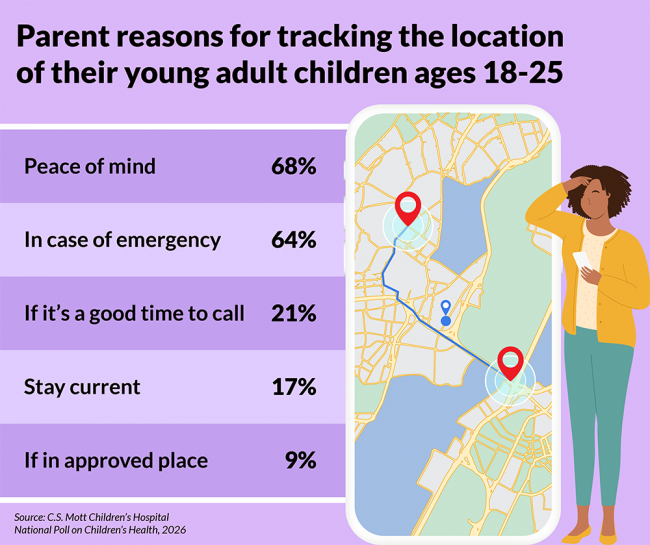
About half (52%) of parents report tracking their young adult child’s location using a cell phone or similar device. Tracking is more common among parents of young adults 18-20 compared to age 21-25, and more common for daughters than sons. Parents say they track their young adult child’s location for peace of mind (68%), in case of an emergency (64%), to know whether it’s a good time to call them (21%), to stay up to date on what their child is doing (17%), or to make sure their child is in places they approve of (9%); 11% say there’s no particular reason for tracking.
Most parents who track their young adult child’s location (71%) say the tracking feature is always on while 29% use tracking only in certain situations. Parents are more likely to check their child’s location if they are out late at night (44%), in an unfamiliar place (39%), using a rideshare or taxi service (25%), or out with someone they don’t know (23%). While 95% of parents who track their young adult child’s location say it helps them worry less, 23% acknowledge it sometimes makes them more anxious than reassured. Nearly all parents who track their young adult child’s location (96%) indicate that their child is aware the parent is tracking them; however, only 54% of parents say they gave their young adult child the option to not have them track their location. Parents of young adults age 21-25 are more likely than parents of children 18-20 to say they gave the option to not track (61% vs 47%).
Parents have mixed views on the impact of tracking. Two-thirds (65%) of parents who do not track, compared to only 16% who do, think tracking feels like an invasion of their child’s privacy. About half (51%) of parents who do not track their young adult child, compared to 11% who do, think tracking may prevent their young adult child from becoming independent and responsible.
About half of parents (48%) say their young adult child tracks their location. In 90% of these cases, the parent is also tracking the young adult child.

Highlights
- Half of parents report tracking their young adult child’s location at least occasionally.
- Nearly all parents who track their young adult child’s location say their child is aware of the tracking.
- 1 in 4 parents who track their young adult child’s location say it sometimes makes them more anxious than reassured.
- Only half of parents say they gave their young adult child the option to opt out of location tracking.
Implications
As smartphones have become ubiquitous, location tracking is now widely accessible through built-in features and apps, offering convenient ways for parents to monitor their child’s whereabouts. As children become young adults, questions arise about whether and when parent location monitoring is appropriate.
Findings from this Mott Poll suggest that parents of young adults are divided on this issue. About half of parents use location tracking on their young adult child’s phone; these parents say it helps them worry less. These parents use location tracking as a way to reduce uncertainty and increase their sense of security. Their most commonly reported reasons for tracking – peace of mind and use in emergencies – highlight the perceived safety benefits of these tools.
At its best, such as when a young adult is travelling late at night or using rideshare services, location tracking provides reassurance to both parents and young adults, and facilitates a quick response if an unsafe situation arises. At its worst, constant location tracking can prompt parents to take over management of their young adult child’s daily life, asking why their child isn’t at work, at a doctor’s appointment, or in class. With that type of hovering, the young adult has less ownership of their own schedule and obligations, and less responsibility to figure out how to be a successful adult.
The other half of parents do not track their young adult child; these parents are more likely to view tracking as an invasion of their young adult child’s privacy or an impediment to developing independence and responsibility – important aspects of young adulthood. Privacy refers to a young adult’s ability to control access to their personal information, while independence involves making decisions and managing responsibilities without parental oversight. Location tracking may affect both, especially if used without clear boundaries or mutual agreement.
Notably, while nearly all parents who track their young adult child’s location report that their child is aware of the tracking, only about half said they offered their child the option to opt out. This suggests that, in some families, tracking may be viewed as a default rather than a negotiated decision. When young adults do not have a role in deciding whether or how tracking occurs, it may contribute to perceptions of intrusion or limit opportunities to build autonomy.
Parents in this Mott Poll were more likely to track the location of their daughters than sons. However, constant location tracking by parents may interfere with young women learning to keep themselves safe. For example, many young women use location-sharing features with friends to look out for one another, such as when traveling, meeting new people, or returning home late at night. This peer-based sharing strategy can promote safety while still allowing young adults to make independent choices about when and with whom to share their location. Safety and independence can coexist, and location tracking is one of the several tools that can support that balance.
An unexpected finding in this Mott Poll is that parent tracking of young adult children is often mirrored by those same young adults tracking their parents’ location. This may offer parents an opportunity to examine their feelings about being tracked. Discussing when tracking may be helpful, such as during travel or emergencies, as well as when it may be unnecessary can help align young adult and parent perspectives. Establishing shared understanding may also reduce conflict and support the development of trust as young adults transition toward more independence.
Used judiciously, location tracking can function as a safety net during transitional periods when young adults are gaining experience navigating the world. Families will benefit from thoughtful discussion about how to use these technologies in ways that support safety while respecting privacy and independence.


