

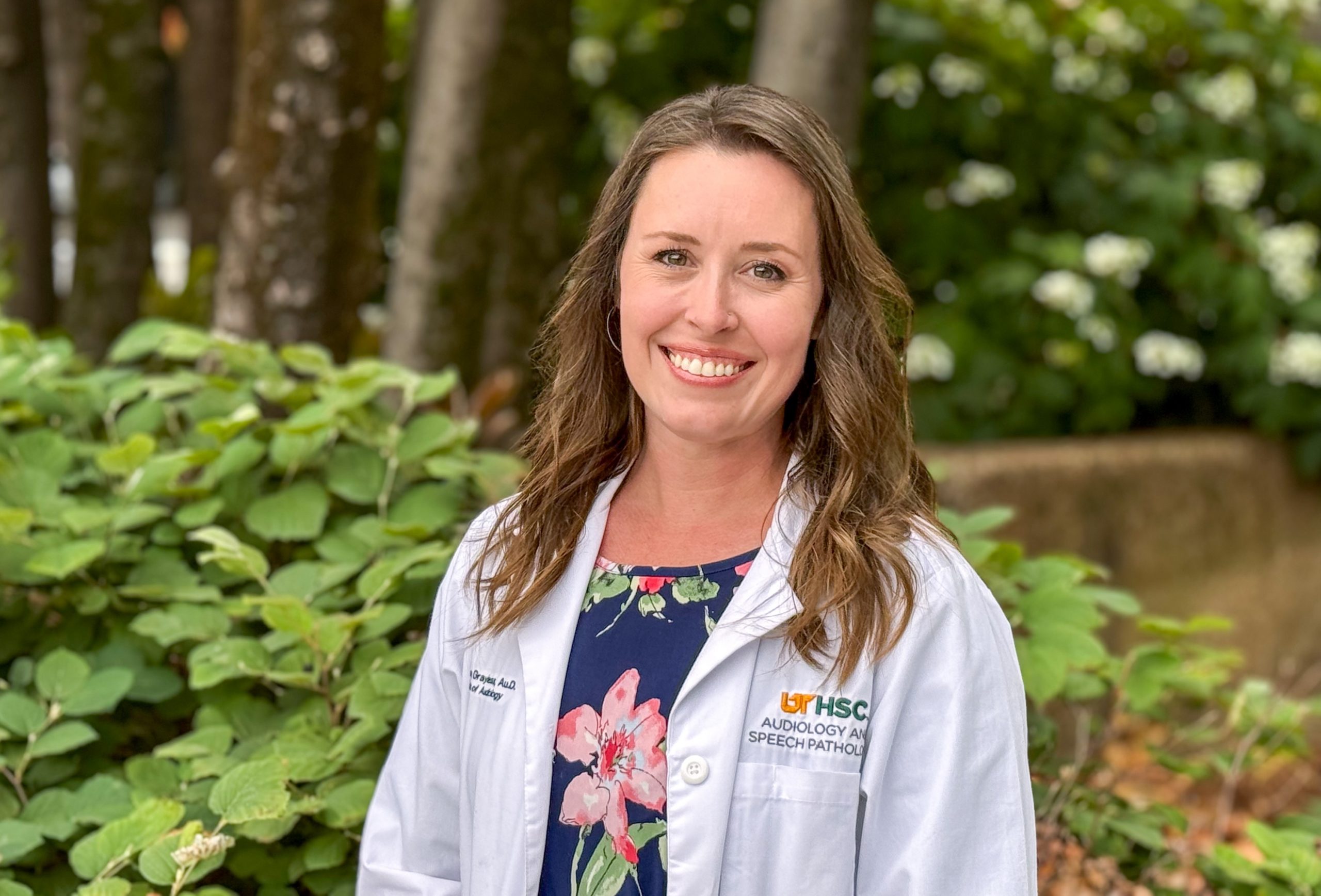

Brittany Grayless holds not one but two doctorates from the University of Tennessee Health Sciences.
Already a Doctor of Audiology (AuD), she graduated in May with a PhD in Speech and Hearing Science from the university.
“You are never done learning,” says Dr. Grayless, a clinical associate professor in the Department of Audiology and Speech Pathology , which is located in Knoxville. “There’s always more to learn to better yourself, whether it is for yourself or for your community, and you should always pursue what you want to learn.”
Setting an Example
Her dedication to learning has not gone unnoticed by those who teach and those who train in the department. “By pursuing two doctoral degrees, Dr. Grayless has shown that learning is a tool for impact, constantly improving outcomes for her patients, while strengthening the knowledge base, skills, and empathy she instills in her students through patient-centered teaching, translational research, and mentorship,” says Ashley Harkrider, PhD, dean of the College of Health Professions, which includes the Department of Audiology and Speech Pathology.
The department operates the Knoxville area’s only academic hearing and speech clinics. It offers degree programs for undergraduate, graduate, and doctoral education in audiology and speech pathology, and its Doctor of Audiology program is ranked No. 23 in the country.
A 2013 graduate of the department, Dr. Grayless has built a busy clinical practice there focusing on diagnosing and treating tinnitus.
“When I was a student pursuing the AuD, I completed my fourth-year externship at Duke Medical Center and was trained on providing services to tinnitus patients,” she says. “It became something I absolutely loved.”
After a stint in a practice in Nashville following graduation, she learned one of her previous clinical supervisors who trained her in Knoxville was retiring. She applied for the job and got the position.
“One of the reasons was because I could bring that new specialty area to the department, and so I created the tinnitus clinic, created the tinnitus class, and we also have a research component as clinical faculty,” Dr. Grayless says.
Care Spurs Research
That clinical practice, which draws patients from across the region, encouraged her interest in researching the causes of the condition and new ways to treat it. That interest led her to pursue her second doctoral degree.
“I started thinking about the tinnitus practice, which had started really growing. I had all these ideas for research in my mind,” she says. “There was no other person here leading these tinnitus projects, and it just made sense for me to pursue the PhD so I could be that person.”

Dr. Grayless says 20% of the population experiences tinnitus, the perception of ringing, buzzing, clicking, or hissing in the ears or head without an external stimulus. The most common cause of tinnitus is hearing loss. However, tinnitus can also result from noise exposure, an illness, an injury, or stress. Additionally, about a fourth of those with the condition experience bothersome tinnitus.
“There is a wide, wide range of bothersome, some people will have ringing in the ears and not notice it at all,” she explains. “And then other patients are on the other end, experiencing suicidal thoughts.”
“One of the things that researchers are interested in is trying to figure out what makes some people bothered by their tinnitus and others not,” she says. “What strategies and treatment plans can we implement to make tinnitus less bothersome?”
Specifically, her research has looked at the effects of patients coming into the clinic to receive a comprehensive tinnitus evaluation. “Overall, tinnitus distress went down, hope levels went up, and for some patients, anxiety went down,” she says. Her dissertation incorporated a personality assessment to see if different personalities respond differently to the information from a comprehensive evaluation.
“You know, knowledge is power and that’s what we’re finding out with my studies. By giving patients information about it (tinnitus), where it comes from, without any formal treatment plan, tinnitus bothersome is improving,” she says.
Forever Grateful
Diane Smith of Knoxville is a case in point. She was referred to Dr. Grayless after seeing multiple healthcare providers following a traumatic ear accident.
“I was in such pain, lost hope until Dr. Grayless,” says Smith, a UT Knoxville graduate. “She listened, I cried, regained hope I could have a quality of life again after she explained the horrible noise in my head from a TBI (traumatic brain injury).”
“I started counseling with her, and slowly as I practiced her tools to cope with tinnitus, my depression score decreased,” Smith says. “Today I am living a high quality of life and the tinnitus that is still present is not crippling my daily activities and functioning. I am forever grateful.”
Not Easy, But Worth It
Dr. Grayless believes the PhD has enhanced her teaching and clinical practice, as well as her research.
Pursuing a second doctorate wasn’t easy with three children ages 9, 7, and 4. She says her children were one of her motivations, as she wanted them to see that you can achieve anything you put your mind to. She credits her husband, Justin Grayless, a battalion chief for the Bradley County Fire Department, for supporting her through the journey.

“In hindsight, I would not do anything different,” she says. “Getting the PhD as a clinician has just been really, really valuable.”
According to Dr. Harkrider, who served as the chair of the department for 16 years before becoming dean of the college in 2025, Dr. Grayless exemplifies the strength and professionalism of the individuals who train students, deliver outstanding instruction, and produce meaningful research in this highly ranked department.
“I’ve had the privilege of knowing Dr. Grayless as a student and a colleague, and in both roles, she has stood out for her intellectual rigor, clinical excellence, and commitment to educational excellence.”
