





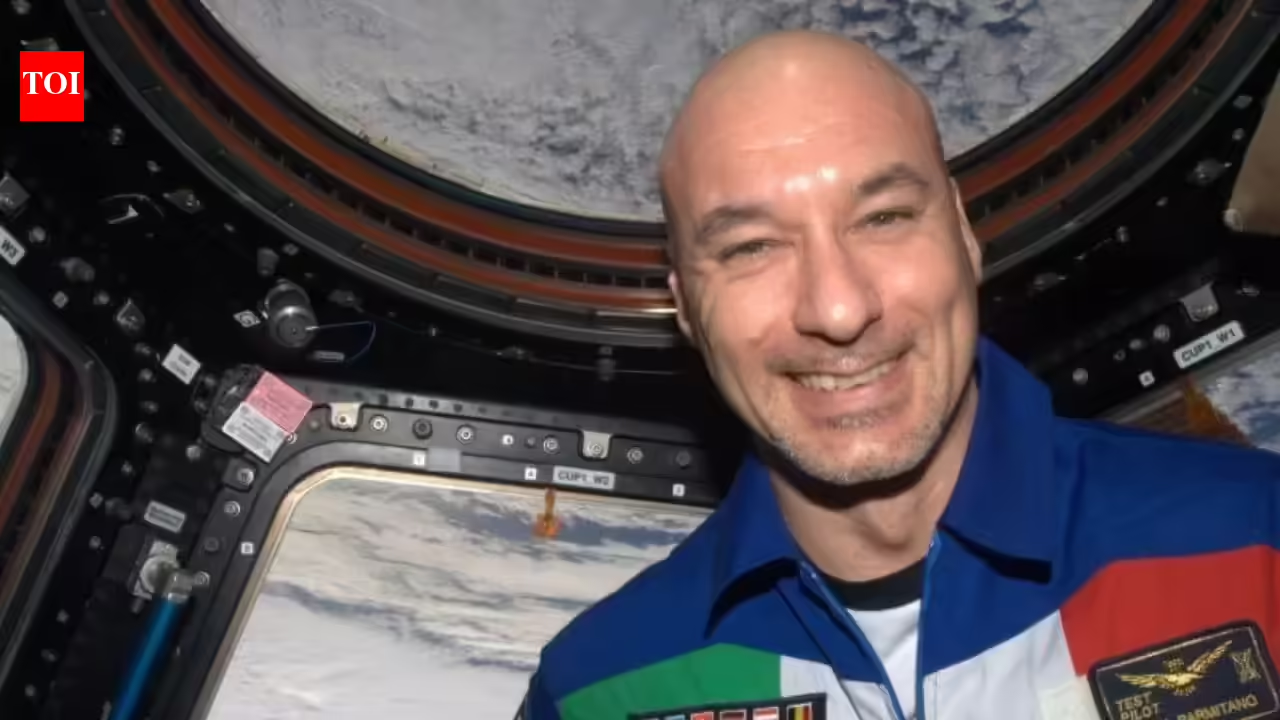

In July 2013, Italian astronaut Luca Parmitano found himself in a situation no astronaut ever wants to face. While performing a spacewalk outside the International Space Station, water began leaking into his helmet. What initially seemed like sweat soon turned into a life-threatening emergency as the water rose around his face, impairing his vision and hearing. More than a decade later, Parmitano’s career has come full circle. The astronaut who survived one of the most dangerous spacewalk incidents in modern history has now been selected as a member of NASA‘s Artemis III crew, placing him at the centre of humanity’s next chapter in deep-space exploration.
The day Luca Parmitano nearly drowned in space
On July 16, 2013, Parmitano exited the International Space Station for what was expected to be a standard six-hour spacewalk. Roughly an hour into the mission, he noticed moisture accumulating inside his helmet.At first, he assumed it was sweat. However, the liquid continued to spread. Water soon covered his eyes, entered his nose and ears, and made communication increasingly difficult. In the weightlessness of space, water does not fall away as it would on Earth. Instead, it forms floating globules that cling to surfaces.As the amount of water increased, Parmitano’s ability to see and hear deteriorated. Finding his way back to the station became increasingly difficult. NASA later determined that a malfunction in the spacesuit’s cooling system had allowed water to leak into the helmet.The incident is widely regarded as one of the most dangerous spacewalk emergencies ever experienced by an astronaut.Parmitano later described the event as the closest he had come to death. The water had formed a growing bubble around his head, raising fears that it could eventually block his airway. Mission controllers immediately terminated the spacewalk, and Parmitano carefully navigated back to the airlock despite limited visibility.NASA’s subsequent investigation resulted in significant changes to spacesuit procedures and safety protocols. The incident became a major case study in astronaut safety and risk management.
From fighter pilot to astronaut
Long before the spacewalk incident made headlines, Parmitano had built an impressive career in aviation and engineering.Born in Paternò, Sicily, he joined the Italian Air Force and trained as a fighter pilot. He accumulated thousands of flight hours on military aircraft before being selected as an astronaut by the European Space Agency in 2009.His technical expertise, operational experience and calmness under pressure quickly established him as one of Europe’s leading astronauts. Following his recovery from the 2013 incident, he continued to fly missions rather than allowing the experience to define or limit his career.
Returning to space and commanding the ISS
Many astronauts would have struggled to return to space after such a traumatic event. Parmitano did the opposite.In 2019, he returned to the International Space Station and later became commander of the orbiting laboratory, making him the first Italian astronaut to hold the position. During his missions, he accumulated more than 360 days in space and conducted multiple spacewalks, demonstrating that the 2013 incident had not diminished his confidence or capabilities.His willingness to return to the environment where he nearly lost his life earned widespread respect within the international space community.
The road to Artemis III
In June 2026, NASA announced Parmitano as one of the four crew members assigned to Artemis III. The selection marked another major milestone in a career already filled with extraordinary achievements.The Artemis programme is intended to establish a long-term human presence beyond low-Earth orbit and lay the groundwork for future exploration missions. Parmitano’s inclusion also represents a historic moment for Europe, as he became the first European Space Agency astronaut assigned to an Artemis crew.For an astronaut who once fought for survival outside the International Space Station, the assignment serves as a remarkable testament to perseverance and trust earned through decades of service.


