






Not every quote explains itself immediately. Some sit quietly for a while before their meaning becomes clearer. The quote by Louis Pasteur is one of those. It speaks about inspiration, personal conviction and the unseen reasons behind human actions. At a glance, the wording may feel old fashioned, but the idea underneath remains familiar. People make decisions every day based on beliefs, ambitions, values and instincts that are often invisible to others. What appears to be a simple action on the surface may have a much deeper source. Pasteur’s observation shifts attention away from achievements themselves and towards the motivations that produce them. In a time when success is often measured through visible results, the quote offers a reminder that the reasons behind an action can matter just as much as the action itself.
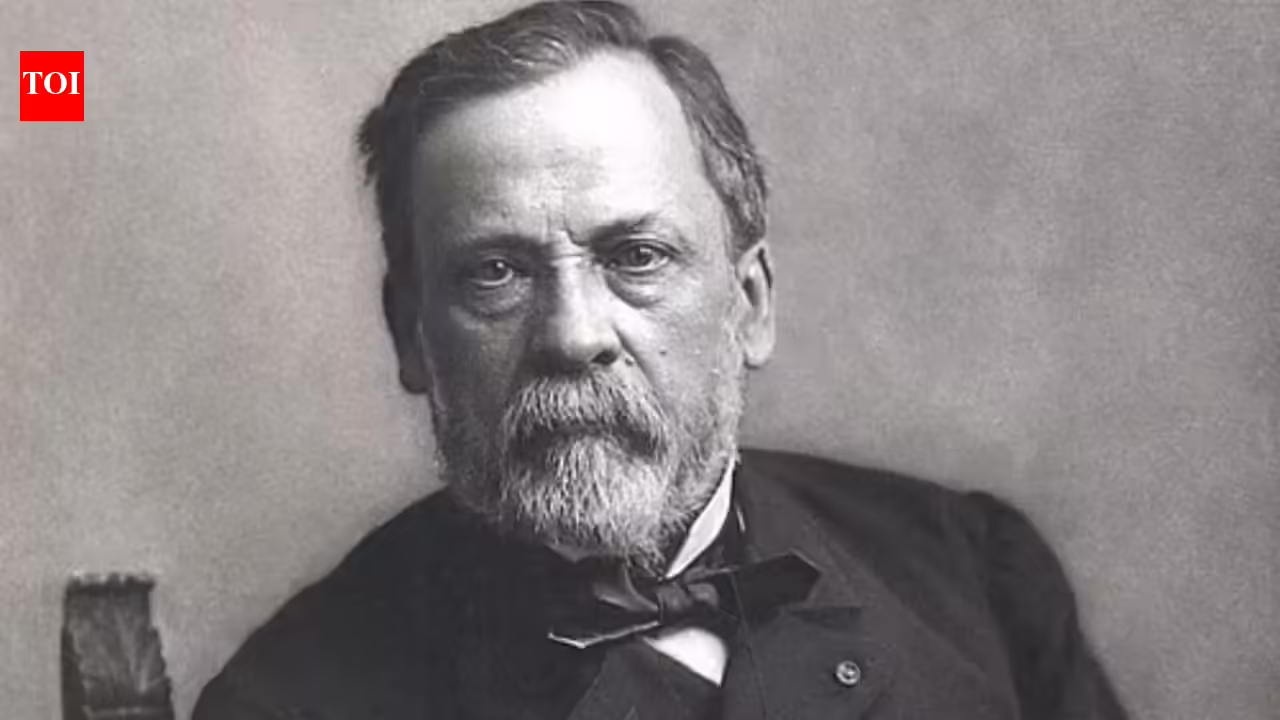
Quote of the day by Louis Pasteur
“Happy is he who bears a god within, and who obeys it. The grandeur of human actions is measured by the inspiration from which they spring.”
Louis Pasteur’s quote focuses on what drives people
“Happy is he who bears a god within, and who obeys it. The grandeur of human actions is measured by the inspiration from which they spring.”The language belongs to another century, but the central thought is surprisingly simple.Pasteur appears to be speaking about an inner guide. Some people may interpret that guide in a spiritual sense. Others may see it as conscience, purpose, principle or a deeply held belief. Whatever form it takes, the idea remains the same. Human beings often carry something inside them that influences their choices.That influence is not always obvious.A person may spend years working towards a goal. Outsiders see the result. They rarely see the motivation that kept the person moving when progress was slow or uncertain.
The source of an action is often overlooked
People tend to notice achievements first.Awards, promotions, discoveries and public recognition attract attention because they are visible. The process behind them receives less discussion.Yet two people can do exactly the same thing for very different reasons.One person may act out of obligation. Another may act because they genuinely believe in what they are doing. The outcome might appear identical, but the inspiration behind it is not.That distinction seems to sit at the centre of Pasteur’s quote.He is not measuring actions only by their size or impact. He is suggesting that their value is connected to where they come from.
Louis Pasteur understood the role of purpose
Pasteur was not a philosopher by profession. He was a scientist whose work changed medicine and public health.His research on germs, vaccination and disease prevention continues to influence modern science. Much of that work demanded patience. Results did not appear overnight.Scientific research rarely moves in a straight line. Experiments fail. Ideas are questioned. Progress can be slow.Looking back at Pasteur’s career, it becomes easier to understand why he placed importance on inspiration and inner conviction. Long periods of effort usually require something stronger than short term rewards.Curiosity itself can become a powerful source of motivation.
Everyday life offers examples of the same idea
The quote sounds grand, but its meaning can be found in ordinary situations.A teacher who spends extra time helping struggling students may never receive public recognition for it. A nurse working through difficult conditions may be driven by a sense of responsibility rather than praise. A parent making sacrifices for a family often acts without expecting acknowledgement.These are not historic achievements. They are everyday actions. Still, the motivations behind them matter.Many people would argue that commitment, care and sincerity give those actions their value. Pasteur’s quote points towards that possibility.
Success and fulfilment are not always the same thing
Modern culture spends a great deal of time discussing success.Success is often linked to money, status, influence or professional achievement. These things can be important, but they do not always create a lasting sense of fulfilment.That gap is something many people recognise.Someone may achieve a goal they worked towards for years and still feel uncertain about what comes next. Another person may find satisfaction in work that receives little attention from others.The difference is not always explained by the outcome. Sometimes it comes down to purpose.When people feel connected to the reason behind what they are doing, their experience of success often changes.
Why the quote continues to resonate
Many famous quotations disappear because they become tied to a particular moment in history. This one has lasted because it deals with something more permanent.Questions about purpose, motivation and personal values do not belong to a single era. They appear in every generation.Technology changes. Work changes. Society changes. People still ask themselves similar questions. Why am I doing this? What matters to me? What kind of life do I want to build?Pasteur’s quote does not answer those questions directly. It simply points readers towards them.Perhaps that is why it continues to be shared. The words are old. The reflection behind them feels much newer.And in a world that often focuses on visible achievements, there is something interesting about a quote that asks people to look at the source instead.


