

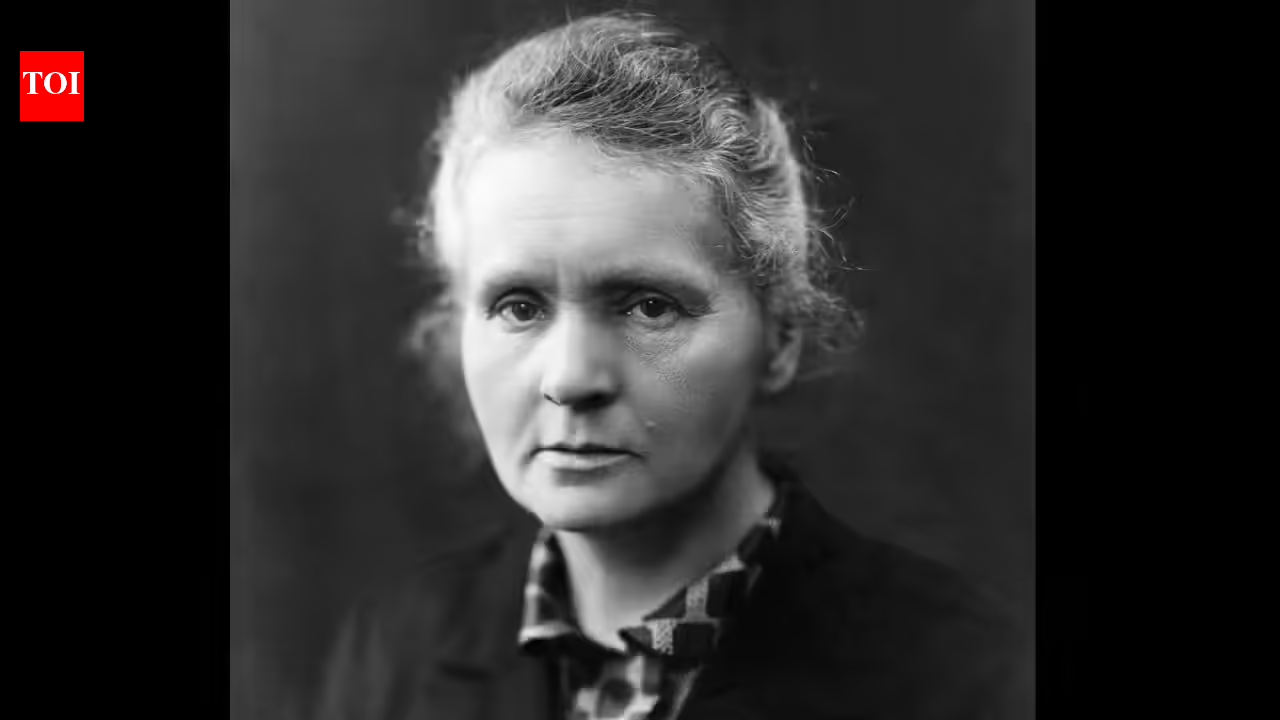
When people talk about Marie Curie today, they usually start at the end of the story. The Nobel Prizes. The scientific breakthroughs. The place she occupies among the giants of modern science.The beginning was far less glamorous.Before the world knew her name, Curie was a young woman in Russian-controlled Poland, a place where opportunities for women were limited and ambitions often collided with reality. There were years spent studying in secret, years spent working to support herself, years spent saving money simply to continue her education. None of it resembled the neat success stories that are often told about famous people.Perhaps that is why her words still ring true more than a century later: “I was taught that the way of progress is neither swift nor easy.”It does not sound like a slogan designed for a poster. It sounds like something learned through experience.
Quote of the day by Marie Curie
“I was taught that the way of progress is neither swift nor easy.”
Understand the meaning of the quote by Marie Curie
Curie’s observation is really a challenge to one of the most persistent myths people tell themselves.The myth is that progress should be visible.When people start learning a skill, building a career or pursuing a goal, they often expect clear signs that their efforts are paying off. They want proof that they are moving forward.Life rarely works that way.For long stretches, progress can look suspiciously like standing still.A researcher spends months chasing an answer and finds nothing. A writer fills notebooks with drafts nobody will ever read. A small business owner works every day without seeing dramatic growth. To an outsider, it may appear that very little is happening.Yet important changes are often taking place beneath the surface.Curie knew this better than most. Scientific discovery is filled with dead ends, repeated failures and long periods where the only visible result is more work.
Why modern life makes this lesson harder
The world Curie lived in moved slowly. The world we live in does not.Food arrives at the tap of a screen. Messages travel across continents in seconds. Television programmes, music and information are available almost instantly. Speed has become so normal that waiting now feels unusual.That expectation often spills into areas where speed has never been possible.People want careers to develop quickly. They want businesses to become profitable immediately. They want expertise without years of practice.When those things fail to happen, discouragement follows.Social media adds another layer to the problem. It presents finished products rather than unfinished journeys. The promotion appears online. The years of uncertainty that came before it rarely do.As a result, many people end up comparing their ordinary Tuesday afternoon to someone else’s highlight reel.It is not a fair comparison, but it is a common one.
How to apply this quote by Marie Curie in daily life
One practical lesson from Curie’s words is learning to judge effort differently.Most people measure progress through outcomes. Did I get the promotion? Did I lose the weight? Did I earn more money? Did I achieve the goal?Those questions matter, but they are not always useful in the short term.A student preparing for an examination may not see immediate results after a week of study. Someone learning a language may spend months feeling clumsy and slow. An employee developing a new skill may feel inexperienced for far longer than expected.The temptation is to assume that nothing is happening. Often, that assumption is wrong.Growth frequently arrives long after the work has begun.The challenge is continuing during the period when improvement is difficult to measure.
The forgotten part of most success stories
Visit any bookshop and browse the business section.The shelves are packed with stories about successful companies, wealthy investors and influential leaders. What many of those stories share is selective memory.People remember the breakthrough. They forget the uncertainty.A company that eventually becomes famous may have spent years operating at a loss. A bestselling novelist may have accumulated stacks of rejection letters. A scientist may have devoted decades to a problem before achieving a meaningful result.Looking backwards makes progress appear inevitable. Living through it feels very different.While success stories are usually told in a few pages, the people involved experienced them day by day, often without knowing how things would turn out.That reality is hidden so often that many people begin to believe they are the only ones struggling.They are not.
Why patience has become an underrated skill
Patience rarely receives much attention.Determination sounds more exciting. Ambition sounds more impressive. Confidence makes for better headlines. Yet patience quietly sits behind many achievements.It allows people to continue when excitement fades. It helps them endure periods when results seem distant. It creates space for learning, adaptation and gradual improvement.Curie’s quote is, in many ways, a defence of patience. Not passive waiting, but active persistence.The kind that keeps moving despite uncertainty.
Marie Curie’s reminder that progress takes time
Marie Curie did not leave behind this quote as a motivational catchphrase. She left it as someone who had lived it.Her life was not a straight line from talent to success. It involved obstacles, sacrifices and years of work that attracted little public attention. The recognition came later.That is often how progress works.From a distance, achievements can appear sudden. Up close, they are usually built from countless ordinary days that seemed unremarkable at the time.Perhaps that is the most useful lesson hidden in Curie’s words. Progress does not always announce itself. Sometimes it arrives quietly, accumulating through effort that feels invisible until one day, looking back, the distance travelled becomes impossible to ignore.
