





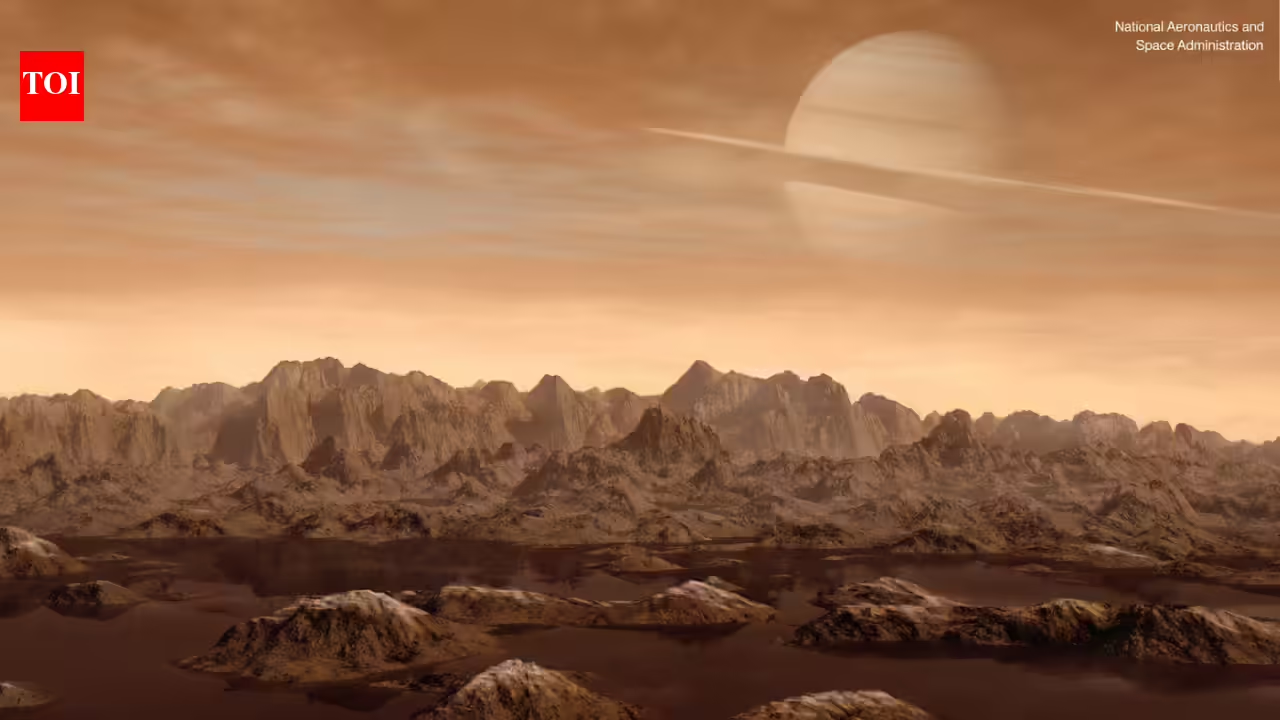

Saturn’s largest moon, Titan, may one day become one of humanity’s most valuable destinations beyond Earth. A recent NASA-supported study led by planetary scientist Conor A. Nixon of NASA’s Goddard Space Flight Center examined Titan’s vast resource potential and how it could support future human exploration. Drawing on decades of observations from missions such as Cassini-Huygens, the researchers assessed the moon’s abundant hydrocarbons, water ice, and atmospheric resources. Their findings suggest Titan could serve as a future refueling hub, industrial outpost, and gateway for missions deeper into the Solar System, making it one of the most promising worlds for long-term space settlement.
How Titan’s vast hydrocarbon reserves could fuel future space missions
Titan is one of the most fascinating worlds in the Solar System. It is the only moon known to have a dense atmosphere, and it is also the only world besides Earth with stable liquids on its surface.Unlike Earth, however, Titan’s lakes, rivers, and seas are not filled with water. Instead, they contain liquid methane and ethane, hydrocarbons closely related to natural gas and other fuel-producing compounds. Titan even experiences a methane-based weather cycle, where methane evaporates, forms clouds, and falls back to the surface as rain.This unique environment has made Titan a prime target for scientific exploration and one of the most intriguing destinations for future space missions.The NASA-supported study highlights Titan’s immense hydrocarbon wealth. Methane accounts for roughly 5 percent of the moon’s atmosphere, while larger hydrocarbons exist in lakes, seas, and deposits scattered across the surface.These materials could prove invaluable for future explorers. Methane can be used as rocket fuel, while heavier hydrocarbons can be processed into plastics, synthetic materials, chemicals, solvents, and industrial feedstocks.Researchers note that Titan contains compounds similar to those used on Earth in cooking gas, heating fuel, gasoline, kerosene, and countless industrial products. However, Titan does not contain petroleum oil deposits formed by ancient biological processes as found on Earth. Instead, its hydrocarbons are produced through natural chemical reactions driven by sunlight and Saturn’s radiation environment.

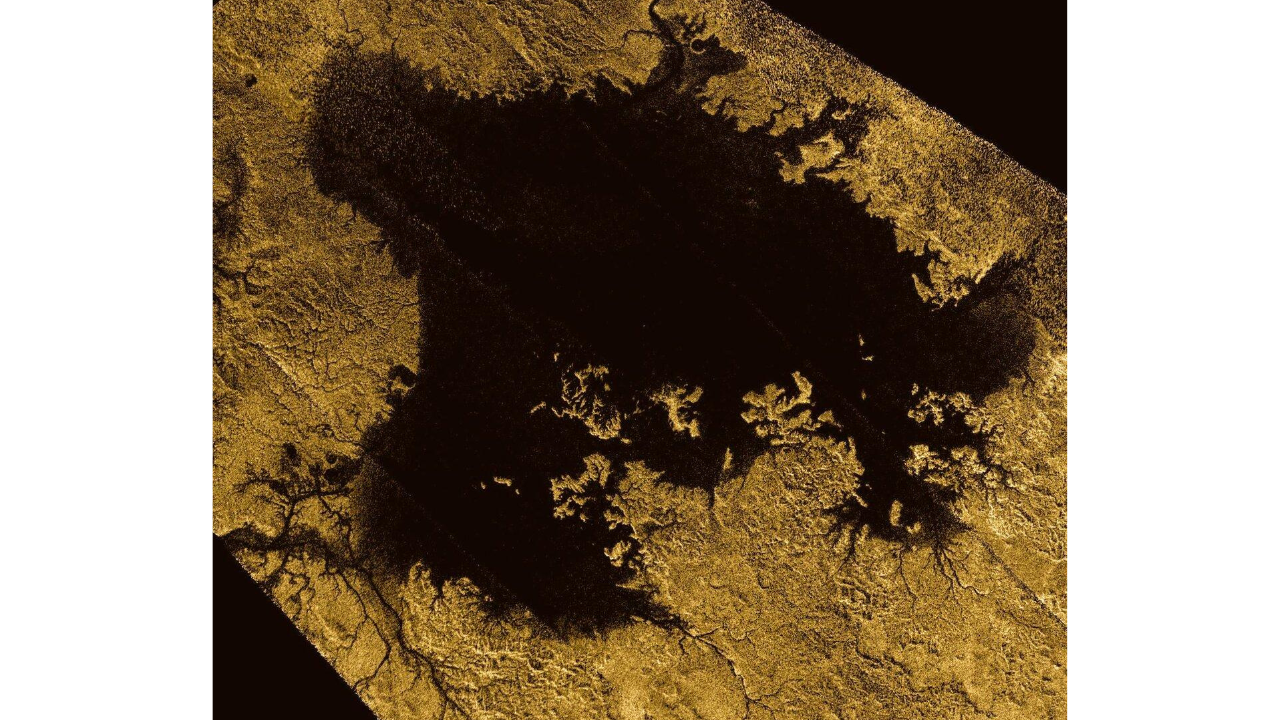
Radar observations from NASA’s Cassini spacecraft revealed large lakes and seas of liquid methane and ethane near Titan’s poles.
Water may be Titan’s most valuable resource
Although Titan is famous for its methane lakes, water may ultimately be its most important resource.Scientists estimate that roughly half of Titan’s mass consists of water ice. Beneath its frozen crust lies what is believed to be a vast subsurface ocean of liquid water mixed with ammonia and salts, which help prevent it from freezing completely.Water is critical for sustaining human life. It can provide drinking water, oxygen for breathing, and hydrogen for fuel production. Through electrolysis, water can be split into hydrogen and oxygen, creating powerful rocket propellants for future spacecraft.The abundance of water alone makes Titan a highly attractive destination for long-term exploration and settlement.
More than a giant fuel station
Previous studies of Titan largely focused on how local resources could be used to manufacture rocket propellant. The new NASA-supported assessment takes a much broader view.The researchers suggest Titan could eventually become a self-sustaining industrial outpost capable of producing a wide range of materials. Hydrocarbons could be refined into plastics and manufacturing feedstocks, while local resources could support construction, agriculture, and advanced 3D-printing systems.In this vision, visiting spacecraft would not simply refuel. They could also replenish spare parts, industrial materials, food ingredients, and other essential supplies needed for long-duration missions.Such capabilities could significantly reduce dependence on shipments from Earth and help establish a permanent human presence in the outer Solar System.
A gateway to the outer Solar System
Titan’s location within the Saturn system gives it strategic importance.Future spacecraft traveling to Uranus, Neptune, or other distant destinations could potentially stop at Titan to obtain fuel and supplies. The moon could also support exploration of neighboring Saturnian moons such as Enceladus and Mimas, both of which are considered promising ocean worlds that may harbor conditions suitable for life.If humanity establishes a permanent presence in the outer Solar System, Titan could serve as a transportation, logistics, manufacturing, and resupply hub.Researchers also suggest that Titan could help support exploration of Saturn’s broader moon system, allowing spacecraft to travel between settlements and scientific outposts more efficiently.
The challenges remain enormous
Despite its resource abundance, Titan remains one of the most difficult destinations for human exploration.Saturn lies roughly 1.4 billion kilometers from Earth, meaning travel times are measured in years rather than months. Titan’s average surface temperature is approximately minus 179 degrees Celsius, cold enough to freeze most familiar materials.The study notes that advanced nuclear power systems and next-generation propulsion technologies would likely be necessary before large-scale settlement becomes practical.For the foreseeable future, Titan remains a long-term prospect rather than a near-term destination for human explorers.
Dragonfly will help unlock Titan’s secrets
Before any discussion of settlement becomes realistic, scientists need a much better understanding of Titan’s environment.NASA’s Dragonfly mission, currently scheduled to launch in the coming years, will send a nuclear-powered rotorcraft to explore the moon’s surface. The mission will investigate Titan’s chemistry, geology, weather systems, and potential for prebiotic chemistry.Dragonfly is expected to provide valuable information about Titan’s resources and help scientists better understand whether the moon could support future exploration and settlement efforts.The mission is widely regarded as one of NASA’s most ambitious planetary exploration projects since the Cassini-Huygens mission transformed our understanding of the Saturn system.
The study behind the claims
The assessment was led by Conor A. Nixon of NASA’s Goddard Space Flight Center, together with Ye Lu of Worcester Polytechnic Institute and Jennifer E. Ruliffson of the University of Florida.Their paper compiles existing knowledge about Titan’s atmosphere, surface liquids, water ice, and chemical resources to evaluate how those materials might be used by future explorers.Rather than announcing new discoveries, the study examines how resources already identified through decades of observations, particularly by the Cassini-Huygens mission, could be utilized through a concept known as in-situ resource utilization, or ISRU. This approach involves using local materials instead of transporting everything from Earth, significantly reducing mission costs and complexity.
Why scientists compare Titan to the Persian Gulf
The comparison stems from Titan’s extraordinary abundance of hydrocarbons. Aerospace engineer and author Robert Zubrin famously described Saturn’s moons as the potential “Persian Gulf of the Solar System” because of their vast fuel-producing resources.The new NASA-supported study reinforces that idea by showing how Titan’s methane, ethane, other hydrocarbons, and water reserves could support everything from spacecraft refueling to industrial manufacturing and long-term settlements.While human colonies on Titan may still be many decades, or even centuries, away, the moon’s immense resource wealth makes it one of the most promising worlds for humanity’s future expansion into the Solar System.If future technologies make deep-space settlement practical, Titan could emerge not merely as a scientific destination but as one of the most strategically important worlds beyond Earth.


