





Verdict
The Honor Magic V6 is a superb foldable with standout battery life, strong cameras and a slim, durable design, held back only by cluttered software and a crease that no longer leads the class.
-
Thin, comfortable and durable design
-
Great battery life and all-round performance
-
Bright, vibrant dual screens
-
Consistent and solid camera performance
-
MagicOS is complicated and unintuitive
-
Aggressive (and unneccesary) battery optimisation
Squirrel Widget
Key Features
-
Slim foldable design
The Magic V6 is impressively thin and light for a book-style foldable, while still feeling sturdy and comfortable in the hand.
-
Big battery stamina
Its 6660mAh battery delivers excellent longevity, comfortably lasting a full day and often pushing well beyond that with lighter use.
-
Strong foldable cameras
The triple-camera system is unusually consistent for a foldable, delivering reliable results across the main, zoom and ultrawide lenses.
Introduction
Honor is finally bringing the Magic V6 to markets outside of China, after first unveiling the phone earlier this year at MWC.
For the past few years, Honor’s book-style foldables have consistently impressed with just how thin, light and easy to live with they’ve become. The Magic V6 continues that trend, while also pushing harder on durability, battery life and camera performance – three areas that still tend to define the foldable experience more than anything else.
So while the headline feature might be its slim design, the bigger question is whether Honor has managed to build a foldable that feels less like a compromise altogether. After using it on and off for the past few months, I think the answer is: almost.
Design
- Slim foldable build
- First foldable with dual IP68 & IP69 protection
- Oddly weak button feedback
Honor made great claims about the durability of its V6 hinge, showing it off in some impressive-looking demos where the device had heavy weights slung over its edges. It even produced an eye-catching video in which a man was ziplined across a canyon, allegedly held up by nothing but a harness attached to an Honor Magic V6. Smoke and mirrors? Perhaps.


It’s a bold claim, and one I certainly wasn’t prepared to verify with my own unit, but it also speaks to the most important advancements in foldable phones over the past few years. Durability has long been seen as the one big compromise of owning a phone with a flexible screen and moving parts.
I will say this, while I don’t think I’ll be launching myself over a precipice using nothing but an Honor Magic phone to hold me up any time soon, I have been using the phone off an on for the past few months – using it as my daily for at least a month of that time – and not once did I feel like the hinge was weak or creaky.

More impressive is that Honor has got it certified to IP68 and 69 standards, making it, to my knowledge, the most water and dust-resistant book-style foldable on the market. Oppo’s Find N6 has the same water resistance, but it doesn’t have the same level of protection against dust getting in. Google’s Pixel 10 Pro Fold has the dust protection, but not the same level of waterproofing. This is in a phone which also happens to be one of the slimmest and lightest of its kind on the market. It’s impressive.
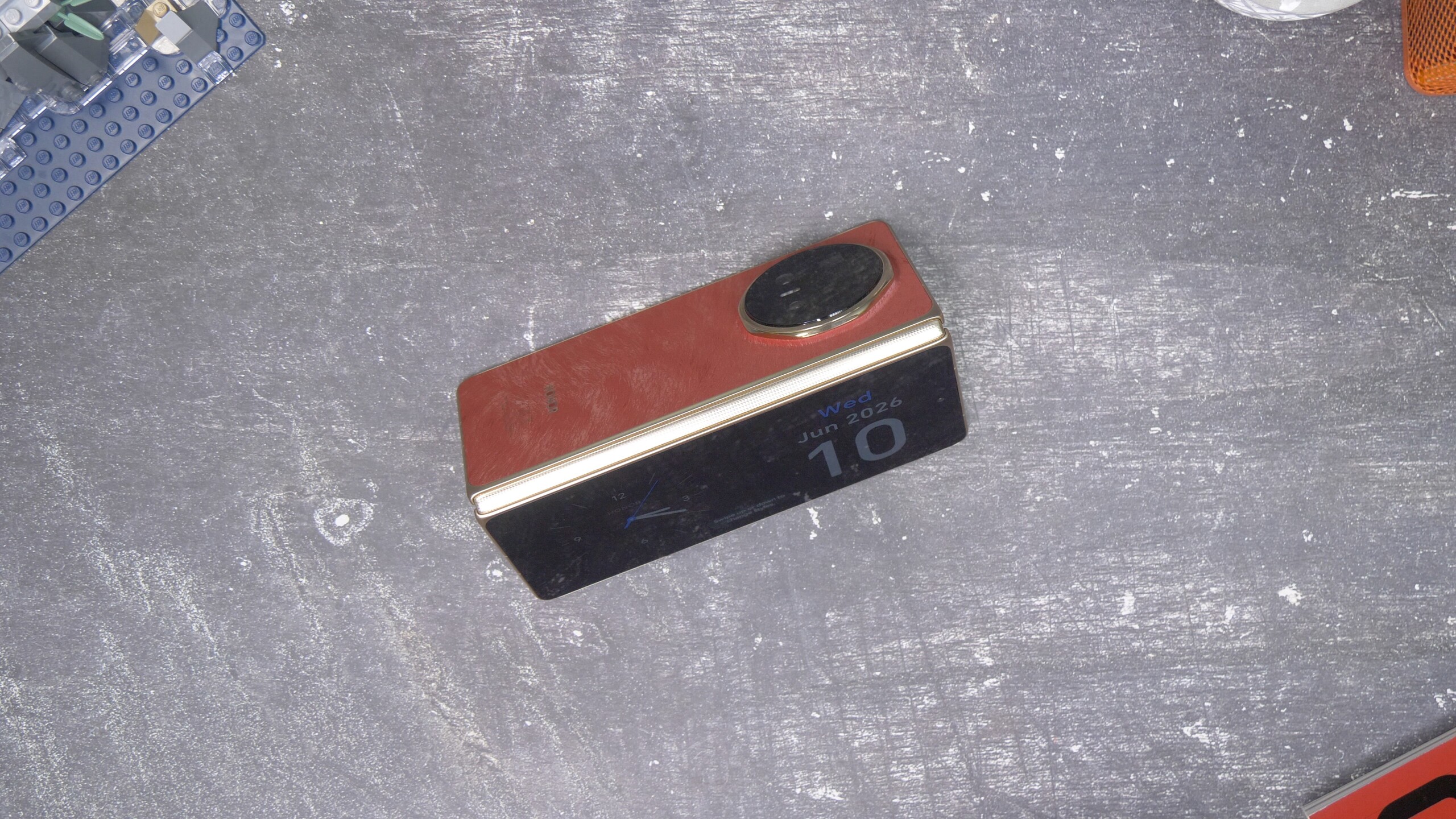
Aesthetically, I’m not a big fan of the red and gold colour combination, but I do really like the soft, almost leather-like texture of the finish on the back. Combined with that thinness and the softened edges and corners, it makes the phone supremely comfortable to hold.

The only real negative with the phone design is the same as any other foldable. To make that internal screen flexible, you can’t use a rigid glass that’s resistant to scratches or impact to any great degree. There’s still work to be done on that front, because it doesn’t seem to take too much effort to leave fingerprint smears or marks on the screen, and certainly would take very little effort to scratch it.

In any other year, I’d applaud the quite minimal crease running down the centre of the screen too. But now the Find N6 exists with its near-invisible crease, and now anything else feels very visible by comparison. Still, it’s very easy to ignore, and hard to see when the screen is brightly lit.
My other admittedly very minor complaint is the clickiness of the volume and power/side keys on the right. They don’t give anywhere near as much audio or tactile feedback as most other phones, and so sometimes I’d press them without realising it – or press them purposefully and be unsure whether or not I had actually pressed them.

Just like the last couple of generations, there’s a thin case included with the phone that features a fold-down ring around the camera island that doubles as a stand and a ring grip. Although it must be said, I’m fairly certain this case is the flimsiest, thinnest, bendiest case I’ve ever used in 16 years of tech reviewing. I can’t imagine it offers any real protection beyond basic scratch protection for the hinge and the back cover.

Screens
- Bright, vibrant dual screens
- Minor lag on the cover screen at times
- Crease visible, but manageable
As cover screens go, the Magic V6 panel is very strong. It boasts some impressive specs, like 120Hz refresh rates and up to 6000 nits peak brightness. But as always, peak brightness is a bit of a misleading spec in that it usually only refers to one bright spot in HDR scenes that could, in the right conditions, reach that brightness.

When using it outdoors under bright daylight, the screen was bright enough to shoot photos and videos clearly. It didn’t seem to automatically ramp up the brightness as much as Oppo’s competitor did, but I have zero complaints really.
It’s a relatively narrow screen, but at around 20:9, it’s not so narrow as to make it impractical. So it’s a great display for casual tasks you want to complete without opening up to the main display.
One-handed typing by gliding your thumb across the keyboard is simple and convenient, and it’s a large enough surface area that you can watch videos on it or doomscroll on social media without feeling hampered at all. And when you do want to open up to the big screen, apps stay open and instantly expand to the larger surface area (or vice versa) without any extra steps or issues, so it feels natural and quick.

Having used and experienced most of the best phones, both foldable and otherwise, only one thing jars when using that outer cover screen: its responsiveness. When swiping or tapping elements on that outer screen, the on-screen response doesn’t consistently feel instant or crisp.
That could be when typing on the keyboard and not feeling the haptic feedback or vibration instantly, like you would on the Pixel Fold or Oppo Find N6. And sometimes, I’ve had instances where I need to tap a second time to get it to respond, particularly at the edges of the display when tapping very small elements. I had the same experience with the V5 and the V3.

The big internal display is bright and vibrant. The shape, as usual, means it’s not perfect for widescreen or portrait video. You’ll get big pillar-boxing or letterboxing black bars, but at the same time, the video frame itself is wide and expansive. Plus, the software makes good use of that space by offering a quick layout button in the dock on the Home Screen. Using it, you can quickly launch two or three apps side by side and expand them, switch between them easily, and even save them as a split-screen view on the recent apps screen.
Because of its size and aspect ratio, it’s not perfect for gaming. Honor’s software does this thing with games where, instead of stretching graphics awkwardly to fit the big panel and producing pixellated graphics with cutout buttons and controls, it puts a black bar at the bottom. It’s a bit awkward looking, but it at least means you’re not missing anything from your favourite time-killing titles.

There are a number of display settings to support eye health too, including high-frequency dimming and natural tones to help the display match the light around you. So even though the panels can both get very bright, they won’t get so bright as to strain your eyes in the wrong settings. Using them both felt comfortable all the time, where Oppo’s – by comparison – felt too bright at times, particularly at night.

Software
- Feature-packed but bloated
- Apple sharing feels clunky
- AI features feel forced
I could do an entire review just covering Honor’s software, because there’s a lot in here. With each new iteration, the company loads in more features, and with it being 2026, that means the buzzwords are included. Those – in the Android space – are AI and AirDrop.
There’s a big play to bake in compatibility with Apple devices recently, and that means (with the right settings) you can send and receive files to and from Apple devices.

Honor’s workaround isn’t as quick and convenient as the version baked right into Pixel or Samsung phones though; it needs an app called Honor Connect. Even if you want to use the OneTap feature, where you hold the back of the phone to the back of an iPhone to share files quickly, you get a pop-up telling you that the Honor Connect app is required on the iPhone.
Clearly then, not as convenient as you’d like it to be.
In fact, ‘not as convenient as you’d like it to be’ is a phrase that pretty succinctly sums up my feelings towards Honor’s Magic OS software as a whole.

Even trying to do simple things like change a wallpaper, add widgets to the Home Screen or anything else seems to take extra steps. And this is where loading so many features into software shows its weakness. By making it so bloated and, at times, complicated, it’s lost its sense of simplicity and convenience.
The other buzzword, of course, is AI. And there’s lots of it crowbarred into all sorts of areas. As with much of its other software, Honor has seemingly crammed in as many AI features as it can. If you’ve seen it on another phone, there’s a version of it on here. From translation and photo editing, through to reading your screen and remembering things you want to come back to.

And instead of giving you a third, dedicated button, you can set the power button to become an ‘AI button’ of sorts with a light touch, rather than a press. But as you can imagine, with the aforementioned weakness in tactile feedback from that button, the experience of launching that feature on purpose is, again, sub-optimal.
Honor’s persistent notifications about apps draining battery in the background or trying to get you to use the phone’s AI features can be frustrating to live with as well. That’s without mentioning the UI and interface, which seem to be a mix of older Android versions and attempts to copy visual elements from iOS while fitting in as many features as possible. It’s not very cohesive and, at this point, needs a refresh from the ground up to make it simpler.

Cameras
- Strong foldable camera system
- Reliable daylight performance
- Low-light flaws remain
Cameras aren’t typically a strong point with folding phones, and they certainly don’t match the capabilities of the ‘Ultra’ labelled slab phones. But with the V6’s camera system, I got the very real sense that I was using what could just be, if not the best, certainly one of the best triple cameras available on a device of this kind.

Its primary sensor, which is similar in size to the Oppo Find N6’s sensor, is joined by a 3x zoom camera with a larger sensor than Oppo’s and an ultrawide camera. And for the most part, at least in the daytime, I got more consistent results across the three cameras from Honor than I did from the Oppo. At least when comparing switching from the primary to the telephoto mode.
Oppo’s zoom camera has a tendency to get a little hazy and sometimes a bit too soft at times, whereas the Honor is sharp and in focus every time, at least under bright lighting conditions.
Honor’s default camera mode is set to a ‘vibrant’ setting by default. And even if you’re someone who prefers a more natural setting, I’d advise sticking with this one. It’s colour-rich and a little saturated, but kicking it into its more muted ‘natural’ mode seems to just overexpose more than it already is and make everything paler, but not in a way that’s actually all that true to the scene.
The vibrant default setting isn’t perfect, particularly in HDR scenes, where it tries too hard to brighten shadows to make dark surfaces visible. But at the same time, there’s consistency and reliability here.
There’s a slight graininess to images when it’s not in the brightest of conditions, which you’ll see mostly in grey clouds or slightly shadowed parts of the image, but that’s really going with a fine-tooth comb to find flaws.
Of the three lenses on the back, it’s the ultrawide that’s the weakest. Which is usually the case. It can take expansive, wide shots, but details are quite rough, and there’s clearly visible distortion towards the edges where detail gets even rougher and warped.
Texture and detail on the whole is where I usually find fault with Honor cameras, because it tends to over-smooth or soften some textures, removing some of the finer details. To the point where if you crop in, you’ll see blotchiness. But then again, that isn’t all that unusual for cameras on foldables, and it’s certainly not bettered in that department by any other foldable I’ve used.
At night, it’s hard to be too critical. Its night mode algorithm kicks in automatically to hold the shutter open for a couple of seconds to deliver clean, bright images at night, provided there’s some street lighting around.
It’s in these situations that you notice more clearly the weaknesses of the ultrawide and zoom camera sensors. The zoom lens, when light levels drop, starts to introduce some unusual artefacts as it tries to make sense of detail with little light available. So you’ll see what I can only describe as glitches in the darker parts of the photo, or introducing a star flare around individual light sources.
That’s without mentioning the aggressive processing that typically happens at nighttime, making details just that bit too smooth and painting light.
It’s safe to say then that it’s best to stick with the primary camera for any low-light photography. It’s the one that’s more capable of delivering results with the most natural and realistic textures and detail.
On the whole then, it’s a camera system I’d be more than happy with day to day. It’s certainly not a compact camera competitor like the Oppo Find X9 Ultra or Vivo X300 Ultra are, but given the limited space for hardware on foldable, Honor’s feels among the least compromised.
Video is decent enough too, although it definitely takes on more of the saturated, overly rich colour profile. Blue skies just look that tiniest bit too blue, to the point that it doesn’t look life-like.
Performance and Battery Life
- Fast, dependable flagship performance
- Excellent battery life overall
- Aggressive background app management
As far as outright speed and performance go, there’s little weakness to be found in the Honor foldable. It’s powered by the all-powerful Snapdragon 8 Elite Gen 5 chipset – the same processor you’ll find in any of the top Android phones of 2026.
At full tilt, it’s capable of crunching through high fidelity games like Destiny Rising, Genshin Impact and Call of Duty. And it’ll even cope well with relatively long sessions, not heating up too much or needing to throttle performance. It shows solid reliability when benchmarked using stress tests to push it to its limits for extended periods. And it’ll happily run those split-screen apps side by side.

Battery life on the V6 is very good too. Part of that is down to the generous 6660mAh battery inside, but also part down to the aggressive optimisation of the system software and performance.
In its ‘balanced’ default power state, the phone only ramps up the chipset’s processing and graphics capabilities to their limits when required during gaming. Otherwise, it effectively runs with the Snapdragon processor running at about 50% of its ability, saving a lot of battery juice in the process.

It’s got an aggressive ability to warn, or take action on, any apps running in the background too. So if you have a smartwatch or smart wearable that needs constant connection to an app running in the background, be prepared for the system notifications every day telling you that it’s found an app running in the background that you should close or manage. Which, in the case of apps like the Pixel Watch app, you really don’t want to do.

Still, with my fairly light usage – barely more than 2-3 hours a day – I could almost get through two full days on a single charge. Power users who constantly use their phone for battery-draining tasks like WhatsApp, video calls, navigation and the like should still get through a full day with constant moving between 5G masts.
Kick it up a notch and start playing those more graphically demanding games on the big screen, and that battery life starts to drain quite quickly.
Like so much of this phone’s performance, it’s right up there near the top of the pile of phones of this kind. And refilling again afterwards doesn’t take too long either; with the right charger, the 80W speeds will mean you only need to plug it in for about 20-30 minutes, and you’ll be topped up enough to last most of the day.

Squirrel Widget
Should you buy it?
You want a foldable with great battery life
The 6660mAh battery delivers excellent stamina for a foldable, easily lasting a full day and often stretching well beyond that with lighter use.
You want a polished software experience
Honor packs in loads of features, but the result is software that often feels bloated, unintuitive and less convenient than it should be for everyday use.
Final Thoughts
If it weren’t for the slight ripple of a crease in the display and my reservations about MagicOS software, the V6 would be my choice as the best foldable phone of its kind. Especially since – unlike the Oppo Find N6 – Honor actually plans on launching this globally at some point.
It’s got two great screens, brilliant battery life and all-round performance, and a design that’s comfortable to use and hold. Even the cameras aren’t the weak point they used to be. Just all-round top-tier hardware.
If Honor could sort out its software to make it less cumbersome, more intuitive and cut out all the added junk we don’t need, it’d be an absolute killer foldable. For other options, take a look at our curated selection of the best foldable phones.
How We Test
We test every mobile phone we review thoroughly. We use industry-standard tests to compare features properly and we use the phone as our main device over the review period. We’ll always tell you what we find and we never, ever, accept money to review a product.
- Used for months
- Thorough camera testing in a variety of conditions
- Tested and benchmarked using respected industry tests and real-world data
FAQs
The Honor Magic V6 has IP68 and IP69 protection, which means it offers strong resistance against water and dust.
Honor has committed to seven years of OS upgrades for the Magic V6.
Test Data
| Honor Magic V6 | |
|---|---|
| Geekbench 6 single core | 3584 |
| Geekbench 6 multi core | 10497 |
| Geekbench 6 GPU | 23634 |
| 3DMark Solar Bay | 42.8 |
| AI performance | 5785 |
| Time from 0-100% charge | 59 min |
| Time from 0-50% charge | 21 Min |
| 30-min recharge (included charger) | 69 % |
| 15-min recharge (included charger) | 36 % |
| 3D Mark – Wild Life | 6264 |
| 3D Mark – Wild Life Stress Test | 57.3 % |
Full Specs
| Honor Magic V6 Review | |
|---|---|
| Manufacturer | Honor |
| Screen Size | 7.95 inches |
| Storage Capacity | 256GB, 512GB |
| Rear Camera | 50MP + 64MP + 50MP |
| Front Camera | 20MP |
| Video Recording | Yes |
| IP rating | IP69K |
| Battery | 6600 mAh |
| Wireless charging | Yes |
| Fast Charging | Yes |
| Size (Dimensions) | 156.7 x 145.6 x 4 MM |
| Weight | 219 G |
| Operating System | MagicOS 10 |
| Release Date | 2026 |
| First Reviewed Date | 16/06/2026 |
| Resolution | 2172 x 2352 |
| HDR | Yes |
| Refresh Rate | 120 Hz |
| Ports | USB-C |
| Chipset | Snapdragon 8 Elite Gen 5 |
| RAM | 12GB, 16GB |


