

Experts cautioned that more research is needed to establish whether these leaks jeopardize human health. Homeowners can look for leaks and plug them up, though some are difficult to address.
Phillips said the paper, published in May, provides one more reason for the state to consider transitioning off natural gas altogether. The study was funded by ZeroCarbonMA, a climate advocacy group based in Brookline, and published in PLOS One, a peer-reviewed journal of the Public Library of Science, a nonprofit that publishes free scientific research, including on climate and sustainability. The American Gas Association, a trade group, disputed the findings, but other scientists interviewed thought the study appeared sound.
The study arrives amid a debate over the future of natural gas in Massachusetts, where policy makers are weighing the state’s climate goals against concerns about rising energy costs. Though regulators previously laid out a framework to transition away from natural gas, Governor Maura Healey has signaled an openness to bringing more of it into the state. Natural gas remains the dominant heating source for Massachusetts homes.

The researchers measured the concentration of methane, the primary component of natural gas, in the air of nearly 200 homes across Massachusetts and Rhode Island. Methane, which is considered safe to breathe at low concentrations, can be tested more cheaply and easily than the pollutants in the gas.
They found that more than 90 percent of residences that used gas had elevated levels of methane — even in newer builds — indicating the presence of leaks. The concentrations were so small that it can be difficult for homeowners to smell the gas.
A 2022 paper led by a researcher at the Harvard T.H. Chan School of Public Health and coauthored by Phillips found that unburned gas delivered to homes throughout the Greater Boston area contained a slew of hazardous air pollutants, including benzene, which the World Health Organization considers to be a carcinogen for which no safe level of exposure can be recommended.
Lindsey Burghardt, the chief science officer at Harvard’s Center on the Developing Child, who was not involved in either study, said further investigation of the leaks is needed to understand the health impacts.
“We spend more than 90 percent of our time indoors, so the quality of the air in that space is an important influence on our health, especially during pregnancy and infancy,” she wrote in an email.
Rob Jackson, an environmental scientist at Stanford who was also unaffiliated with the study, said that while the leaks are a cause for concern, the health risks posed by cooking with gas are likely even greater.

When natural gas is burned, it releases pollutants such as formaldehyde, a known carcinogen, and nitrogen dioxide, a gas that can worsen respiratory issues. These appliances have been linked to premature deaths and pediatric asthma. Gas-powered furnaces and water heaters, which also combust fuel, are required to be vented outdoors.
“For most of us, it’s the flame you need to worry about even more than the gas leaks for day-to-day, month-after-month exposure,” Jackson said.
The American Gas Association, a trade group, disputed the findings. Richard Meyer, vice president of energy markets, analysis, and standards, said the study was “methodologically limited,” including by not using a random sampling of households, and overstates what the data can support.
“Bay Staters deserve well-founded research that will allow them to make fact-based decisions rather than politically driven headlines that are not backed up by sound science,” he said.
Phillips said the researchers made sure they had homes that represented a range of housing stock, including different types and ages.
The gas association also identified an error in a table in the study. Meyer said the issue “calls into question the analytical rigor” of the project. Phillips acknowledged the error and said the research team requested a correction. The gas association and the authors agreed that the conclusions of the study were not affected.
Still, climate and health advocates said the study adds to the growing body of concerns associated with using natural gas. In addition to the health risks, the fuel is notorious for larger leaks across its supply chain that send methane, a superheater greenhouse gas, into the atmosphere. They also argue that the state’s reliance on gas has driven up energy costs.
The advocates have notched big wins in recent years. A climate bill signed by governor Charlie Baker in 2022 launched a pilot program in 10 cities and towns banning the use of fossil fuels in new buildings.

The next year, state officials issued an order laying out a new regulatory strategy to move the state “beyond gas,” including discouraging further expansion of the natural gas system and supporting residents switching to electric alternatives.
Healey, however, has embraced an “all of the above” approach to energy — including signaling an openness to more natural gas. She backed a plan from Eversource increasing the gas supply in Massachusetts, stating that it would lower bills.
Ann Boland of Mothers Out Front, a Boston-based climate justice organization, said she still wants to see the state ditch natural gas. But she said residents can transition their homes to electrical appliances to eliminate the home leaks.
“This is something that people can, depending on their income level, do something about,” she said.
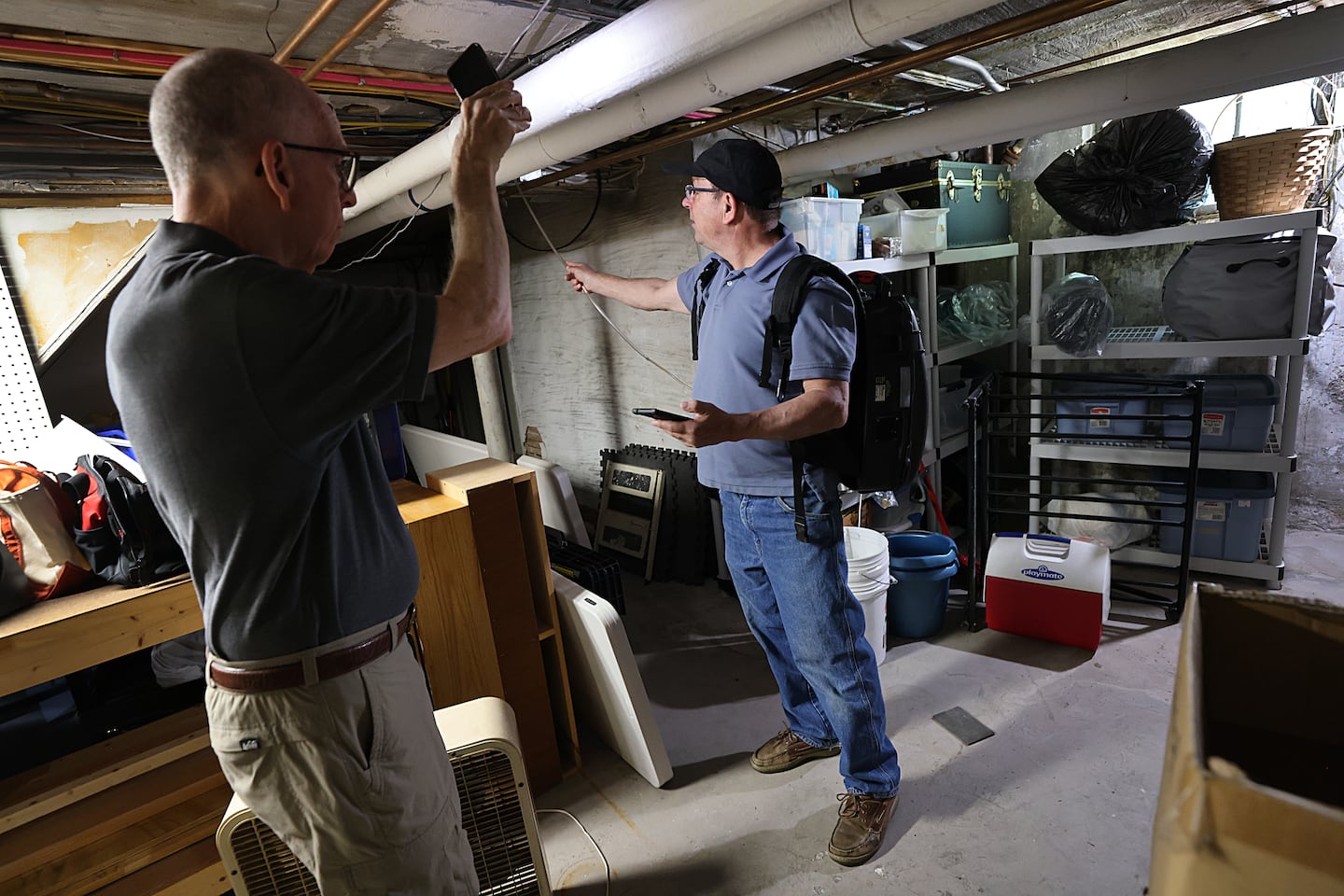
Bob Ackley, a paper coauthor and the owner of Gas Safety Inc., a methane consulting firm that carried out the testing for the study, said that if you suspect a gas leak, you should call 911 and your gas company to rule out a big leak that could cause an explosion.
Ackley said testing for smaller leaks is not easily available to homeowners — in part because there is no demand for it. If you smell gas at a particular location, he said, you can apply a soapy solution and watch for bubbles to see if the gas is escaping. As a “last resort,” he said, his company would also be open to testing homes for a fee.
Phillips had to contend with a leak himself. Not long ago, Ackley walked into his house and immediately said, “I smell gas.”
“I don’t have a poor sense of smell, but I was completely oblivious to it,” Phillips said.
With further investigation, Phillips determined the leak was in his basement at a faulty pipe connection. He sealed it with putty, and the problem was solved — for now. But he is in the process of transitioning his home off gas appliances entirely.
Kate Selig can be reached at kate.selig@globe.com. Follow her on X @kate_selig.
