





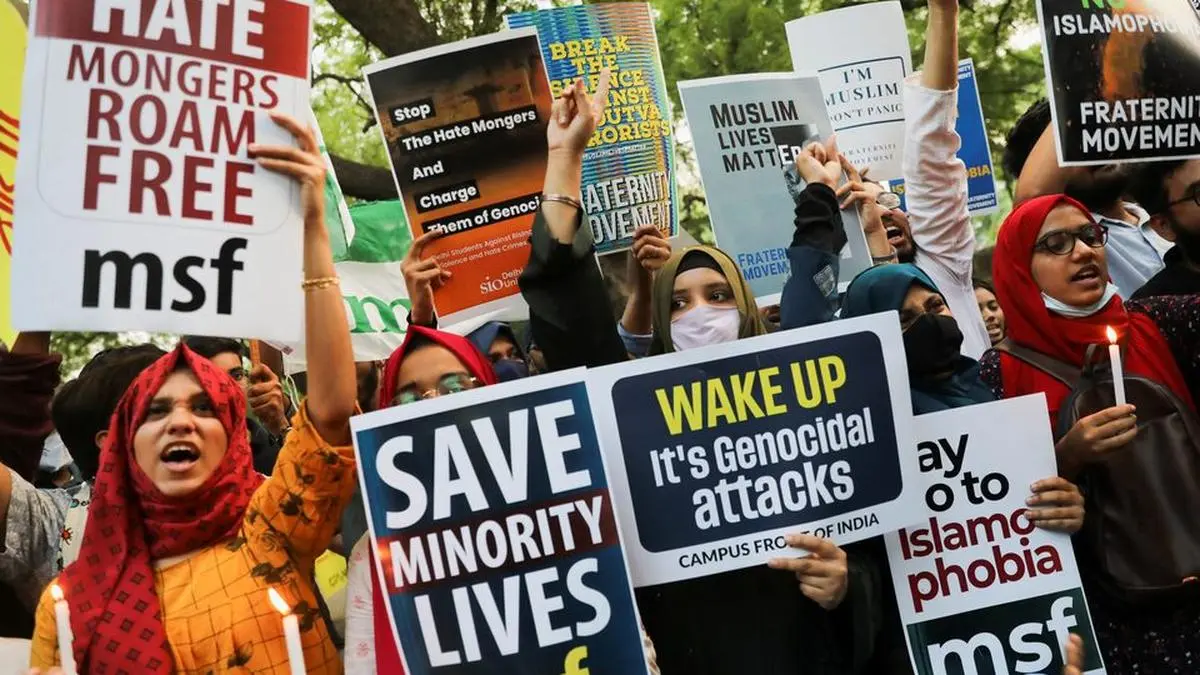


Citizens shout slogans and hold placards during a peace vigil organised to protest violence against Muslims in the country, in New Delhi on April 16, 2022. The rapid growth of the “cockroach movement” following a Supreme Court remark raises broader questions about dissent, political participation, and public perceptions of identity in India.
| Photo Credit: Anushree Fadnavis/REUTERS
When I was listening to the Supreme Court proceedings online, and the Chief Justice made his now-famous “cockroach” remark, I remember thinking the comment would draw public reaction. After all, remarks from the highest court of the country rarely pass unnoticed. There would be criticism, there would be debate, and social media would have a field day. That much seemed obvious.
What I did not expect was what followed. Within a few days, the issue had acquired a life of its own. What began as a reaction to a courtroom remark gradually transformed into something resembling a political movement. New groups emerged, people rallied around a common cause, and discussions moved far beyond the legal community. The movement’s founder, Abhijeet Dipke, became a recognisable figure, and by the time he arrived in India on June 6, it was clear that this was no longer a fleeting internet controversy.
To be honest, there was something heartening about watching it unfold. In recent years, we have witnessed shrinking spaces for dissent and criticism. Yet here was a group openly questioning powerful institutions, organising themselves, attracting public support, and making their voices heard. The fact that the Delhi police granted permission for the protest gave the impression that democratic space still existed and could be used by ordinary citizens. Whether one agreed with the movement or not was beside the point. The important thing was that people were participating in public life.
But while following these developments, a question kept bothering me. Had Abhijeet Dipke been a Muslim, would events have unfolded in the same manner? More specifically, had he been a Kashmiri Muslim, would the response have been the same?
I do not claim to know the answer. Nor am I suggesting that anyone was favoured or discriminated against in this particular instance. Yet the question persisted because it reflects a broader anxiety that many people, especially Muslims, carry today.
For a large section of Indian Muslims, political expression often comes with an additional burden. There is a feeling, rightly or wrongly, that they are expected to constantly prove their intentions. A protest, a demand, a political campaign or even a strongly worded opinion is sometimes viewed differently depending on who is expressing it. Actions that may be seen as legitimate democratic participation in one context can, in another, become a subject of suspicion.
An added burden
This feeling is perhaps even stronger among Kashmiri Muslims. For decades, Kashmiris have repeatedly been told to trust democratic institutions and constitutional processes. They have been encouraged to seek solutions through courts, elections and peaceful political engagement. Many have done exactly that. They have approached courts, participated in elections, entered public service, and relied upon constitutional mechanisms. Yet there remains a perception among many that their political actions are often viewed through a different lens.
Whether this perception is entirely justified is a separate debate. What cannot be denied is that the perception exists. And perceptions matter.
A democracy does not function merely through laws and institutions. It also depends on whether citizens feel they have an equal stake in the system. If a community begins to feel that its political participation will automatically invite greater scrutiny or suspicion, the consequences are serious. People withdraw. They become reluctant to engage. Trust in institutions weakens.
As I watched the movement gather momentum, I found myself noticing something else. There were no Muslim faces visible among its leading voices. Perhaps there were some, and I simply did not come across them. But the absence itself made me wonder whether many Muslims today feel comfortable associating themselves with political causes that involve direct criticism of institutions and authority.
That is not a healthy situation for any democracy. A democracy needs participation from all sections of society. It needs people to speak, question, disagree, and organise. More importantly, it needs citizens to feel secure while doing so. Rights guaranteed by the Constitution cannot become meaningful only for some while remaining uncertain for others.
The question, therefore, is not about one movement or one individual. It is about something larger. Do all citizens feel equally free to exercise their democratic rights? Can everyone organise a campaign, launch a movement, hold a protest or demand accountability without first worrying about how their identity might shape public perception?
India’s greatest strength has always been its diversity. The Constitution does not distinguish between citizens on the basis of religion. The rights it guarantees belong equally to everyone. That principle must not remain confined to constitutional texts; it must be reflected in lived experience.
Watching recent events gave me reason to feel optimistic. It was encouraging to see citizens actively engaging with public issues. At the same time, it left me with a lingering question that I have been unable to shake off. If the faces leading this movement had been Muslim, and particularly Kashmiri Muslim, would the story have unfolded exactly as it did?
Ummar Jamal is a Kashmir-based columnist and National President of J&K Students Association.
Also Read | When the cockroaches arrived in Delhi
Also Read | The cockroach and the toffee


