

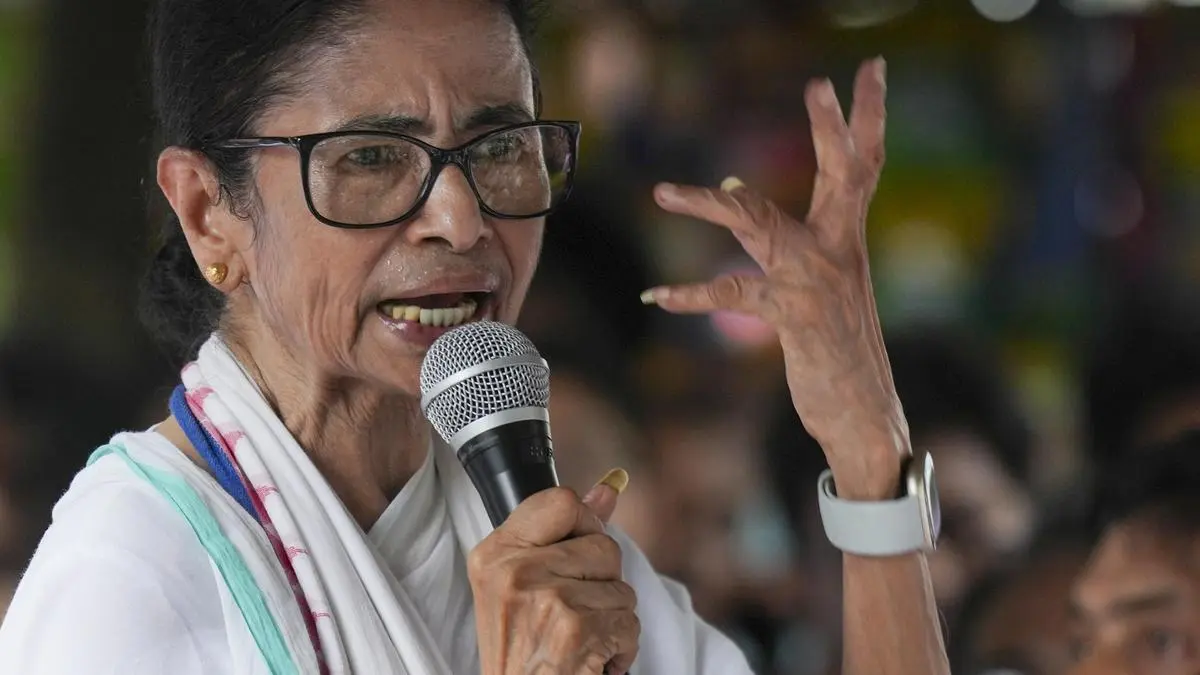
In less than a month after the Assembly election results were declared in West Bengal, former Chief Minister and Trinamool Congress supremo Mamata Banerjee lost not only power in the State, but also control over the very party she founded 28 years ago. On June 3, 58 of the 80 legislators who had won with a Trinamool ticket, revolted against the diktat of the party leadership by electing expelled MLA Ritabrata Banerjee as the Leader of the Opposition and laid claim to the position of “principal opposition” in the State. Interestingly, they did not detach themselves from the Trinamool Congress party and maintained that Mamata Banerjee was still their leader. Ritabrata Banerjee, while addressing the media, even requested her to be their “chief adviser”.
From the position of the supreme leader, whose word was the writ not just within the Trinamool but also the whole State for 15 years, Mamata has found herself elbowed out of control of her own party, and that too by Ritabrata, a man she rescued from the political wilderness by allowing him into the Trinamool fold in 2020, three years after his expulsion from the CPI(M).
Moreover, the Trinamool is undeniably still synonymous with Mamata Banerjee in Indian politics and one cannot be separated from the other. More than 90 per cent of the Trinamool MLAs and MPs derive their authority from Mamata and have been voted to power primarily on the strength of her massive mass-appeal. It is doubtful if any single one of the rebel MLAs would win if they had contested independently or against Mamata’s candidates. So, to be outmanoeuvred in the party of her own creation was perhaps the “unkindest cut of all”. It has cast a long dark shadow over the political future of one of the biggest mass leaders to emerge from Bengal.
According to the veteran political analyst Biswajit Bhattacharya, what happened to Mamata was inevitable, although it perhaps occurred faster than expected. “The myth that even a lamp-post supported by Mamata would win in Bengal was finally shattered in this election. She herself had told the electorate to believe that it was Mamata Banerjee who would be contesting in every seat… Today she has nothing left in her bag. But since she managed to secure 41 per cent of the votes, she is being asked to be an adviser as a token gesture. She could not read the writing on the wall, either before or after the election,” said Bhattacharya. He pointed out that Mamata, who not so long ago insisted on calling the shots in the INDIA grouping, today needs the Congress and the alliance more than they need her.
On June 3, after days of ill-concealed political intrigue and not-so-secret meetings in private establishments, away from prying eyes in party offices, the 58 rebel MLAs, led by two legislators expelled by the party, submitted a letter to the Speaker, Rathindranath Bose, nominating Ritrabrata as the Leader of the Opposition; Javed Khan, Sandipan Saha, Sabina Yeasmin, and Seuli Saha as deputy leaders; and Akhruzzaman as the Chief Whip.
Earlier, Mamata’s nephew, Abhishek Banerjee, the national general secretary of the Trinamool and perceived to be Mamata’s political heir, had selected Sobhandeb Chattopadhyay as the Leader of the Opposition; Asima Patra and Nayna Bandopadhyay as deputy leaders; and Firhad Hakim as the Chief Whip. The rebel MLAs, with more than two-thirds of the Trinamool legislative party on their side, smoothly side-stepped the anti-defection rules and assumed the position of the main opposition party. An early indication of what was about to transpire had come on May 31 when only 20 out of the party’s 80 MLAs attended a meeting called by Mamata at her residence; the meeting had to be cancelled.
However, one question still remains: can someone who was expelled earlier from the party head the legislative wing of the same party? Trinamool MP Kalyan Banerjee pointed out that the Speaker of the Assembly must abide by the decision of the party concerned in the selection of the Leader of the Opposition and cannot decide which group within a party forms the majority. He also emphasised that an expelled member of the main opposition party cannot be made Leader of the Opposition. The Trinamool is planning to move court on the matter.
All Trinamool committees dissolved
The very day that its legislative party split, the Trinamool dissolved all its committees in West Bengal. In its statement, the party said:
“After careful consideration, it has been decided that all committees of the All India Trinamool Congress in West Bengal, as well as all its frontal organisations, shall stand dissolved with immediate effect. The party will undertake a comprehensive exercise of introspection, performance review and organisational assessment at every level. Based on the findings of this exercise, the organisational structure of the parent body and all frontal organisations will be reconstituted and announced in due course. The party remains committed to strengthening its organisation and preparing it to meet future challenges with renewed vigour and purpose.”
Forged signatures
The rebel MLAs’ coup came in the wake of a raging controversy over the alleged forging of the signatures of Trinamool MLAs in a document submitted to the Assembly, endorsing Sobhandeb Chattopadhyay as Leader of the Opposition. The document, containing the minutes of the Trinamool meeting that purportedly took place on May 6, along with the signature of the 70 MLAs who had supposedly taken part in it, was submitted to the Assembly on May 20.
Subsequently, two first-time MLAs—Ritabrata and Sandipan Saha—played whistleblowers by writing to the Speaker, alleging that no such meeting took place on May 6 and that some of the signatures were forged. Their allegations were made public by Chief Minister Suvendu Adhikari, and soon after Ritabrata and Sandipan were expelled from the Trinamool. The State government ordered the Criminal Investigation Department (CID) to probe the case and Abhishek was summoned for questioning.
Rebel Trinamool MLA Ritabrata Banerjee addresses a press conference in the West Bengal Legislative Assembly in Kolkata on June 3. With the support of more than two-thirds of the Trinamool legislative party, Ritabrata has managed to become Leader of the Opposition in the Assembly.
| Photo Credit:
PTI
Mutiny was brewing in the Trinamool right from the time the party lost to the BJP in the recently concluded Assembly election. From the day that the results were declared (May 4), party leaders and spokespersons—who until recently had projected themselves as loyal followers of Mamata and Abhishek—suddenly discovered their “conscience” and began to criticise their leaders in language no less scathing than Mamata’s political opponents.
While addressing a press conference on June 3, the rebel Trinamool MLAs said that the new legislative party would function in a democratic manner. “This is a collective fight against individualism,” said Ritabrata. He made it clear that there was no place for Abhishek Banerjee in the new dispensation. “Abhishek Banerjee and collectivism are poles apart,” he said.
All the grievances, anger, and allegations seemed to be directed at Abhishek Banerjee and his allegedly “undemocratic” and high-handed style of functioning. Leaders and spokespersons came out in the open to blame him directly for the Trinamool’s loss and criticised Mamata for allowing her nephew to “destroy” the party that she built.
Abhishek even got a taste of the kind of public anger that had been building up against him and the Trinamool when he was attacked by local people at Sonarpur near Kolkata, where he had gone to visit the family of a Trinamool activist allegedly killed in post-poll violence. Local residents pelted him with eggs and followed him with cries of “thief”. Abhishek alleged that the BJP had planned the attack.
The former Trinamool Rajya Sabha member Jawhar Sircar, who quit the party in September 2024 in protest against the gruesome rape and murder of an on-duty doctor inside the state-owned R.G. Kar Medical College and Hospital, told Frontline, “This was almost inevitable, given the fact that most MLAs and other Trinamool leaders were fed up with Abhishek’s domineering style and the way he operated his own parallel government through I-PAC [the election strategist agency that was working for Trinamool from 2019]. Suvendu Adhikari got his revenge on Abhishek for smoking him out of the Trinamool.” Sircar was referring to the largely accepted view that Adhikari, once one of the tallest leaders in Trinamool, left the party for the BJP in 2020 mainly because his position was undermined by the rise of Abhishek.
The new Deputy Leader of the Opposition, Sandipan Saha, claimed that at a party meeting held after the election was lost, all the MLAs and leaders present were forced to give a standing ovation to Abhishek for his “efforts”. “There were many veteran MLAs present, who were doing politics while Abhishek was still in school. Being forced to give him a standing ovation and not criticise him after defeat rankled with many,” said the rebel MLA.
Trinamool Congress general secretary Abhishek Banerjee, wearing a helmet that was handed to him as he was mobbed in Sonarpur near Kolkata on May 30. The incensed crowd hurled stones, shoes, and eggs at him.
| Photo Credit:
PTI
Mamata’s party fell into disarray after the new government came in as one Trinamool leader after another, from ministers and high-profile stalwarts to elected members of panchayat and municipal bodies, began to be arrested for corruption. Local leaders were seen fleeing from the wrath of the public who claimed to have been victims of extortion and violence for the longest time. Senior party leaders appeared to have suddenly changed political colour and were openly praising the preliminary administrative steps taken by the new government while attacking the old government, of which they themselves had been an integral part.
The price of corruption
The corruption at the grassroots has destroyed the once formidable organisation of the party. Local leaders have either gone into hiding to escape public anger or are facing arrest for past crimes that were not addressed or investigated. Within a month of the election result being announced, more than 100 Trinamool councillors tendered their resignation. On June 3, Firhad Hakim, one of Mamata’s closest aides, announced his decision to resign from his post of Mayor of Kolkata. The following day, another Mamata loyalist, Krishna Chakraborty, said she would step down as Mayor of Bidhannagar.
A leader of Mamata’s stature and popularity, who, at a single call, could fill up stadiums with supporters, has found herself completely isolated with just a handful of old-timers standing by her. On June 2, when Mamata hit the streets in Kolkata in protest against post-poll violence, less than 10 of her 80 MLAs landed up, and only three out of her 41 MPs (28 in the Lok Sabha and 13 in the Rajya Sabha). The very next day, when the split in the legislative party took place, 20 MLAs, including those still loyal to Mamata—such as Firhad Hakim and Kunal Ghosh—attended an administrative meeting called by Adhikari.
A Trinamool source admitted that as long as the party was winning elections and appeared entrenched in power, the lure of power and wealth kept it together and functioning. The lack of any steadfast ideology has led to its swift disintegration as soon as it lost. “The main purpose of the party when it was formed was to end the long rule of the CPI(M).
After that there was initial development, but then corruption spread across the party ranks. In the end, when Mamata Banerjee practically gave up the reins of the party to Abhishek, who in turn handed it over to the I-PAC, everything began to get out of hand. All that kept the party together was power and the scope of making money. Now that it has lost, the corrupt elements wish to disassociate themselves from the Trinamool, mainly to save their hides and their future,” said the Trinamool leader.
Incidentally, the rebel bloc includes a number of MLAs who are either under investigation on various charges or are likely to face investigation in the coming days. “This may be an overture to the BJP to make matters easier for them,” the source told Frontline.
The psephologist Biswanath Chakraborty does not see much chance of Mamata staging a comeback at this stage of her life. “It will be very difficult for her to recover. The street fighter image of Mamata, which endeared her to the public before she came to power, has been destroyed in the last 15 years because of the manner in which her government institutionalised corruption, politicised administration, and perverted the democratic system through intimidation and relentless rigging. She will not get any support or sympathy from outside either, as it was she who made it a political practice to take in breakaway members of other parties in her attempt to achieve an opposition-less scenario. The legislative party has been split, now it is the turn of the parliamentary party. There is rumbling there as well. Mamata has been paid back in her own coin,” said Chakraborty.
He does not harbour much hope for the rebel group either, as none of their leaders has any mass support base. In fact, they still need to cling to the image of Mamata even as they break away from her. Moreover, not all the rebel MLAs are happy with Ritabrata’s statement of Mamata being just the chief adviser for the party. The veteran MLA Gulshan Mallik may have sided with the rebels, but he still considers Mamata Banerjee to be his supreme leader. “Mamata Banerjee will have to remain our supreme leader, not just adviser. If she remains our leader, we are with the party, if not we will leave,” he said. Sangita Basunia and a few other MLAs were also of the same opinion.
Although the new Trinamool bloc insists that it would continue to oppose the BJP in the Assembly, political observers believe that their rebellion has strengthened the BJP’s position. “In this entire episode, the BJP is the biggest beneficiary. They now have control over the main opposition, like Jyoti Basu did during the CPI(M) era. In one move, Mamata Banerjee’s power has been reduced, the opposition space has been divided, and the INDI Alliance at the Centre has been weakened,” said Biswanath Chakraborty.
Also Read | Managed democracy, made in Bengal
Also Read | Deconstructing the Bengal ‘miracle’
