


The first time I went to Goa, it was with a friend from college, and it was my first non-work trip in a decade. Up until then, I had travelled a lot within India, much of it as a news reporter, which meant that I would sort of blunder into a new town and, on finding a hotel, briefly peep into the room and reception area before checking in to make sure the “vibe” was safe. In small-town India, this meant telling the rickshaw guy I hired at the railway station to take me to a “family hotel”: code to let him know that as a solo woman traveller, I was looking for safety on a budget. In Goa, I did not see any reason to do this a different way. Panaji was a tourist hub, after all, and there was a room to fit all budgets. Besides, I was not travelling alone.
Imagine then, my perplexity when I found myself trudging from hotel to hotel, baggage in tow, and my friend refusing to check in anywhere. The rooms looked fine to me, the hotels reasonably secure. What could be the matter? At the third hotel, my friend finally explained: she refused to stay at any hotel that did not have white sheets.
White bed linen. White towels. White robes. Code for luxury. All five-star hotels have them, and most four-star and three-star hotels too since they model themselves on the five-starred ones. But oh! The quiet boredom of five-star decor! Over the years, I have written a few stories for travel magazines that involved staying at five-star hotels with the implicit understanding between the editors and the hotels (who were also advertisers for the magazines) that the article should subtly nudge the reader towards the joys that were on offer. For a writer like me, this is a hard ask. Part of the problem is that I do not like to do as I am told, but even when I am willing, there is the additional problem of not having much to write about. Every fancy hotel is more or less like any other fancy hotel. They celebrate this monotony by putting out advertising jargon that describes the experience of staying at such hotels as “home”.
Now, my home is nothing like a fancy hotel. For starters, my sheets are not white. I like printed sheets and I like them to be changeable so that the bedroom can transform from riotous cheer to soothing calm with each round of laundry. But if I was paying to get away from home, the last thing I would want is for home to come shuffling after me!
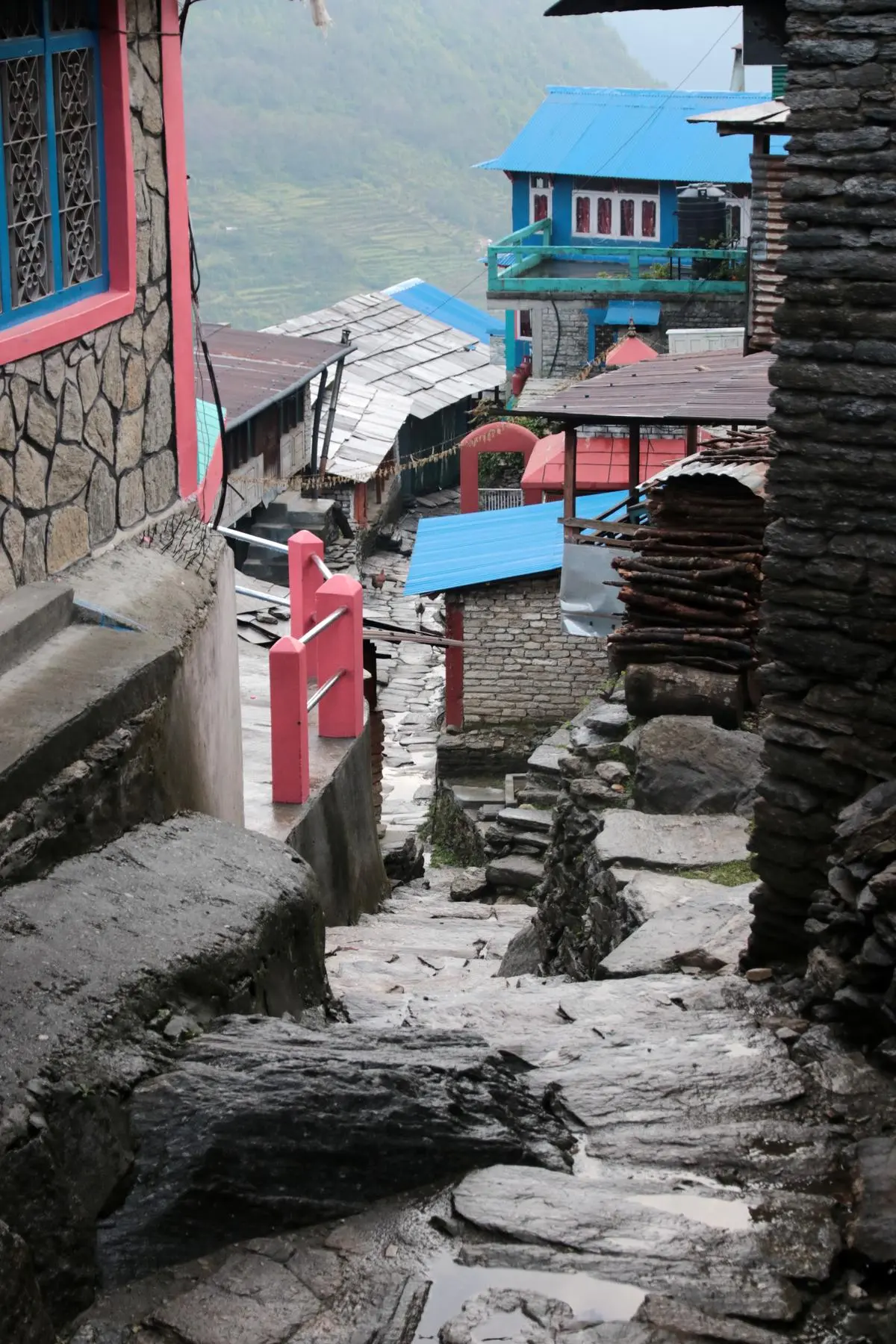
A Himalayan mountain village nestled in the Annapurna mountain range.
| Photo Credit:
Getty images/istock
Still, I understood my friend’s frustration in Goa all those years ago. She did not necessarily want luxury, but she did come from more money than I did, and she had not travelled as rough as I had. What she wanted was an assurance that the sheets were clean and crisply ironed. There is a reason hotels choose white sheets: they suggest unfailing standards of hygiene. White sheets start to show usage rather quickly, and what people pay for at fancy hotels are crisply ironed, new-looking sheets that offer the illusion of having been bought just for you. This intensifies the illusion that nothing can possibly go wrong in a room where the bedding looks so very clean, so very unused.
The fancy facade
Over the years, my work has taken me to hotels on either end of the spectrum: from places that are so dodgy that I opted to sleep in an NGO office instead, to five-star and branded-five-star-but-budgetish hotels. Even in luxury hotels, I have found old dust in corners and carpets that trigger allergies, powdered milk sachets gone off because they have not been changed for months, a cockroach in the dish ordered at the restaurant, hotel staff who refuse to give a hairdryer when asked for one. All of the above have happened to me, but I was often too tired to kick up a fuss. At first, I did not complain because I was a guest at the hotel upon invitation from other organisations, and I felt intimidated by the fancy facade and the knowledge of how much it would cost if I were occupying the room on my own pocket. In later years, I occasionally complained about this or that thing. What I really want to complain of is boredom.
Also Read | From Uttarakhand, a mouthful of mountain love
The kettle and tea bags and coffee sachets are all placed in a corner in more or less the same style at all fancy hotels. There are plastic bottles of mineral water. The television is inevitable, and the screen is large. There is a writing desk in one corner and stationery embossed with the hotel’s name, as if we are still in the 19th century and sending letters post-haste. The more expensive the hotel and the room, the more spacious it is. There is art on the wall, but it is usually anodyne and evokes nothing in particular. The carpets, similarly, are either in muted colours or colourful to a controlled degree. They are never so vivid in their imagery that they invite the beholder to sink to the floor in admiration of the weaver’s craft.

A hotel breakfast I remember fondly in Colombo where local cuisine was the hero.
| Photo Credit:
Getty images/istock-
When the fancy hotels do innovate their decor, they tend to invest in technology that irritates. My personal pet peeves are invisible light fixtures and LED lighting. In some hotels, the lighting is so technologically advanced, I have had to call reception for help in the middle of the night, and then I have spent more hours tossing and turning in those very white sheets, feeding my impostor syndrome even as I have wondered if hotel designers derive a subversive joy from making their rich guests struggle with the lighting. After all, a hotel room is the one place where they do not have their servants on call to come and flip a switch for them at midnight. On the other hand, perhaps the rich think of the hotel staff as their personal servants and so…. My brain ticks away until dawn, when I want to pull back the curtains, only to discover that they are remote-controlled, and I am going to have to figure out which of the three remote control devices in the room is the right one for the purpose. All this before I have made my way to the kettle and instant coffee sachet.
Budget travel (read: no-star hotels), for all its complications (and trust me, there are several), has one advantage: it achieves what travel is meant to do. It broadens your inner horizons. It teaches you what life is all about, and how to negotiate with a chaotic world that you cannot quite control. I have vivid memories of a small guest house in Spiti where I travelled at a time when all the hotels were shut for the winter. I distinctly recall the musty smell of the quilts, the smoke-infused wooden floors, the instant noodles I ate, and the young man who was managing the place who had quit his life in Delhi in search of something different. In retrospect, I am very glad the bigger hotels were all shut.
The illusion of peace and plenty
Luxury travel, no matter how the advertisements make it look, actually shrinks your horizons. Five-star hotels do protect you from visible dirt and disorder, but they also protect you from the fact that an overwhelming majority of people out there do not sleep or talk or eat as you do. They offer the illusion of peace and plenty in a world that is teeming with hunger and violence, and this is further tempered by the illusion that you are the centre of the universe for there is nothing you desire that the hotel will not do its utmost to provide.
Another of my unforgettable travel memories came from a trip to the lower Himalaya, where I stayed at a fancy hotel (not quite five-star though; I could tell by the thread count on the white sheets, which were not quite crisp, and the towels, which were not white enough). It did have an infinity pool, and for this, water was pumped up hundreds of feet. What I remember most vividly is the bitter taste in my mouth after a conversation I had with the owner of the hotel when I asked him about the water usage and how he intended to give back to the community since he was taking so much of a precious community resource. He said he would not and that he believed he had a right to take a hundred times more.

On Barkhor Street, Lhasa, Tibet.
| Photo Credit:
Getty images/istock
The worst part of luxury hotels is that they flatten out your experience of the world. You can go to Himachal Pradesh or Kerala, Assam or Rajasthan, but there is bread, butter, jam, marmalade, yogurt, muesli, and orange juice in the breakfast buffet. None of these items are intrinsically part of the local cuisine, and yet, they are assumed to be an indispensable part of the “home” cuisine of the anonymous luxury traveller, who, we must presume, is either Western or so long exposed to Western habits and diets that they are effectively Western in their expectations of a breakfast buffet.
Now, I have eaten bread all my life, and I confess that I prefer toast-marmalade to, say, poha. What I do not like is the assumption that my likes and dislikes matter enough for others to change their buffet to suit me. I especially do not like the excess that is served up by Indian luxury hotels every single morning: dosas and poha and paratha and puri-aloo and a full English and a full continental on the buffet. As if a traveller might explode if they ate a boiled egg instead of an omelette, for once. As if we were entitled to carry that much cultural baggage everywhere we went.

Small, family-owned hotels where the decor aligns with local textiles and crafts.
| Photo Credit:
Getty images/istock
I do have good memories of meals eaten in the course of my travels, but these memories were shaped by moments when familiar food was not available. Poha breakfasts, for instance, in budget hotels that did not even have their own kitchen, and there is neither pea nor peanut in the poha. But one fancy hotel breakfast I do remember fondly was in Colombo, where the local cuisine was foregrounded in the buffet. I am sure bread was available too, but because it was less visible, I ended up eating a novel, and thus memorable, breakfast. In a similar vein, the hotels I find memorable are small, family-owned enterprises in Rajasthan where the decor aligns with local textiles and crafts. Their sheets are not white.
Also Read | Happily unhurried in Bhutan
Luxury hotels persist in doing what they do for a reason. They allow their guests the illusion that they own the world, and this illusion is sustained by a conspiracy of sameness wherever the well-heeled traveller goes.
They also allow their guests the illusion that their bodies are sacrosanct, that no piece of another human can dare invade the borders of their corporal self. In fact, they remove all reminders that other people, with other habits and needs, exist. People who spill things on carpets. People who bleed on the sheets. People with skins and tongues and snot inside their noses.
Above all, there is the luxury of not knowing too much, not feeling too much, not encountering any danger, or even any real art —nothing that makes you think about labour or talents that far exceed your own. Nothing that makes you think about who deserves to be served, in what way, and who deserves water, and how much of it. You are not allowed to confront anything that makes you doubt who you are, and what could be fancier, and more pitiful, than that?
Annie Zaidi is a writer and filmmaker.
