





The defeat of the Dravida Munnetra Kazhagam (DMK) in the 2026 Tamil Nadu Assembly election puzzled many observers. By most conventional measures, the government had performed well. Economic indicators remained robust. Welfare programmes retained wide public support. Infrastructure investments expanded. Tamil Nadu continued to rank among India’s best-performing States on several social indicators. Even in healthcare, the State remained one of the country’s strongest performers, with a public health system that most other States could only aspire to emulate.
Elections are rarely decided by statistical achievements alone. They are shaped by public perception, lived experience, and the gap between expectations and delivery. If healthcare was one contributor to anti-incumbency in 2026, it is not because Tamil Nadu’s health system collapsed. Rather, it is because a State celebrated for its healthcare excellence appeared, in the eyes of many voters, to be struggling to adapt to new realities.
Tamil Nadu’s position in the country’s healthcare landscape is similar to that of its neighbour Kerala. Unlike many north Indian States, where electoral debates still revolve around the question of access to hospitals and doctors, Tamil Nadu’s voters judge governments on higher standards. The benchmark is not Bihar or Uttar Pradesh, but Tamil Nadu’s own long history of public health innovation, maternal health success, immunisation programmes, medical education expansion, and welfare-oriented governance under successive Dravidian governments.
This created a paradox for the DMK government. The stronger the existing system, the harder it is to demonstrate transformative progress.
Between 2021 and 2026, the DMK government launched several ambitious initiatives aimed at strengthening both preventive care and healthcare infrastructure. The flagship Makkalai Thedi Maruthuvam programme took the screening and management of non-communicable diseases directly to doorsteps, while the State Health Council, established under the Tamil Nadu Health System Reform Programme with World Bank support, sought to improve population health monitoring and policy coordination. In August 2025, the government launched Nalam Kaakkum Stalin, a large-scale preventive health campaign that organised medical camps across all 38 districts for the screening and early detection of chronic illnesses. All the while, investments continued in expanding government medical colleges, establishing super-specialty facilities, and increasing dialysis capacity.
The State’s electorate, however, now views healthcare not as a welfare benefit delivered by the state, but as a fundamental right, much like education and freedom of expression. As public expectations rise, voters increasingly judge the government not by the availability of healthcare alone, but by the quality, accessibility, and responsiveness of the services provided.
A workforce under strain
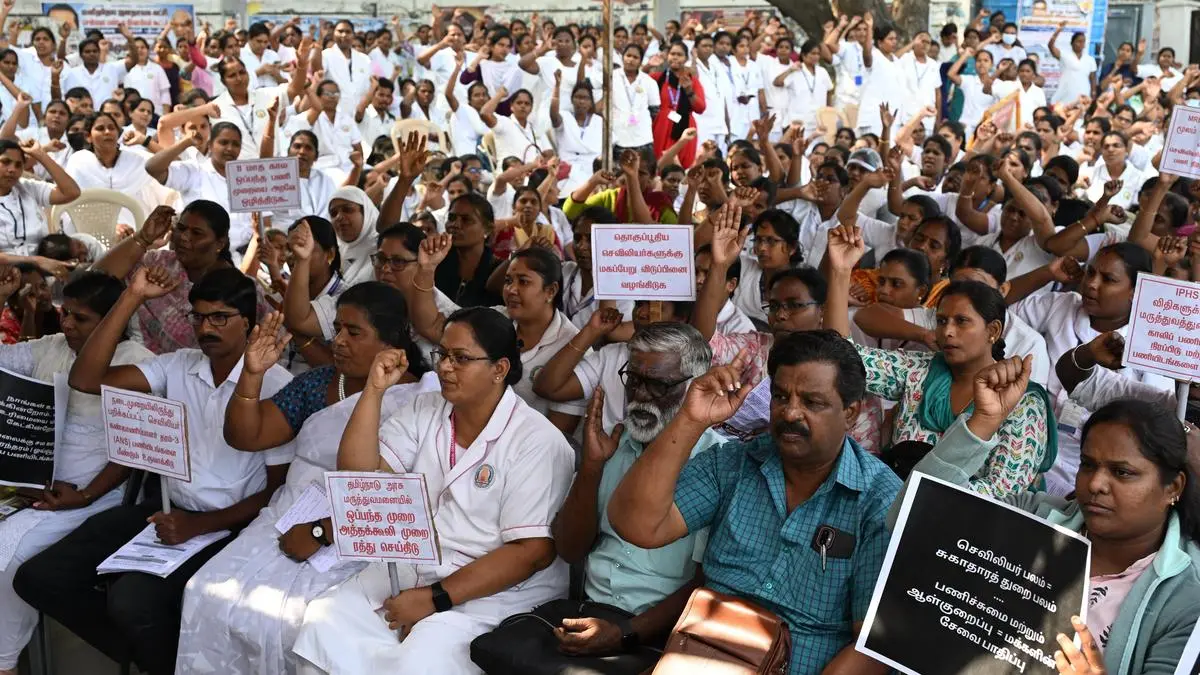
One of the criticisms against the DMK government was the growing strain on the healthcare workforce. During its tenure, nurses repeatedly protested over delayed regularisation, pay disparities, maternity benefits, and the growing dependence on contract jobs in the state sector. Protests erupted in 2023 and again in 2025, with nurses saying that promises on regularisation had not been fully implemented. Opposition parties framed these protests as evidence that the government was relying on temporary labour to sustain the healthcare system.
The symbolism was damaging. Nurses occupy a uniquely trusted position in public perception. When nurses complain about salaries, staffing shortages, and working conditions, voters interpret these as indicators of deeper institutional stress. Even though the government subsequently regularised many contract nurses and improved benefits, the political damage had already been done.
The urban–rural divide
Another factor was the perception gap between urban and rural healthcare. Chennai continued as one of India’s foremost medical hubs, alongside cities such as Madurai and Coimbatore. These places house world-class government institutions, tertiary hospitals, and specialty centres. It also means that patients from many districts travel long distances to reach advanced care, reinforcing the impression that healthcare investment is concentrated disproportionately in a few urban centres.
In the last five years, reports from district hospitals periodically highlighted shortages of specialists, nurses, and critical-care personnel. In places such as Tenkasi, hospitals had large patient loads but limited staff strength, resulting in increased referrals to larger centres. These problems are not unique to Tamil Nadu, nor are they of a huge magnitude, but they become magnified in a State that prides itself on healthcare leadership.


Members of the Tamil Nadu Medical Department Administrative Staff Association staging a protest at Madurai Medical College on July 30, 2024.
| Photo Credit:
R. ASHOK
Large referral hospitals in Chennai, Madurai, Coimbatore, and Tiruchirappalli attract patients from across south India. Their popularity reflects public trust, but it also generates long queues, delayed consultations, bed shortages, and overworked staff, which lends to the narrative of a system under strain.
Vector-borne diseases provided another source of vulnerability. Just before the State went to the polls, the Union Health Ministry in January 2026 released data showing that Tamil Nadu had reported 20,866 dengue cases and 12 deaths in the first 11 months of 2025, the highest incidence of dengue across India. This was because of stronger surveillance and better reporting mechanisms rather than a breakdown in disease control. But electoral politics rarely showcases technical explanations.
For many voters, the media headlines of Tamil Nadu topping the country in dengue infections became a decisive factor. Even though mortality was low, the perception of large-scale outbreaks reinforced an image of a healthcare system struggling to keep pace with emerging epidemiological challenges.
A shifting disease burden
The changing nature of the disease pattern also played a role. Tamil Nadu’s healthcare systems are built largely around combating infectious diseases, improving maternal health, reducing infant mortality, and expanding primary care. But by the 2020s, the State’s disease burden had shifted. Lifestyle disorders such as diabetes, hypertension, chronic kidney disease, cancer, and obesity, along with mental health conditions, had become dominant challenges.
This meant that many patients shifted to private hospitals and incurred out-of-pocket expenditure. Over and above Tamil Nadu’s extensive public healthcare network, many families relied on private hospitals for oncology, fertility treatment, advanced diagnostics, cardiac care, and specialised surgeries. While insurance helped reduce their financial burdens to some extent, it also created a perception that public resources were increasingly flowing towards private healthcare providers, through insurance payments, rather than towards strengthening public facilities for advanced and tertiary care.
The resulting debate around insurance-led healthcare became politically salient. Critics argued that expanding insurance coverage, while beneficial, could not substitute for deep investments in specialist capacity, workforce expansion, and infrastructure modernisation in the public system. The question was no longer whether healthcare was available, but whether the State’s celebrated public institutions were evolving rapidly enough to meet 21st century health challenges.
Scandals and controversies
Hospital controversies, although relatively isolated, amplified these concerns. Investigations into maternal deaths at a private hospital in Tiruchirappalli between 2021 and 2025 generated significant public attention. Official inquiries identified shortcomings in emergency management, referral systems, specialist availability, and critical-care infrastructure. Although the incidents took place in the private sector, they fuelled questions about regulatory oversight and patient safety.
A kidney-trafficking scandal also surfaced in 2025, centred on Namakkal, which combined allegations of the exploitation of poor workers with questions about regulatory oversight. Investigations led to the cancellation of transplant licences held by private hospitals, but by then the issue had fuelled opposition attacks on the government. The controversy acquired an added political dimension because critics repeatedly highlighted a remark by the DMK MLA S. Kathiravan, whose family owns one of the hospitals involved, in which he compared the alleged profits from the operations to the cost of his father’s Rolls-Royce. Whether fair or not, the episode became a powerful symbol of the perception that the healthcare system was failing to protect the most vulnerable citizens.
Besides these, eight patients died after treatment at a dental clinic in Vaniyambadi, dozens of pregnant women fell ill after iron sucrose injections in Sirkazhi, and a young woman died after bariatric surgery at a private hospital in Chennai, all of which harmed the DMK government’s image. While the incidents were unrelated and varied widely in cause, together they contributed to the overall narrative on healthcare.
Shortly before the election, stories broke of medicine shortages and procurement controversies. At one point, government hospitals were instructed to procure essential medicines, including intravenous paracetamol and pantoprazole, from the local market after supply from the Tamil Nadu Medical Services Corporation was disrupted. While the stoppage was temporary and due to administrative hitches, these episodes undermined the image of a system known for efficient procurement and distribution.
The DMK government also found itself fighting a parallel battle in the digital space. A series of images, videos, and reels depicting alleged failures in government hospitals circulated widely across social media platforms. These included videos of intravenous drip bottles hanging from mop sticks because of inadequate equipment. The former Health Minister Ma. Subramanian argued that many such videos were staged, misleadingly edited, or stripped of context. He accused political actors of deliberately trying to discredit public hospitals. But in the age of viral content, fake news moves faster than clarifications.
Perhaps most importantly, healthcare became the vessel into which broader anti-incumbency sentiment was poured. Individual incidents, a delayed ambulance, an allegation of hospital negligence, a staffing shortage, were interpreted as symbols of wider administrative fatigue.
What lies ahead
Ironically, many of the State’s headline healthcare indicators continued to improve during this period. Maternal and infant mortality rates remained among the lowest in India, while new initiatives aimed at monitoring high-risk pregnancies and strengthening maternal care were introduced. These achievements, however, could not compete with the few real problems that surfaced and the many fabricated ones that went viral.
Ahead of the 2026 election, Tamil Nadu’s public health system remained among India’s strongest. Yet voters judged it against both higher expectations and a louder narrative of disruption. The DMK dispensation discovered a difficult political truth: in a State accustomed to healthcare excellence, maintaining a good system is rarely enough. Voters expect continuous reinvention.
The lesson of 2026 may be less about healthcare failure than about the politics of healthcare success.
Ameer Shahul is the author of the bestselling book Vaccine Nation: How Immunisation Shaped India (Macmillan, 2025). His forthcoming title, The Silent Syndicate: Who Prices Your Health (Hachette, 2026), explores the changing dynamics of India’s healthcare ecosystem.
Also Read | How the DMK’s toxic media activity backfired
Also Read | Political party as content creator


