

As people age, cholesterol and fat gradually clog the walls of two large arteries carrying oxygen-rich blood to the brain.
Over time, depending on a person’s diet and other lifestyle choices, the carotid arteries can narrow to the point surgeons intervene by scraping out calcified gunk, called plaque, to reduce the risk of stroke and other diseases.
It turns out tiny bits of plastics pollution accumulated during this hardening of the arteries might increase the probability of future health problems.
Out of more than 300 patients who had their neck arteries scoured, Italian researchers reported, those with higher levels of plastics-laden plaque were more likely to suffer strokes, heart attacks or sudden death during the next three years.
Reporting for this story was supported by the Pulitzer Center’s StoryReach U.S. initiative.
The 2024 study, published in the prestigious New England Journal of Medicine, is among a growing amount of human and animal research suggesting plastics pose health hazards that only now are coming into focus.
Scientists are particularly concerned about microplastics, bits no larger than a grain of rice that could trigger heart and brain diseases and other ailments, either by their mere presence in people or from toxic chemicals leaching out of the particles.
Tinier fragments — nanoplastics — are 1/70th the diameter of a human hair. They might be even more dangerous.
“Right now it’s a chicken-and-egg problem,” said Heather Patisaul, a neurobiologist and scientific director at the National Institute of Environmental Health Sciences, an arm of the National Institutes of Health.
“Did you get sick because of microplastics?” Patisaul said during a recent interview. “Or did your body pile up a bunch of microplastics because you were already sick?”
To date, Patisaul said, the strongest evidence of harm includes the Italian study linking bits of plastic in humans to cardiovascular diseases.
Close behind is research into possible relationships between microplastics and neurological diseases such as Alzheimer’s and dementia, she said.
Scientists also are exploring whether microplastics contribute to or cause Parkinson’s disease, impaired fertility, premature births, certain cancers and developmental problems in children. One example: University of Illinois researchers have been tracking the effects of plastics-related chemicals in more than 400 downstate kids since before they were born.
All of these findings are particularly relevant for the more than 40 million people in the United States and Canada sustained by the Great Lakes.
At least 22 million pounds of plastic waste end up in the lakes every year, according to one estimate. The pollution — including water bottles, food packaging and tire dust — breaks down over time into long-lived micro- and nanoplastics.
More is coming. A lot more. Plastic production worldwide has doubled since 2000 and is forecast to triple by 2060.
The Chicago Tribune reviewed hundreds of health studies as part of “Great waste in the Great Lakes,” an ongoing series delving into threats the tiny particles pose to Americans and Canadians who depend on the world’s largest source of fresh surface water.
Researchers interviewed by the Tribune emphasized much of their work is in early stages. That said, several noted teams in multiple countries are publishing similar findings in peer-reviewed scientific journals.
“We are seeing more and more studies corroborating that higher levels of plastics equals worse disease,” said Matthew Campen, a University of New Mexico toxicologist whose research has found concentrations of microplastics in human brains appear to have significantly increased in recent years.
Unproven threats
The American Chemistry Council, the chief trade group for plastics manufacturers, contends academic researchers haven’t proven the industry’s products are hazardous.
As far as the chemistry council is concerned, newspaper stories, television news programs and online posts are to blame for people increasingly clamoring for industries and governments to address plastic waste.
“The media is moving faster than the science on this issue, and that creates some real challenges,” Ross Eisenberg, president of the council’s plastics division, said in a paid online advertisement in The Washington Post.
“You’ll see a headline about a report with a shocking conclusion,” Eisenberg is quoted in the ad, “and you’ll find the studies are very small or didn’t account for other factors.”
The Tribune asked the chemistry council to provide studies vouching for the safety of plastics.
In response, a spokesman for Eisenberg cited an online statement from the U.S. Food and Drug Administration stating “current scientific evidence does not demonstrate that levels of microplastics or nanoplastics detected in foods pose a risk to human health.”
Also cited by Eisenberg’s spokesman: An October review by the European Food Safety Authority that questioned how scientists are measuring microplastics. Many of the studies exaggerate the amount in human organs, the European officials concluded.
Scientists agree some types of plastic can mimic fat, in particular in the brain, and that standardized methods are needed to sample and analyze plastic bits in the body.
But there is no doubt microplastics are lingering inside people and animals, multiple studies show.
President Donald Trump’s administration appears to agree.
In April, the Department of Health and Human Services, the FDA’s parent agency, announced it will spend $144 million to develop uniform testing methods and study how to remove microplastics from the body.
The federal agency “is taking decisive action to confront microplastics as a growing threat to human health,” Robert F. Kennedy Jr., the Trump administration’s health secretary, said in a statement unveiling the new program.
To support the need to take action, the statement cited several health studies lambasted by the plastics industry trade group.
Anja Brandon, associate director of U.S. plastics policy at the nonprofit Ocean Conservancy, said science is moving so fast the FDA statement cited by the chemistry council already is out of date.
“We know microplastics have been found throughout the human body, which perhaps isn’t surprising as they’ve been found in the food we eat, the air we breathe and whatever we drink,” Brandon said in an interview. “The trend is going in the wrong direction.”
‘Mired in an abyss’
Despite Kennedy’s announcement of a new microplastics research initiative, there are reasons to be concerned the Trump administration won’t follow through on its promises.
Former chemical industry executives in Trump’s second administration — and political operatives with similar agendas — have dramatically scaled back federal funding for scientific studies.
They have gutted the staff of several agencies, including the FDA, the U.S. Environmental Protection Agency, the Centers for Disease Control and Prevention and the National Institutes of Health.
A Trump executive order, signed by the president on June 3, strips civil service protections from about 8,000 federal workers, allowing the White House to fire them without cause. Examples of the affected jobs include scientific positions such as “epidemiologist,” “health scientist” and “toxicologist.”
Academic scientists say Trump administration officials are sitting on scores of grant proposals, combing through applications in search of suddenly forbidden words such as “climate change” and “environmental justice.” Administration statements might pledge to protect Americans from toxic pollution, the scientists say, but many of its actions run counter to those words.
“Everything is mired in an abyss,” Carmen Marsit, an Emory University epidemiologist who studies environmental impacts on the placenta, said in an interview. “You can’t figure out if they are saying ‘no’ or if things are just indefinitely delayed.”
One direction the Trump administration is definitely moving toward is eliminating animal testing to gauge the toxicity of chemicals, including many used in plastics manufacturing — a long-term goal for industry and animal rights groups.
Some scientists are concerned such a move would undermine attempts to understand links between chemicals and cancer, reproductive issues and developmental problems. Computer models and other non-animal testing methods still aren’t the best available science, critics contend.
The new policy revives changes proposed but never enacted during Trump’s first term.
“By decimating our world-class scientific institutions, the Trump administration is destroying the rights of people to be free from toxic chemicals, dangerous air pollution and contaminated water,” Katie Pelch, a senior scientist at the nonprofit Natural Resources Defense Council, said in an email.
“There is no route to a healthier, more prosperous America without scientific integrity unshackled by political interference,” Pelch said, “or undue influence by industries seeking a blank check to pollute the air, water, and human bodies.”
Harm at an early age
More than 16,000 chemicals are added to plastics, according to the EPA. Most haven’t been tested for safety, but many are known to be toxic.
Genoa Warner, a toxicologist at the New Jersey Institute of Technology, is an expert on hormone-mimicking substances known as endocrine disruptors. Much of her research focuses on bisphenols and phthalates, two families of chemicals added to plastics to make them hard or flexible for various products.
Similar to those chemicals, Warner said, her recent animal studies suggest microplastics interfere with hormones in ovaries and the placenta. That means the tiny particles could affect a woman’s ability to conceive, and contribute to developmental effects in the womb and early childhood that cause diseases later in life.
Still unknown is whether the particles themselves are triggering these problems. Or the chemicals inside them.
“Our traditional definition of an endocrine disruptor is a chemical or a mixture of chemicals that interfere with any aspect of hormone action,” Warner said. “Just because we don’t know the mechanism yet with microplastics doesn’t mean they might be impacting hormone-signaling in some way.”
In May, Marsit and a group of 13 other prominent health researchers urged governments to ban phthalates, bisphenols and flame retardants in food-contact materials and other packaging, citing well-studied risks to children.
Enough is known about these chemicals to warrant dramatic action, the scientists wrote in the journal Environment International.
They also called for phasing out polyvinyl chloride or PVC, which is synthesized from vinyl chloride, a known carcinogen; and polystyrene, made from styrene, which according to the National Toxicology Program is “reasonably anticipated to be a human carcinogen.”
Some of the research cited by the scientists comes from a national effort to track how toxic chemicals affect mothers and their children, including the federally funded Illinois Kids Development Study.
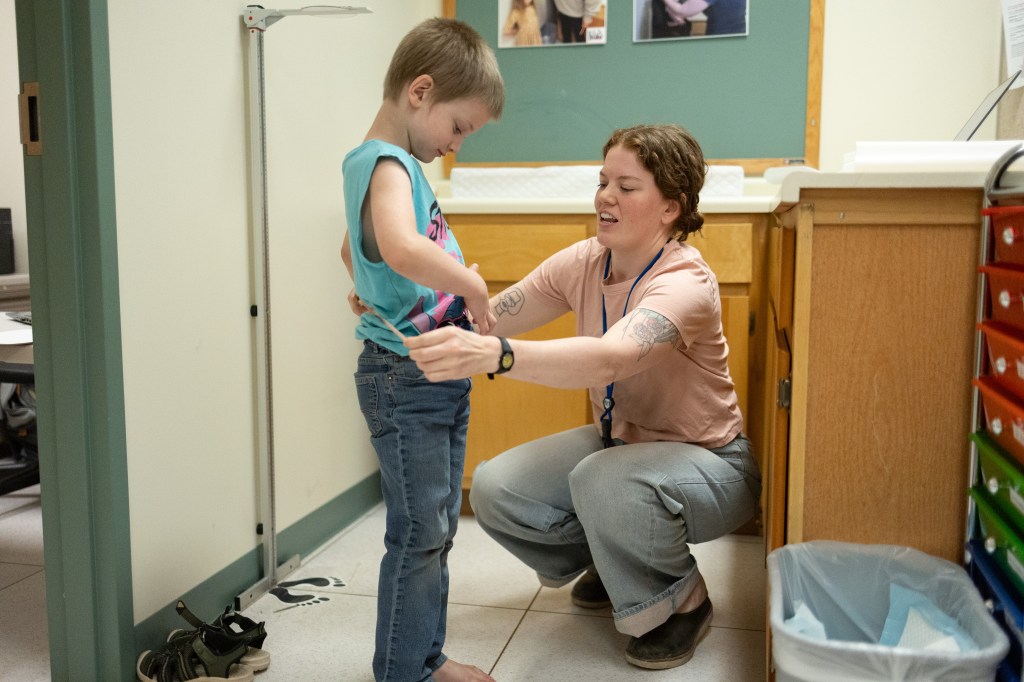
One of the latest study participants arrived in the arms of her mother last week. Two assistants weighed the 9-month-old infant and took other measurements in a windowless room at the Beckman Institute in Urbana.
-

Research coordinator Danisa Nieto, left, observes 9-month-old Sabrina Callesano after placing her on a scale during an Illinois Kids Development Study (IKIDS) microplatstics test at at the University of Illinois Urbana-Champaign on June 18, 2026. Scientists at the university’s Beckman Institute have been tracking levels of plastic-softening phthalates in the blood of children since before they were born up until age 11. (Josh Boland/Chicago Tribune)


1 of 3
Research coordinator Danisa Nieto, left, observes 9-month-old Sabrina Callesano after placing her on a scale during an Illinois Kids Development Study (IKIDS) microplatstics test at at the University of Illinois Urbana-Champaign on June 18, 2026. Scientists at the university’s Beckman Institute have been tracking levels of plastic-softening phthalates in the blood of children since before they were born up until age 11. (Josh Boland/Chicago Tribune)
Her mother, Susie Aguinaga, described how the study team recruited her during a prenatal checkup at nearby Carle Foundation Hospital. Aguinaga gave blood to be analyzed for phthalates and other chemicals, and she and her husband, Salvatore Callesano, completed several surveys. Both are U. of I. researchers themselves.
“I really liked the methodology of this study,” Aguinaga said. “They took blood samples, hair samples, breast milk samples. For Sabrina, it’s mainly been urine samples and measurements so far.”
Jamie Headley, 6, is farther along in the study. After taking his measurements, a research coordinator handed him an iPad to play several games designed to test his cognitive skills.
“We can measure the impact of plastics chemicals on attention and learning in babies as young as 4 months old,” said Susan Schantz, an emerita professor of neuroscience at U. of I. who leads the study.
“What we have been finding is the harm from plastics-related exposures starts very early and continues to affect children into adolescence,” Schantz said in an interview.
Exciting but scary findings
During another of the key microplastics studies published so far, researchers at the University of Rhode Island tested mice that had been modified to include a gene, APOE4, linked to Alzheimer’s disease.
Some of the mice drank regular water. Others got water laced with microscopic bits of polystyrene, the type of plastic used in Styrofoam coolers, utensils, egg cartons and food packaging.
To highlight the polystyrene, researchers embedded a fluorescent material in the microplastics so they could track where the particles moved through the mice.
Male mice given microplastics-laded water began spending more time in the middle of their pens, rather than staying in corners for safety like healthy mice do. This matches a symptom of Alzheimer’s in men, who are likely to display signs of apathy, said Jaime Ross, a neuroscientist and the research paper’s senior author.
Female mice exposed to microplastics during the study appeared to not recognize previously familiar objects, compared to mice with the Alzheimer’s-linked gene that drank regular water.
Women with the disease are more likely to suffer memory problems, Ross noted.
“To our surprise we saw accumulation (of microplastics) in every tissue we looked at — the brain, liver, heart, lungs, spleen,” Ross said during a January conference of scientists studying the health effects of microplastics.
“As a scientist this was exciting,” Ross said, “and scary at the same time.”
Campen, the New Mexico toxicologist, leads a team that examined the brains of 12 people who had been diagnosed with dementia before they died. The scientists found the brains of the deceased had concentrations of microplastics up to five times higher than what has been found in normal brains.
The New Mexico team also looked at brain tissue collected during autopsies in 1997, 2016 and 2024 and found rising concentrations of microplastics over time. It didn’t matter how old the people were when they died, Campen said.
Developing regulations
Some scientists remain skeptical about the studies conducted to date.
On the last day of the January conference of microplastics researchers, Scott Coffin, a toxicologist at the California Office of Environmental Health Hazard Assessment, threw down the equivalent of a dueling glove to the crowd.
Few of the studies reviewed by Coffin and his team would be fit for developing regulations limiting microplastics, he said.
His comments hold weight because California laws demand the nation’s most significant protections from the tiny particles, and the state tends to provide a model for action in other parts of the country on environmental issues.
Coffin ended his presentation on an optimistic note. More than 3,000 new studies of microplastics and health are expected to be published this year alone.
