

image:
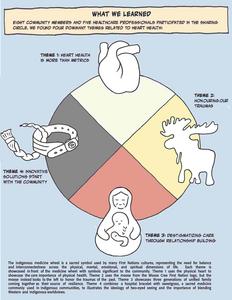
An arts-based graphic report published in CJC Open highlights four themes that shape Indigenous heart health, revealing the need for interventions that extend beyond clinical management to include culturally grounded nutrition programming, relationship-centered care pathways, and models that combine Indigenous and Western knowledge systems
Credit: CJC Open / Zhao et al.
A novel study among Indigenous communities in Canada utilizing sharing circles as the primary method of qualitative data collection shows that heart health is shaped by emotional, spiritual, social, and systemic factors, with trauma strongly influencing how care is accessed and trusted. Results of the study appear in CJC Open, published by Elsevier, as the journal’s first arts-based report. This novel format provides an authentic visual narrative that reflects the depth of community experiences and perspectives.
The research highlights the need for interventions that extend beyond clinical management to include culturally grounded nutrition programming, relationship-centered care pathways, and models that combine Indigenous and Western knowledge systems.
First Nations people in Canada are approximately 2.5 times more likely to develop cardiovascular diseases than non-Indigenous people. In the James and Hudson Bay region, the remoteness of each community creates significant challenges for people living with heart conditions. Limited healthcare services are offered locally, and many patients have to travel three to nine hours south to receive care.
Despite these barriers, communities continue to draw strength from their cultural ties, relationships, and collective resilience toward a promising future. A collaborative partnership was formed between the University Health Network (UHN) and the Weeneebayko Area Health Authority (WAHA) to gain important insights about community heart health and opportunities to improve access to culturally safe care.
This study was grounded in community-based participatory research (CBPR), which emphasizes equity, reciprocity, and shared decision-making across all stages of research. To integrate the relational principles of CBPR into practice, sharing circles—a communication practice rooted in the Indigenous tradition of storytelling—were used as the primary method of qualitative data collection.
Four themes emerged from the sharing circles conducted in Moosonee, Ontario:
- Heart health is more than metrics
- Honoring our traumas
- Destigmatizing care through relationship building
- Innovative solutions start with community
“Academic research often comes with pre-determined, deficit-based assumptions regarding Indigenous communities and their health outcomes, without considering the implications of colonial influence that have created the very conditions affecting Indigenous well-being,” says principal investigator and team lead Sahr Wali, PhD, TRANSFORM Heart Failure Strategic Initiative, Ted Rogers Centre for Heart Research, University Health Network, University of Toronto.
“This study is a celebration of community stories, inspired by the traditional teachings that challenge Western definitions of heart health. Instead of focusing on physical symptoms only, we wanted to emphasize holistic well-being.”
One of the most surprising and meaningful findings was the central role of humor as a culturally grounded and intentional mode of communication. “Community partners emphasized that humor is deeply embedded in everyday life and serves as an important way of engaging with topics that are emotionally heavy, historically painful, or otherwise difficult to discuss. Rather than diminishing the seriousness of experiences with heart disease, humor functioned as a source of strength, resilience, and connection,“ explains WAHA co-author Justice Seidel, medical student at the Northern Ontario School of Medicine University and Member of Moose Cree First Nation.
The insights gained from the study were transformed into an arts-based graphic report that draws on principles of “two-eyed seeing”—a metaphor for negotiating between two cultures—to help bridge Indigenous and Western knowledge and foster engagement across communities and care providers.
It is the first time research has been published in this form in CJC Open. “Following the path less traveled, this arts-based graphic report upholds the authenticity of Indigenous storytelling, embraces holistic worldviews on health and healing, and strengthens Indigenous community voices,” says author of the accompanying editorial Laura Banks, PhD, MA, Ontario Tech University, Oshawa, and University Health Network, Toronto.
She continues, “Storytelling remains an invaluable form of knowledge for Indigenous people, used to share traditions, including cultural beliefs, histories, values, relationships, and practices. This approach can arguably improve the possibility of both healing and well-being for the complex grief and history with which too many Indigenous people continue to live in today’s world.”
Graphic medicine was intentionally chosen for its ability to convey complex health concepts and lived experiences in accessible, emotionally resonant ways.
Q. Jane Zhao, first author, lead graphic artist, and PhD candidate, Institute of Health Policy, Management and Evaluation, University of Toronto, notes, “Comics are one way we can make research equitable for everyone. Most research never makes it outside the ivory tower of conference presentations and academic journals. By translating research into an accessible comic report, we made it so everyday people, the community members who participated in sharing circles, could understand what they contributed to—that their stories really mattered.”
While developed in Indigenous community contexts, this study’s methodology offers valuable transferability to other ethnic minority populations, which often face disproportionate cardiovascular risk, systemic barriers to care, and the need to navigate complex social and cultural determinants of health.
Dr. Wali concludes, “Storytelling enables community members to speak and share their stories in their own voices, reclaiming space and power in systems that have long silenced or distorted their truths.”
Method of Research
Data/statistical analysis
Subject of Research
People
Article Title
Heart Health Begins with Community: An Arts-Based Report on the Experiences of Heart Health in the Moosonee Community
Article Publication Date
11-Jun-2026
Disclaimer: AAAS and EurekAlert! are not responsible for the accuracy of news releases posted to EurekAlert! by contributing institutions or for the use of any information through the EurekAlert system.
