

Rajiv Gandhi walked into Parliament on January 30, 1985, and described the problem with unusual bluntness. Political defections, he told the House, were “likely to undermine the very foundations of our democracy and the principles which sustain it”. Four decades on, those words have not aged into irrelevance. They have aged into prophecy, and India is living through their fulfilment in real time.
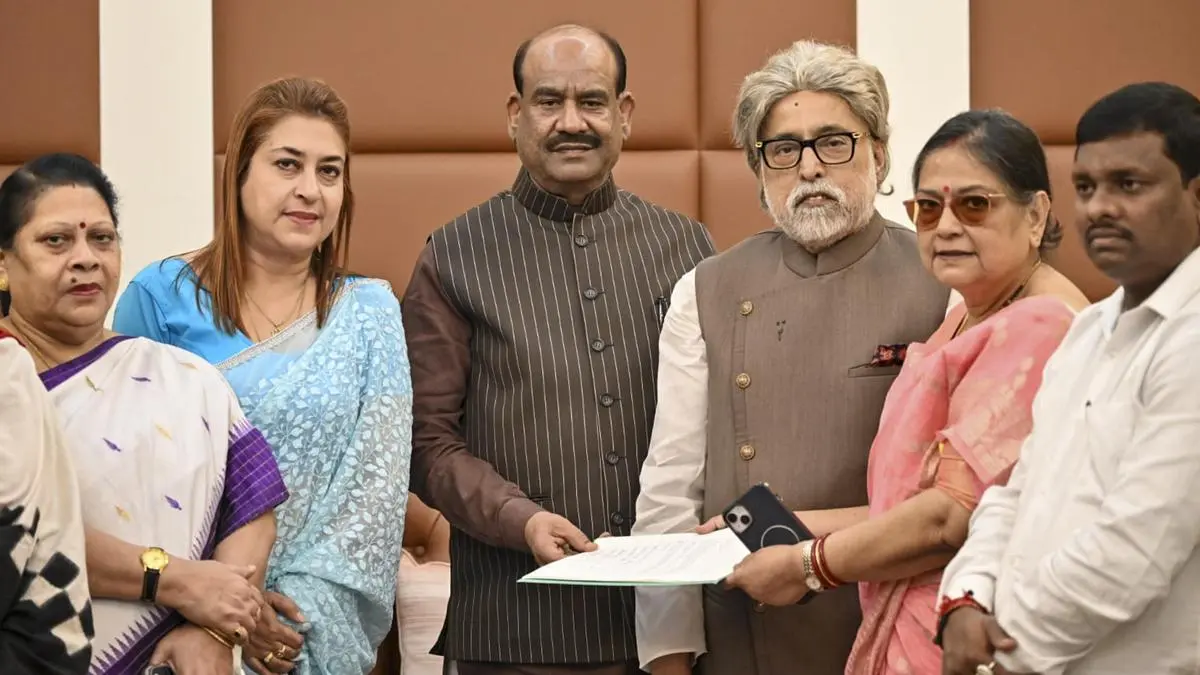
Two episodes unfolded this week which, taken together, make the case more forcefully than any academic paper could. In West Bengal, 19 rebel Trinamool Congress Lok Sabha MPs, led by former party chief whip Kakoli Ghosh Dastidar and veteran parliamentarian Sudip Bandyopadhyay, walked into Lok Sabha Speaker Om Birla’s office on June 14 and announced their merger with the Nationalist Citizens Party of India, a registered but little-known outfit from Tripura with no meaningful presence in national politics. In Maharashtra, six of Shiv Sena (Uddhav Thackeray)’s nine Lok Sabha MPs skipped a “three-line party whip” meeting on June 18 and submitted a letter to the Speaker seeking merger with Eknath Shinde’s Shiv Sena, with a formal announcement expected by June 20. Two parties, two States, one template.
The Bengal operation warrants close attention precisely because of its legal ingenuity. The rebel MPs did not join the BJP directly. Many face corruption allegations that the BJP levelled during its campaign in the 2021 and 2026 Bengal Assembly elections, making a direct induction politically awkward. So, they merged instead with a registered but obscure party, producing what might fairly be called a political parking lot, a vehicle that lets them vote with the National Democratic Alliance without technically crossing the floor in a way that triggers disqualification. The Tenth Schedule’s merger clause, which exempts two-thirds or more of a legislative party from disqualification when they merge with another party, was designed for genuine ideological realignments. In Bengal in June 2026, it became a surgical instrument for a politically engineered exit that preserved the letter of the law while gutting its spirit.
Maharashtra tells a slightly different story, but the underlying logic is identical. In 2022, Eknath Shinde engineered a split within the undivided Shiv Sena, brought down the Maha Vikas Aghadi government, and, with the BJP’s support, eventually claimed the original party’s name and symbol. The Supreme Court adjudicated the constitutional principles at stake, but it could not undo the political reality already manufactured on the ground. What is unfolding now with the Shiv Sena (Uddhav Thackeray) is the second act of the same play. Senior leaders Sanjay Raut and Arvind Sawant met Speaker Birla to urge protection against unlawful defection. Show-cause notices have gone to the six absent MPs. The rebels dispute the validity of a whip issued for an internal party meeting rather than a House vote. The courts will eventually adjudicate. The political damage accumulates while litigation runs its course.

Shiv Sena (Uddhav Thackeray) MPs Sanjay Raut and Arvind Sawant at a press conference in New Delhi on June 8, 2026.
| Photo Credit:
ANI video grab
This pattern is not new, and it is not confined to any single party. Himanta Biswa Sarma left the Congress and joined the BJP on August 23, 2015, citing the Congress leadership’s refusal to name him as the next chief ministerial candidate in Assam. He went on to become Chief Minister; his trajectory is widely studied as a template for how such transitions are structured and rewarded. In Madhya Pradesh, Jyotiraditya Scindia’s resignation from the Congress in March 2020, which pulled 22 loyalist MLAs with him, toppled the 15-month-old Kamal Nath government and earned Scindia a Union Cabinet berth. In Rajasthan, the same year, Sachin Pilot and 18 rebel Congress MLAs challenged their disqualification notices before the Rajasthan High Court, which ordered status quo on the proceedings. The crisis was ultimately resolved through political negotiation rather than the law’s deterrent force.
The pathologies driving defection
What these cases share is structure, not ideology. Three pathologies drive the phenomenon. The near-total collapse of intra-party democracy closes off every legitimate channel for dissent, leaving defection as the only exit a legislator who disagrees with party leadership can take. The systematic exploitation of the Tenth Schedule’s loopholes, including the merger clause, the engineered delays in Speaker adjudication, and the choreographed technical splits, has hollowed out the law from within. And the slow erosion of any normative assumption that party membership carries moral weight beyond electoral utility removes the ethical foundation on which the law’s deterrent effect depends.
India’s constitutional design makes the problem structurally irreducible. In Kihoto Hollohan v. Zachillhu (1992), the Supreme Court upheld the Tenth Schedule’s validity while striking down the provision that had sought to exclude judicial review of the Speaker’s decisions, warning that the Speaker’s adjudicatory role under the Schedule raised serious questions of conflict of interest. Fourteen years later, in Nabam Rebia v. Deputy Speaker (2016), a five-judge Constitution Bench held that a Speaker facing a pending removal notice cannot simultaneously decide disqualification petitions, a ruling whose logic exposes the core constitutional flaw: the adjudicator’s own tenure depends on the very majority whose composition the defection dispute affects. The Tenth Schedule, thus, creates the strongest version of the anti-defection law and then assigns its enforcement to the most structurally compromised adjudicator available.
The remedies are not unknown. The Law Commission’s 170th Report of 1999 explicitly recommended transferring adjudicatory authority from the Speaker to an independent tribunal, a position the Dinesh Goswami Committee had reached nearly a decade earlier in 1990 and that the National Commission to Review the Working of the Constitution reaffirmed in 2002. None of it became law. Every time a legislator crosses the floor, seeking his refuge in the language of conscience while reaching for the rewards of power, that unimplemented promise resurfaces. An independent constitutional tribunal for defection cases, mandatory intra-party elections with public disclosure of party finances, and a clear constitutional bar on defectors holding ministerial office for the remainder of their term are not radical proposals. They are the unfulfilled homework of Indian democracy, sitting in a drawer since the last century.
The morality argument deserves one direct answer before it becomes the alibi of this season. The AAP members who crossed to the BJP in April 2026, the Trinamool MPs who just discovered their conscience this week, and the Congress legislators who discovered theirs in Madhya Pradesh in 2020 all invoked an inability to remain within parties “touched by corruption”. If the grievance is genuine criminality, the prescribed remedy in a constitutional democracy is the courts, the electorate, or a competing political platform. A morality argument that leads, with such regularity and such uniformity of direction, towards the ruling dispensation is not morality. It is navigation with a convenient compass.
India first confronted this problem in 1967, when Gaya Lal, an MLA from Hassanpur in Haryana, switched parties three times within a fortnight, twice within a nine-hour span, and gave the political lexicon the sardonic phrase “Aaya Ram, Gaya Ram” (Ram came, Ram went). Parliament’s institutional response, 18 years later, was the Tenth Schedule. The law was meant to end the game. Instead, the game learned to play the law. The electorate deserves a legislature that finally closes the loopholes.
Ankit Mishra is an ICSSR Fellow in political science at the Govind Ballabh Pant Social Science Institute, Prayagraj. Samanta Sahu is an associate professor of political science at the same institution, with over two decades of research and teaching experience.
Also Read | The ripple effects of Shiv Sena’s latest split
Also Read | ‘Dadagiri’ democracy
