


How app-based luggage storage works
The mechanics are roughly the same across the four. Each app signs up local businesses (shops, cafés, hotels) that have spare room behind the counter or in a back office. You book in the app, which reserves your space and switches on whatever cover comes with the booking. You hand the bags over, they get tagged or logged, you go off and do your day, you come back to collect.
What actually varies comes down to four things:
-
The pricing model. A flat price for a rolling 24 hours, a price tied to the calendar day, or an hourly meter.
For a single bag for a day, prices across all four are broadly comparable. None is dramatically cheaper than the rest once you read the full checkout. What differs is the shape of the charge and what’s bundled in.
The four platforms side by side
Stasher
How it works
You book a StashPoint through the Stasher app or site. It’s usually a vetted local business, and often a hotel. You pay a single flat price for a rolling 24-hour window per bag, shown in full before you book. Handover runs through an ID-checked process with numbered tags, and you collect within the location’s opening hours. Cancellation is free before drop-off.
Strengths
-
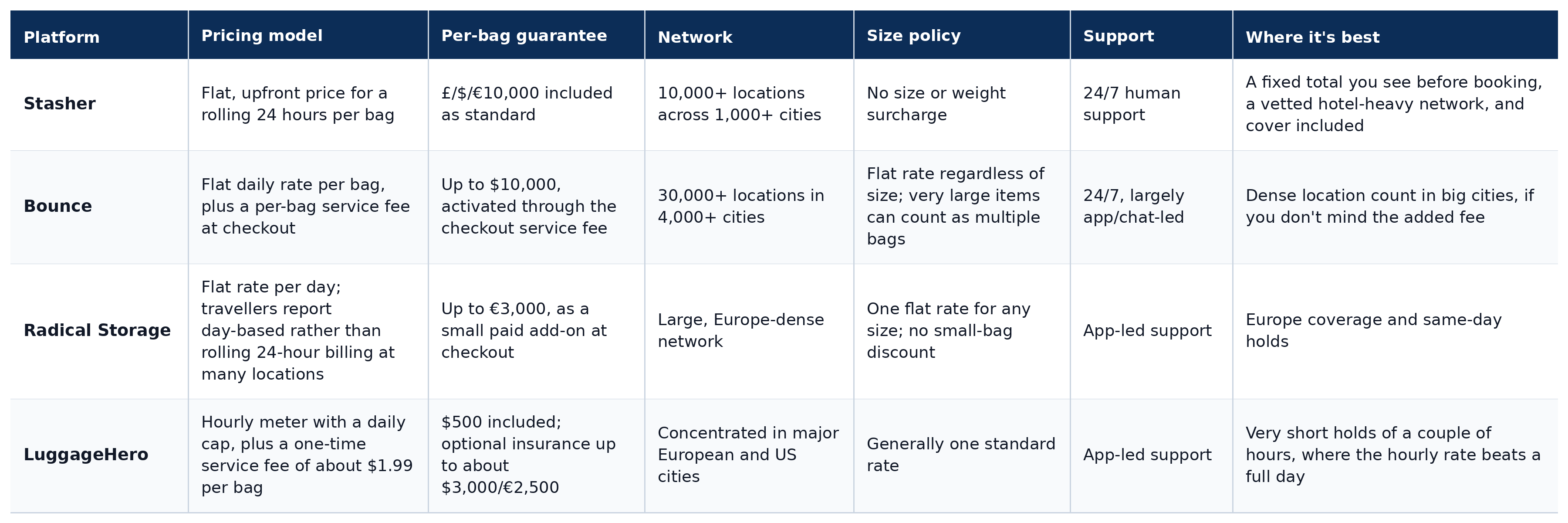
Flat, upfront pricing for a rolling 24 hours. The full 24-hour price is shown before you book, and there’s no hourly meter ticking while you’re away, so there’s no surprise total at collection. Stasher sits broadly in line with Bounce and Radical on price for a single bag-day, so the edge here is predictability, not being the cheapest.
-
A £/$/€10,000 per-bag guarantee is included as standard. Cover against loss, theft or damage comes bundled into every booking rather than sold as a paid add-on at checkout.
-
No size or weight surcharge. Skis, boxes and oversized bags go at the flat per-bag rate. For something genuinely enormous or unusual, it’s worth a quick check with the location first.
-
A vetted, hotel-heavy network. Many StashPoints are established hotels rather than back-room counters, which tends to feel more secure for first-time users. The network runs to 10,000+ locations across 1,000+ cities, and partners include Premier Inn and other major hotel brands.
-
24/7 human support, an “Excellent” Trustpilot rating, and more than 3 million bags stored by the company’s count.
Honest drawbacks
The network is well-vetted and hotel-heavy, but it’s smaller by raw location count than the numbers Bounce reports, and availability depends on the location: in a smaller town you may find fewer pins on the map, and the most convenient spots can book out on busy days. And because pricing runs per 24 hours, a genuine two-hour hold costs the same as a full day. If all you need is a brief stash, an hourly model can come out cheaper for that one trip.
Bounce
How it works
Bounce uses the same drop-and-collect model, booked through its app, with a flat daily rate per bag for a rolling 24-hour period and free cancellation before drop-off.
Strengths
-
One of the largest reported networks. The company quotes 30,000+ locations across 4,000+ cities, so in major cities you’ll usually find something close.
Honest drawbacks
-
A per-bag service fee is added at checkout, and it’s also what activates the bag protection, so what you actually pay runs higher than the headline daily rate. Read the full total before booking.
Radical Storage
How it works
You book a partner location (Radical calls them “Angels”) through the app and pay a flat daily rate per bag, whatever the bag’s size.
Strengths
Honest drawbacks
-
Billing is pegged to the day, not a rolling 24 hours, at many locations. Travellers repeatedly report overnight holds (drop at 8pm, collect at 10am) billed as two days. Radical’s own materials describe the day as usually running from drop-off, so check exactly how your dates will be charged before booking anything that crosses midnight. This is the single biggest thing to watch.
-
The “Radical Protection” cover (up to around €3,000) is a small paid add-on at checkout, not bundled into the headline price, so your total comes out a little above the advertised rate if you want the cover.
-
As with Bounce, the cheapest advertised rate is often only at a few locations, not necessarily the convenient ones.
LuggageHero
How it works
LuggageHero is the outlier on pricing. Instead of a flat day rate, it runs an hourly meter per bag, with a daily cap so a long hold can’t exceed the day rate. You start a timer at drop-off and stop it at collection. A one-time service fee of around $1.99 per bag is added at checkout.
Strengths
-
For genuinely short holds, say a couple of hours between checkout and a lunchtime train, the hourly rate can work out cheaper than paying for a whole day elsewhere.
Honest drawbacks
-
The hourly meter can balloon. Reviewers regularly report there’s no clear live running total while bags are stored, so it’s easy to lose track of what you’re accruing. A “quick” stop that drifts into most of a day costs close to the cap anyway.
-
Lower included cover. The standard guarantee is up to $500 per bag, well below what Stasher bundles in. Optional insurance up to roughly $3,000/€2,500 costs around $1.95 extra.
Which should you choose?
There’s no single best app for everyone. The right one turns on how long you’re storing, where you are, and how much certainty you want at the counter.
-
Full day, or an open-ended wait, and you want a fixed total with cover already in: Stasher. This is where it genuinely comes out ahead. A flat price for a rolling 24 hours shown upfront (no meter, no day-boundary trap), a £/$/€10,000 per-bag guarantee included as standard, a vetted hotel-heavy network, no size or weight surcharge, free cancellation before drop-off, and 24/7 human support. If you’d rather not do maths at the counter, it’s the most predictable of the four. It isn’t the cheapest, and it isn’t the densest network. It’s the one with the fewest surprises.
-
Big city, and you want the most pins on the map: Bounce. Just check the full total including the service fee, and pick a real location instead of chasing the headline rate to some far-flung pin.
-
Bouncing around Europe and storing within a single day: Radical Storage. Coverage is strong here, and the flat any-size rate suits big bags. Plan around the day-based billing if your hold crosses midnight, factor in the protection add-on, and run the numbers before using it for a small daypack.
-
A genuinely short hold of a couple of hours: LuggageHero. The hourly model can beat a full day. Keep an eye on the meter, and remember the included cover is lower unless you upgrade. For anything past three or four hours, a flat 24-hour price is usually the safer call.
FAQ
I’m only storing for two or three hours. Does the hourly meter actually save me money?
Sometimes. For a genuinely short hold, LuggageHero’s hourly rate can land below a full day on the flat-rate apps. The risk is that a “quick” stop stretches into most of a day, and reviewers report there’s often no clear live total while your bags are in. Once you’re near the daily cap, you’ve paid full-day money anyway. For anything past three or four hours, a flat 24-hour price is usually the safer call.
Why does my final price come out higher than the rate I saw advertised?
Checkout lines. Bounce adds a per-bag service fee (which also activates its protection), Radical’s protection cover is a separate add-on, and LuggageHero adds a one-time service fee per bag. Stasher shows a single upfront price for the full 24 hours. Whichever app you use, read the full checkout total before you tap book.
What’s the practical difference between “rolling 24 hours” and day-based pricing?
A rolling 24-hour price (Stasher, Bounce) runs 24 hours from your drop-off time. Drop at 3pm, collect by 3pm tomorrow, one charge. Day-based billing, which travellers widely report with Radical Storage, is pegged to the date, so an overnight hold that crosses midnight can count as two days even if it’s under 24 hours. If your hold spans a night, this is the thing that bites, so confirm how your dates are charged when you book.
Which one’s best if I’m carrying skis, a bike box or something oversized?
Stasher takes oversized items at their standard flat per-bag rate, with no size surcharge. With Bounce, very large items can be counted as multiple bags, and LuggageHero generally works to one standard rate; with both, confirm with the specific location first. For anything truly unusual, a quick message to the location before you book saves a doorstep surprise.
Which platform includes the most cover before I pay for an upgrade?
Of these four, Stasher includes a £/$/€10,000 per-bag guarantee as standard. Bounce’s cover runs up to $10,000 but is activated through its per-bag checkout fee. Radical’s cover (up to around €3,000) is a small paid add-on. LuggageHero includes up to $500 per bag, with paid insurance beyond that. Read each platform’s own terms for exactly what the guarantee covers and what it doesn’t.
Is app-based luggage storage safe?
Generally yes. On every platform, your booking activates cover on your bags, and reputable hosts log or tag them at drop-off. The feel varies by host. Vetted hotel-based locations, which make up a large share of Stasher’s network, tend to reassure first-time users more than a back-room counter in a corner shop. Whichever you use, keep passports, medication and anything irreplaceable on you.
If a drop-off goes wrong, which app gets me a person fastest?
Stasher offers 24/7 human support. Bounce and Radical lean more on in-app and chat routes, which some travellers report can be slower to reach an actual person. If getting a human quickly matters to you, weigh that accordingly.
